Algeria
 Egypt
 Libya
 Morocco
 Sudan
 Tunisia
 Benin
 Burkina Faso
 Cabo Verde
 Côte d'Ivoire
 Ghana
 Guinea
 Guinea-Bissau
 Liberia
 Mali
 Mauritania
 Niger
 Nigeria
 Senegal
 Sierra Leone
 The Gambia
 Togo
 Cameroon
 Central African Republic
 Chad
 DR Congo
 Equatorial Guinea
 Gabon
 Republic of the Congo
 São Tomé and Príncipe
 Burundi
 Comoros
 Djibouti
 Eritrea
 Ethiopia
 Kenya
 Madagascar
 Malawi
 Mauritius
 Mozambique
 Rwanda
 Seychelles
 Somalia
 South Sudan
 Tanzania
 Uganda
 Angola
 Botswana
 Eswatini
 Lesotho
 Namibia
 South Africa
 Zambia
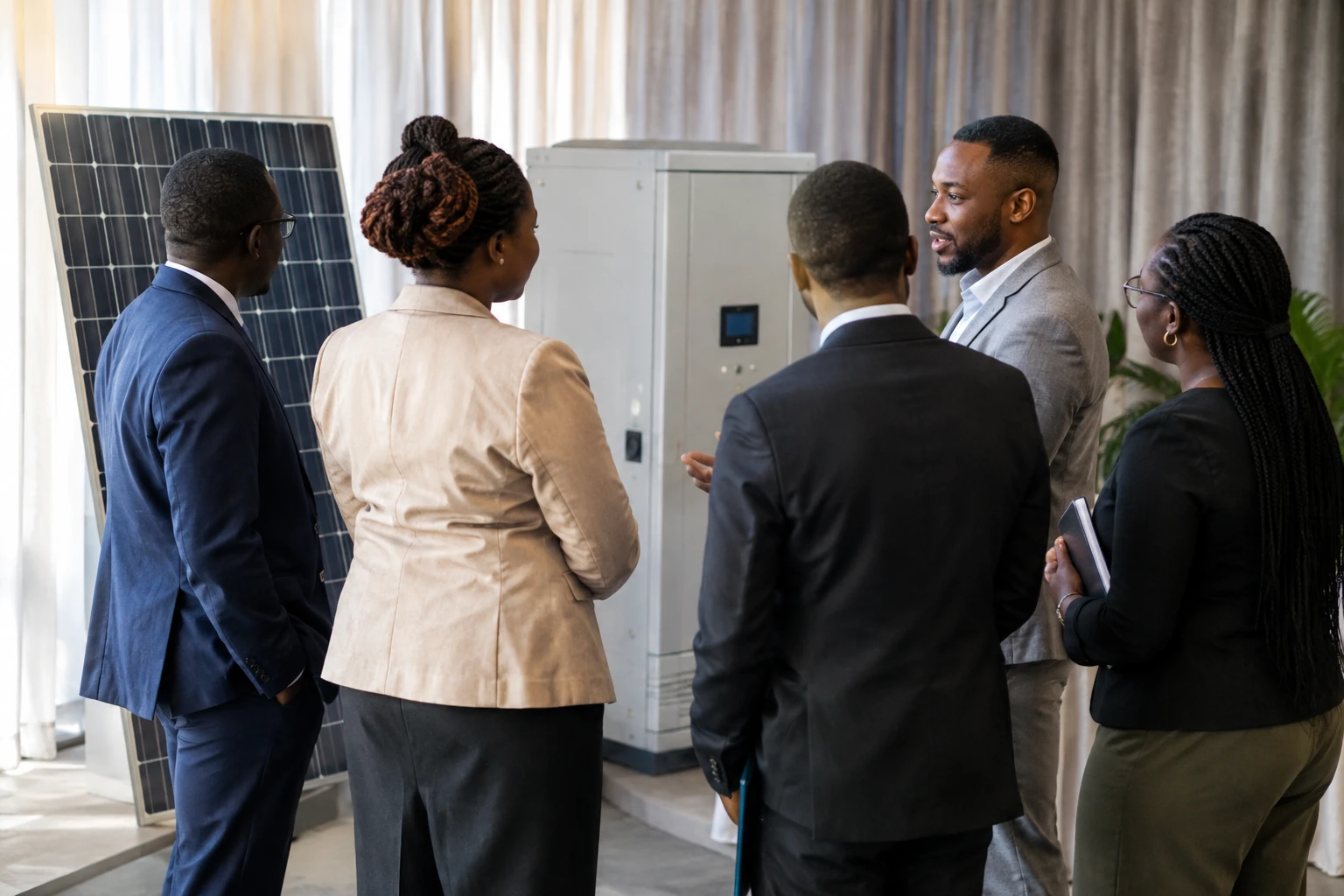
For households and businesses in Zimbabwe, an announced power plant does not yet mean a more reliable electricity supply. Financing, connection to the grid and electricity sales are among the steps still to be completed before power can reach consumers.
A project still far from producing its first megawatt-hours
In Mashonaland Central province, the Guruve-Mazowe project would combine wind, solar and batteries. Developers Modaso Energy and Tatanga Energy estimate the investment at about $300 million. Its announced generation capacity is 228 megawatts: 128 MW of wind and 100 MW of solar. A 50 MW storage system, with an energy capacity of 100 megawatt-hours, would complete the installation. These figures describe a project under development, not a power plant that has already been built.
On 10 November 2026, Afreximbank announced that it had issued indicative terms for taking part in its financing. This is not a confirmed disbursement or a final investment decision. Standard Bank and its Zimbabwean subsidiary, Stanbic Bank, are involved in arranging the debt. The developers are targeting financial close in mid-2027, followed by commercial operations in 2029, subject to completion of the necessary steps.
The developers estimate annual output at about 550 gigawatt-hours. ZESA, the state-owned electricity company, would be the main buyer. ZimGreenCo, a Zimbabwean electricity trading company, has also signed preliminary terms to buy part of the output. The developers have raised the possibility of selling additional volumes on the Southern African regional electricity market. Final contracts and delivery arrangements will still have to define these commitments.
Diversification also depends on the grid
Zimbabwe is seeking to increase generation while reducing its dependence on coal-fired power plants and hydropower. The national energy compact sets, among other goals, a target of raising the share of renewables excluding large hydropower in the generation mix to 29% by 2030. It also provides for increased renewable capacity and investment in transmission and distribution. The Guruve-Mazowe project is in line with this direction, but will not be enough on its own to meet these targets.
One technical caveat matters: the announced wind and solar capacities total 228 MW, but the plant would connect to the grid through a 100 MW connection. The battery can store and then release electricity; its power rating is not added to generation capacity as if it were a third power plant. In practice, the actual contribution will depend on the connection, how the storage system operates and the grid’s ability to carry power to points of consumption.
The hybrid system could help manage fluctuations in output: solar panels and wind turbines do not generate at the same rate. But storage alone cannot guarantee a continuous supply. The grid will also need to absorb the volumes, while buyers must have sufficiently robust contracts and payment capacity. These factors will weigh on the project’s financial viability just as much as the equipment itself.
Benefits will depend on use and contracts
Additional generation could support electricity-intensive activities, particularly industry, mining and agricultural processing. A more predictable supply would help these businesses plan their operations. For households, however, the impact will be neither immediate nor automatic: it will depend on the plant entering service, the state of the grid and how electricity is allocated among different users.
The financing structure brings together commercial banks and a pan-African institution. Afreximbank, whose activities in Southern Africa are co-ordinated from Harare, can help mobilise resources and strengthen the project’s financial structure. Its proposed participation does not, however, remove risks relating to financing, sales contracts or grid connection. Financial close, planned for 2027, will therefore be a more decisive milestone than the announcement of indicative terms.
The project is also presented as a first for the country: according to its developers, it would be Zimbabwe’s first large-scale wind farm and the country’s first site to combine wind, solar and batteries. This ambition will need to be tested as approvals, financing and construction progress. The available information describes an industrial prospect, not a result already secured.
A project to watch across Southern Africa
The timetable also has implications for regional electricity trade. Zimbabwe is a member of SADC, the Southern African Development Community, and the developers are considering sales on the regional electricity market. The possibility of exports will nevertheless depend on contracts, trading rules and interconnection capacity. For now, supplying ZESA remains the main stated destination.
The project forms part of a broader trend: African financial institutions are seeking to support energy infrastructure developed by private-sector companies across the continent. For Zimbabwe, the challenge is to turn transition targets into electricity that is actually delivered, without neglecting the grid and people’s access to power. The next milestones will be finalising the financing, signing power-purchase contracts and starting construction. Until those steps are taken, the 228 MW remains projected capacity.
The project also forms part of a series of renewable energy initiatives supported or being prepared in Zimbabwe. In 2025, Afreximbank signed a $4.4 million project-preparation facility to fund studies related to a floating solar project on Lake Kariba. That financing covers project preparation, not construction of the power plant. The comparison underscores an essential distinction: financial interest and studies represent progress, but do not amount to commissioning.
Sources consulted: Modaso Energy’s announcement on Afreximbank’s proposed participation and the project’s features, cross-checked against reporting by Zimbabwean outlet The Granite Post and The Zimbabwe Mail. For national targets, see Zimbabwe’s energy compact and the national renewable energy policy. For the Lake Kariba precedent, see PV Magazine’s report.