Algeria
 Egypt
 Libya
 Morocco
 Sudan
 Tunisia
 Benin
 Burkina Faso
 Cabo Verde
 Côte d'Ivoire
 Ghana
 Guinea
 Guinea-Bissau
 Liberia
 Mali
 Mauritania
 Niger
 Nigeria
 Senegal
 Sierra Leone
 The Gambia
 Togo
 Cameroon
 Central African Republic
 Chad
 DR Congo
 Equatorial Guinea
 Gabon
 Republic of the Congo
 São Tomé and Príncipe
 Burundi
 Comoros
 Djibouti
 Eritrea
 Ethiopia
 Kenya
 Madagascar
 Malawi
 Mauritius
 Mozambique
 Rwanda
 Seychelles
 Somalia
 South Sudan
 Tanzania
 Uganda
 Angola
 Botswana
 Eswatini
 Lesotho
 Namibia
 South Africa
 Zambia
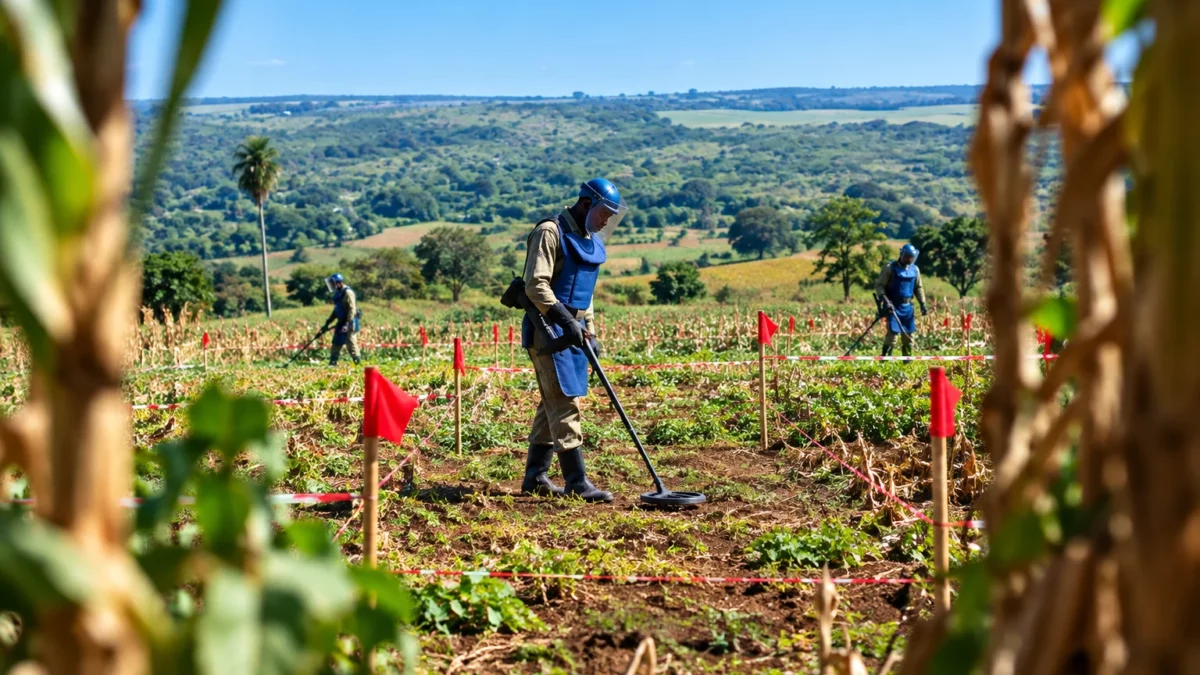
In north-east Zimbabwe, a plot cleared of mines can once again become a field, grazing land or a route to school. But behind every area made safe, one crucial question remains: will teams have the means to finish the work before the 2030 deadline?
A legacy of war still weighing on the land
The mines that still threaten Zimbabwean communities were laid along the borders with Mozambique and Zambia during the 1970s liberation war. At independence in 1980, the country inherited eight minefields. Explosive devices have since restricted access to farmland and economic activities, as well as endangering people and animals.
The contamination mainly affects rural areas far from Harare. Its impact is therefore measured not only in accidents prevented. It also affects families’ ability to grow crops, graze their livestock and reach essential services. Mine clearance is both a security operation and a condition for local development.
Zimbabwe is carrying out these operations with its national mine clearance unit and several specialist organisations, including HALO Trust, Norwegian People’s Aid and Mines Advisory Group. The Anti-Personnel Mine Ban Convention, an international treaty that requires, among other things, the clearance of contaminated areas, provides the framework for the country’s commitment. Regionally, the issue also concerns Mozambique and Zambia, the neighbours along whose borders the minefields were laid.
Milestone reached in Rushinga and Mount Darwin districts
On 19 November 2026, HALO Trust announced that it had destroyed 250,000 mines since beginning operations in Zimbabwe in 2013. The figure covers its work in Rushinga and Mount Darwin districts in the country’s north-east. It is the organisation’s own figure and does not, by itself, represent the national total of mines removed by all operators.
In Rushinga, HALO says its operations have directly benefited more than 14,000 people. Clearance enables farmland to be reclaimed, livestock to move freely and safer access to water, schools, health centres and markets. The organisation also reports that, for a family that loses a cow, a mine can represent a loss equivalent to six months of school fees.
In Mount Darwin, HALO says it handed over an entire district declared mine-free in 2021. The announcement marks a local milestone, not the end of mine clearance in the country. For rural communities, safer travel and access to land can broaden income opportunities. For workers in the sector, these operations also provide jobs and technical skills.
HALO’s figure forms part of a broader national effort. The Zimbabwean army says that at the end of October 2025, 10.093 km² of mined areas remained to be cleared, compared with an estimated initial area of more than 310 km². These national figures and HALO’s own tally are not directly comparable: they cover different areas and periods.
The 2030 deadline also depends on funding
Zimbabwe had previously aimed to complete mine clearance by 2025. Under the Convention, it was granted an extension until 31 December 2030. The decision recognises the progress made, but also emphasises that the national plan depends on stable international resources and the capacity of organisations working on the ground.
This funding risk is not theoretical. Mine Action Review, an independent organisation that monitors clearance operations, reports that a fall in US funding in 2025 led HALO to reduce its capacity and APOPO to leave the country in March of that year. A reduction in teams can slow operations even when areas to be cleared have been identified and methods are available.
HALO has also warned of wider cuts to international aid. The organisation estimates that 4% of the affected land remains contaminated and says that $6.5 million would be needed to make Zimbabwe mine-free by the end of the decade. This figure is HALO’s estimate, not an independently verified national budget. Reliance on donors therefore leaves the deadline vulnerable to shifts in priorities abroad.
For the authorities, the challenge is to maintain national coordination and secure predictable resources. For people in affected areas, every delay prolongs restrictions on land use and the risks posed by hidden devices. Needs also differ from one village to another: farmland, a water point and a route to a clinic do not have the same priorities.
A regional security and development issue
Progress in mine clearance matters beyond the districts concerned. Zimbabwe shares with Mozambique a border where mines have long hindered travel and agricultural use. Mozambique was declared free of anti-personnel mines in 2015, according to HALO. This precedent shows that a national goal can be achieved, but it does not guarantee that the same timetable or financial conditions apply to Zimbabwe.
The next step will be to monitor Zimbabwe’s annual reports to the Convention’s States Parties, as well as changes in funding and capacity on the ground. The country must also submit an updated work plan by 30 April 2028. Until then, the milestone of 250,000 mines destroyed attests to a concrete effort, carried out in particular by Zimbabwean teams. Final success will depend as much on their work as on the continuity of the resources committed.
Context sources: HALO Trust announcement on operations in Zimbabwe, Zimbabwean army data on national mine clearance, independent monitoring by Mine Action Review and decision on the 2030 deadline.