Algeria
 Egypt
 Libya
 Morocco
 Sudan
 Tunisia
 Benin
 Burkina Faso
 Cabo Verde
 Côte d'Ivoire
 Ghana
 Guinea
 Guinea-Bissau
 Liberia
 Mali
 Mauritania
 Niger
 Nigeria
 Senegal
 Sierra Leone
 The Gambia
 Togo
 Cameroon
 Central African Republic
 Chad
 DR Congo
 Equatorial Guinea
 Gabon
 Republic of the Congo
 São Tomé and Príncipe
 Burundi
 Comoros
 Djibouti
 Eritrea
 Ethiopia
 Kenya
 Madagascar
 Malawi
 Mauritius
 Mozambique
 Rwanda
 Seychelles
 Somalia
 South Sudan
 Tanzania
 Uganda
 Angola
 Botswana
 Eswatini
 Lesotho
 Namibia
 South Africa
 Zambia

A first shipment that means more than a simple dispatch
In Zimbabwe, lithium is no longer just a resource to be extracted. It is becoming a test of industrial strength. In Harare, the issue is clear: keeping more value in the country rather than letting raw ore flow to foreign refining centres.
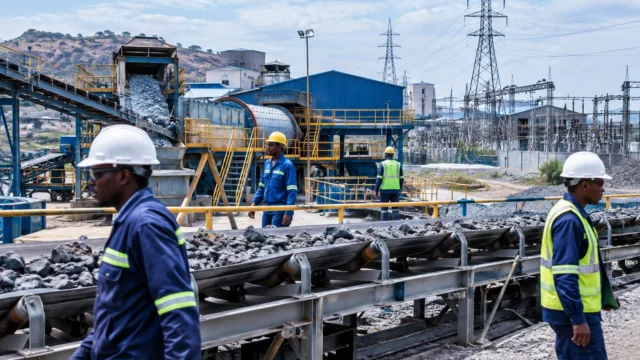
In this context, LOHUM’s announcement carries particular significance. The Indian company said on 9 September 2026 that it had shipped its first cargo of lithium ore from its mining assets in Matabeleland South, in south-western Zimbabwe. Reuters says this marks the start of its mining operations in the country and makes the company the first Indian firm to produce lithium from assets it owns abroad.
Zimbabwe pushes its industry towards more processing
The development is part of a broader national trajectory. Since 2023, the Zimbabwean government has introduced a series of measures to limit exports of unprocessed lithium and encourage local processing, with one goal now central: capturing more value at home. The regulatory framework cites the promotion of the industrial beneficiation of mineral resources.
On the ground, the country has already taken several steps. Media outlets and specialist organisations report that a suspension of lithium concentrate exports was announced for January 2027, to give refining projects time to ramp up. But in 2026, Harare also took a tougher line, immediately suspending exports of concentrates and other raw minerals in the name of combating irregular practices in the export chain.
This timetable is not incidental. It shows that the Zimbabwean state wants to move from being a mere supplier of concentrates to becoming the architect of a more complete industry. It is also a way of responding to a familiar reality in the country: Zimbabwean lithium first supplies factories and markets outside the continent, while the most skilled jobs and highest margins remain elsewhere.
LOHUM, India and the battle for value addition
LOHUM is not arriving in Zimbabwe as a conventional mining player. Founded in 2021, according to its communications materials, the company first established itself in lithium-ion battery recycling, then moved into refining and higher-value products such as cathode active materials. Its move into upstream mining therefore marks an extension of its strategy towards directly securing supplies.
According to Reuters, the company has obtained rights to ten lithium mining blocks in Matabeleland South, covering about 1,100 hectares, with reserves estimated at between 30 million and 40 million tonnes of ore. The same source cites production potential of 300,000 tonnes of lithium carbonate equivalent and a theoretical value of about $7 billion at current prices. These figures remain project estimates, but they give a sense of the expectations attached to the asset.
LOHUM says it intends to go beyond extraction and develop concentration capacity in Zimbabwe. This is a decisive point. Spodumene concentrate already represents an initial stage of beneficiation, but the real move up the value chain begins with lithium chemistry, which makes it possible to produce carbonate or hydroxide, two key battery inputs. In short, the further the value chain advances, the more revenue, expertise and technical jobs the country captures.
Harare’s timetable is nevertheless putting pressure on all operators. If Zimbabwe does indeed ban concentrate exports in 2027, mining companies will have to prove that they are investing in local processing plants. Some Chinese groups are already doing so, notably Zhejiang Huayou Cobalt, which has begun producing lithium sulphate in the country. This example matters: it shows that the state no longer wants to settle for profitable extraction, but is seeking a genuine industrial presence.
What this means for Zimbabwe and beyond
For Zimbabwe, the issue goes far beyond the arrival of a new Indian investor. It is a policy of economic sovereignty applied to a strategic mineral. The country is already one of Africa’s leading lithium suppliers, and several recent analyses have highlighted its growing place in global supply chains, particularly for China. But this position has political meaning only if it translates into more local processing.
The effects will not be the same for everyone. For the state, local value addition means more tax revenue and greater control over the sector. For mining groups, it entails heavier investment, longer timelines and greater exposure to regulatory decisions. For the people of Matabeleland South, the promise is first and foremost of jobs, subcontracting and infrastructure. But it will be credible only if industrial projects advance at the same pace as extraction.
The regional dimension is just as clear. In southern Africa, the lithium debate is linked to the continent’s place in the global energy transition. The Southern African Development Community, SADC, is seeing a recurring debate intensify: export minerals, or build regional industrial chains capable of supplying batteries, then vehicles and energy storage. Zimbabwe, with Harare as its decision-making centre, is seeking to show that an African country can set its own rules for value addition, rather than leaving prices and processing stages to be determined elsewhere.
The next steps will play out on two fronts. On one, LOHUM’s actual ability to install concentration and then refining plants in Zimbabwe. On the other, the coherence of Zimbabwean public policy, balancing a ban on raw exports, investment security and the development of industrial skills. This is where the difference between a mine that exports and an industry that industrialises can be measured in practice.