Algeria
 Egypt
 Libya
 Morocco
 Sudan
 Tunisia
 Benin
 Burkina Faso
 Cabo Verde
 Côte d'Ivoire
 Ghana
 Guinea-Bissau
 Liberia
 Mali
 Mauritania
 Niger
 Nigeria
 Senegal
 Sierra Leone
 The Gambia
 Togo
 Cameroon
 Central African Republic
 Chad
 DR Congo
 Equatorial Guinea
 Gabon
 Republic of the Congo
 São Tomé and Príncipe
 Burundi
 Comoros
 Djibouti
 Eritrea
 Ethiopia
 Kenya
 Madagascar
 Malawi
 Mauritius
 Mozambique
 Rwanda
 Seychelles
 Somalia
 South Sudan
 Tanzania
 Uganda
 Angola
 Botswana
 Eswatini
 Lesotho
 Namibia
 South Africa
 Zambia
 Zimbabwe
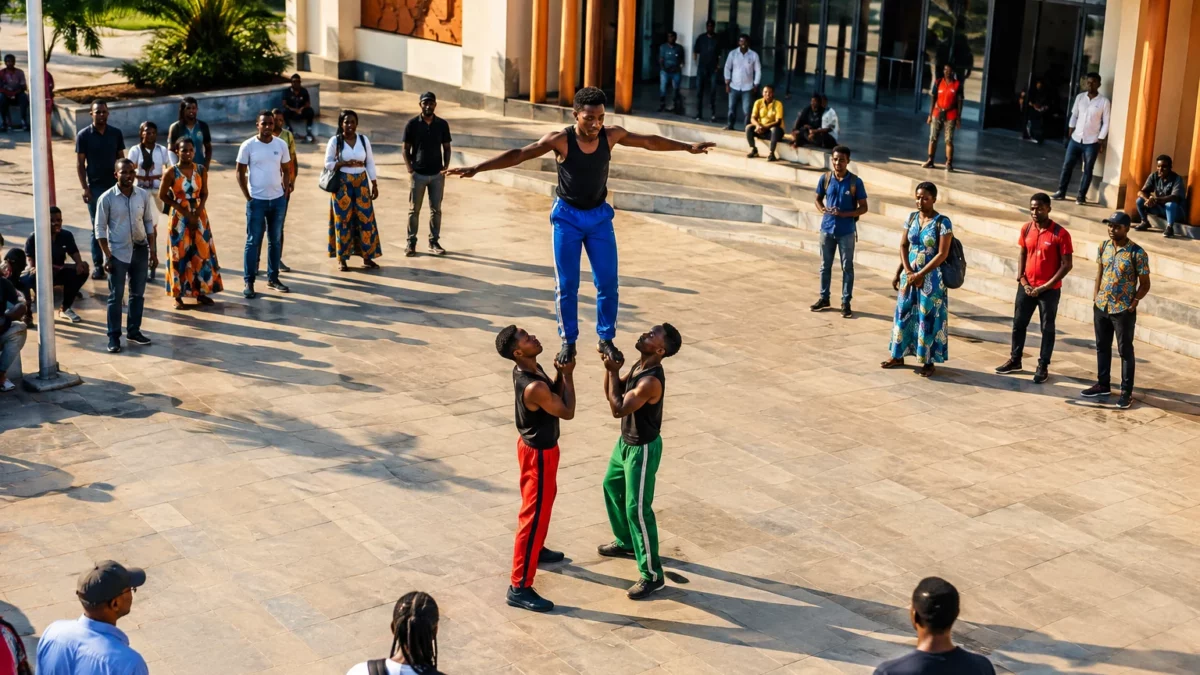
In Conakry, the circus ring is also becoming a place of training. For young Guinean artists, the Yirwa Biennale offers more than a series of performances: it opens up a space for work, encounters with audiences and professional contacts.
A biennale to grow Guinea’s circus scene
The first Yirwa International Circus Biennale is taking place in Conakry from 24 to 28 November 2026, according to Guinea’s Ministry of Culture. The programme brings together indoor performances, events in the communes, school shows and professional meetings. The ministry says around 15 professionals, including some from France and Canada, are taking part in the discussions.
The evening of 25 November puts Circus Baobab in the spotlight. Founded in Conakry in 1998, the company combines acrobatics, dance and Guinean cultural references. Its presence at the opening gives a central role to a local troupe at an event focused on international exchanges. The Franco-Guinean Cultural Centre is hosting the main evening performances, according to information provided in the programme.
The initiative is part of a momentum that has been building for several years. Launched in 2023, the Yiriwa project aimed to support several Guinean circus companies, including Circus Baobab, Amoukanama Circus and Cirque Tinafan. The goal is therefore not simply to bring in performances: it is also to build skills and create opportunities locally.
‘Wakili’: courage in motion
Among the works being presented is ‘Wakili’, a performance by the Circus Baobab school. According to apprentice Fatoumata Bangoura, the title means grit and courage. The piece combines acrobatics with dances associated with Malinké and Fulani cultures. It draws on the artists’ experiences without being reduced to a documentary narrative.
Fatoumata Bangoura brings the realities of work and motherhood into the performance. She is accompanied by her daughter, who was four months old at the time of the rehearsal described. The artist highlights the possibility of continuing to work while caring for her child. Her presence gives the performance a concrete perspective on women’s place in circus arts and the material conditions in which they practise.
Director Karim Troussi describes ‘Wakili’ as a poetic account of perseverance: falling, starting again, then trying once more. For the young artists, the performance is also a technical learning experience. They take part in the artistic preparation, discover the demands of the stage and meet professionals from other countries.
From training to artistic work
This dimension matters in a sector where training, access to equipment and regular incomes remain challenges. In February 2026, the Ministry of Culture announced a three-year partnership between Circus Baobab and the KPC Foundation. It provides for support for the school’s operations, the creation of performances, social initiatives and tours. The announcement signals institutional and private-sector support, but cannot by itself establish the resources actually available or how long they will last beyond the contract.
For students, performing for an audience can help turn a practice into a profession. For companies, professional meetings can facilitate collaborations and invitations abroad. But the results are not automatic: they depend on continuity in training, artists’ pay and the ability to perform regularly in Guinea, not only during a biennale.
The programme announced in different communes of Conakry also widens access to performances beyond venues and audiences already familiar with the performing arts. School shows can introduce circus to new audiences. They also create a direct link between artists and young people, although no assessment is yet available to measure attendance or impact.
A Guinean event in a regional network
The Biennale is taking place in a member country of ECOWAS, the Economic Community of West African States. This membership does not mean the event is run by the regional organisation: its significance lies instead in the potential movement of artists, expertise and partnerships between West African scenes. The meetings announced in Conakry provide a practical setting in which to begin these exchanges.
Guinean circus is already part of a history of tours and international collaborations. Circus Baobab productions have been presented abroad, while training and support organisations are developing in Conakry. The biennale can bring these two dimensions closer together: a company’s visibility abroad and the building of an arts sector able to train new generations locally.
The next indicators will be less about promises of international reach than what follows from the meetings: lasting partnerships, performance opportunities, support for schools and young artists’ access to technical as well as artistic professions. For Guinea, Yirwa is therefore a showcase, but also a test of the ability to make circus creation sustainable.