Algeria
 Egypt
 Libya
 Morocco
 Sudan
 Tunisia
 Benin
 Burkina Faso
 Cabo Verde
 Côte d'Ivoire
 Ghana
 Guinea
 Guinea-Bissau
 Liberia
 Mali
 Mauritania
 Niger
 Nigeria
 Senegal
 Sierra Leone
 The Gambia
 Togo
 Central African Republic
 Chad
 DR Congo
 Equatorial Guinea
 Gabon
 Republic of the Congo
 São Tomé and Príncipe
 Burundi
 Comoros
 Djibouti
 Eritrea
 Ethiopia
 Kenya
 Madagascar
 Malawi
 Mauritius
 Mozambique
 Rwanda
 Seychelles
 Somalia
 South Sudan
 Tanzania
 Uganda
 Angola
 Botswana
 Eswatini
 Lesotho
 Namibia
 South Africa
 Zambia
 Zimbabwe
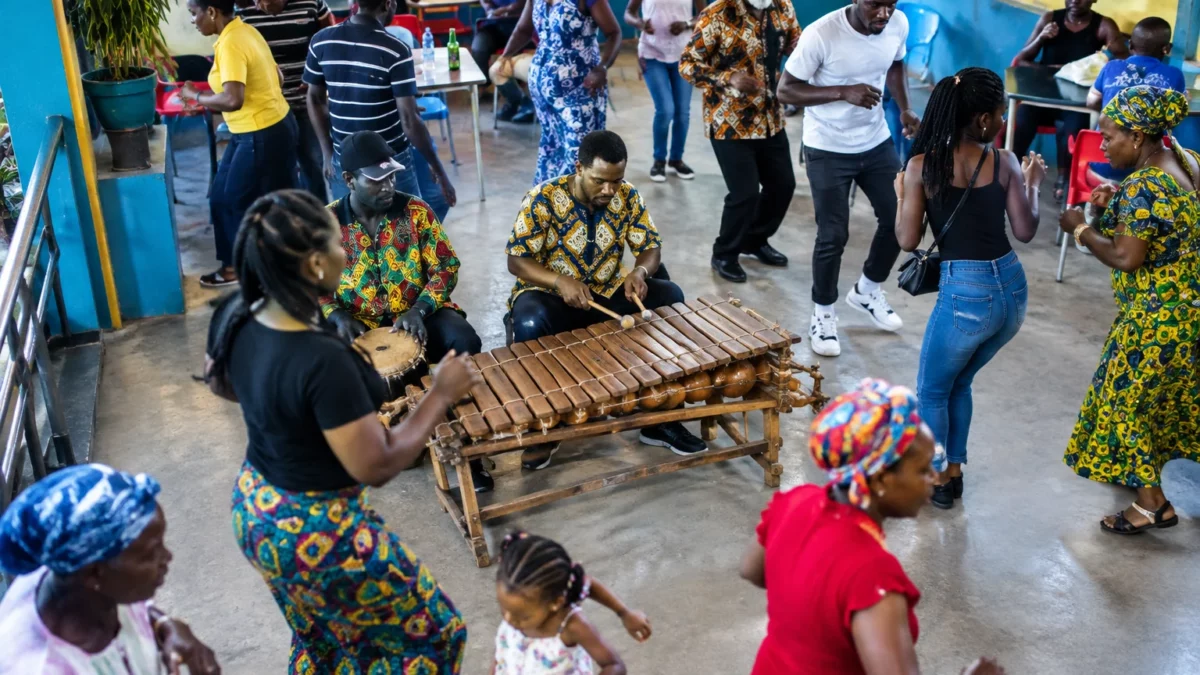
In Ahala, south of Yaoundé, wooden bars struck to the rhythm of medzang bring several generations together. For the musicians who play it, the challenge goes beyond the stage: passing on musical knowledge while finding it a place in contemporary urban life.
From the village to Yaoundé’s cabarets
Medzang — also written as mendzang or mendjang — refers to the balafon and, depending on usage, the music that accompanies it in Fang, Bulu and Beti communities. These groups are found mainly in Cameroon’s Centre and South regions. Their practices form part of a broader cultural area linked to the Ekang community, which also spans borders in Central Africa.
The balafon is therefore more than a simple entertainment instrument. It is part of an oral heritage in which music, dance, stories and collective events interact. An analysis of the Fang-Beti sociocultural area lists the balafon among the instruments associated with these traditions, alongside the tam-tam and drum. Cameroon’s Ministry of Arts and Culture also notes that traditional music can accompany events and shape moments of collective life.
In cities, the practice has moved to a different setting without necessarily losing its roots. Groups now play in cabarets, where audiences come to listen, dance and share an evening. In Ahala, this urban scene attracts both regulars attached to their memories and young people discovering the repertoire through their friends.
One instrument, many voices
Musician Akim Kondor says he helped make medzang known in Yaoundé and Douala. He says he began his career at the age of six and claims 45 years of practice. These biographical details are his own; above all, they illustrate the role artists can play in keeping a tradition in circulation, from the village to urban stages.
Making the instrument also requires specialised skills. In the account of Marc Okali, an art historian, the bars are carved from a red wood called padouk. They rest on calabashes, which act as resonators. Two mallets make the wood vibrate and give the instrument its characteristic sound.
The arrangement of the bars allows the musical roles to be divided. Kondor describes solo, accompaniment and bass parts. In other words, the instrument is already an ensemble: several musical lines can cross, while voices and dance complete the performance. A catalogue entry in the University of Osnabrück’s collection of musical instruments also documents a Beti mendzang balafon, confirming the instrument’s presence in collections devoted to world music.
This musical structure helps explain why medzang can find a place in a cabaret without being reduced to a heritage curiosity. The audience is not simply looking at an old object: it takes part in live music that can evolve with the voices, rhythms and reactions in the room.
Passing on the tradition without freezing it
In the room, generations mingle. Mélanie Yalla, a woman in her sixties quoted at an evening performance, associates the music with childhood memories and the passing on of family values. Thomas Delors Nti, who is younger, says he came with friends. He emphasises the performers’ talent and what he sees as the timeless quality of the music.
These accounts describe two different points of entry: personal memory and discovery. Their coexistence matters. A living tradition is passed on not only through ceremonies or in a village setting; it can also circulate in neighbourhoods, performance venues and exchanges among peers. The urban stage thus broadens the audience, even if it does not replace the original settings and practices.
The question of resources remains. Kondor laments the lack of support and promoters who, in his view, could back artists and give the balafon international visibility. This points to practical challenges: musicians’ pay, access to stages, the making and maintenance of instruments, training for young people and documenting repertoires.
Institutional recognition can help, but it is not enough to ensure the tradition is regularly passed on. In 2020, Cameroon’s Ministry of Culture included elements of intangible cultural heritage in the national heritage list. This general framework reflects an effort to recognise heritage; it does not, on its own, allow one to claim that medzang is among the listed elements. The ministry also says that safeguarding depends on practitioners, festivals and opportunities for training.
A Cameroonian heritage in a connected region
Medzang is part of a cultural history that extends beyond Cameroon’s borders. Fang communities and their musical traditions are also found in neighbouring countries, notably Gabon. This regional proximity creates opportunities for artists and know-how to circulate, but it also calls for local contexts to be specified rather than these traditions being presented as uniform.
For Cameroon’s cultural authorities, the challenge is to support diverse practices across the country. For artists, it is about being able to earn a living from their work and pass on their techniques. For audiences, particularly young city-dwellers, access to this music also depends on its presence in places where it can be heard and practised.
In Ahala, the dance floor offers a concrete but partial answer: medzang continues to bring people together because it is played in the present. Its future will depend less on a frozen image of the past than on the conditions available to musicians, instrument-makers and younger generations to develop it without erasing its roots.
To learn more about this tradition, see an analysis of the Fang-Beti sociocultural area in Cameroon, the Cameroonian Ministry of Arts and Culture’s page on intangible heritage and the entry on the Beti mendzang balafon.