Algeria
 Egypt
 Libya
 Morocco
 Sudan
 Tunisia
 Benin
 Burkina Faso
 Cabo Verde
 Côte d'Ivoire
 Ghana
 Guinea
 Guinea-Bissau
 Liberia
 Mali
 Mauritania
 Niger
 Nigeria
 Senegal
 Sierra Leone
 The Gambia
 Togo
 Central African Republic
 Chad
 DR Congo
 Equatorial Guinea
 Gabon
 Republic of the Congo
 São Tomé and Príncipe
 Burundi
 Comoros
 Djibouti
 Eritrea
 Ethiopia
 Kenya
 Madagascar
 Malawi
 Mauritius
 Mozambique
 Rwanda
 Seychelles
 Somalia
 South Sudan
 Tanzania
 Uganda
 Angola
 Botswana
 Eswatini
 Lesotho
 Namibia
 South Africa
 Zambia
 Zimbabwe
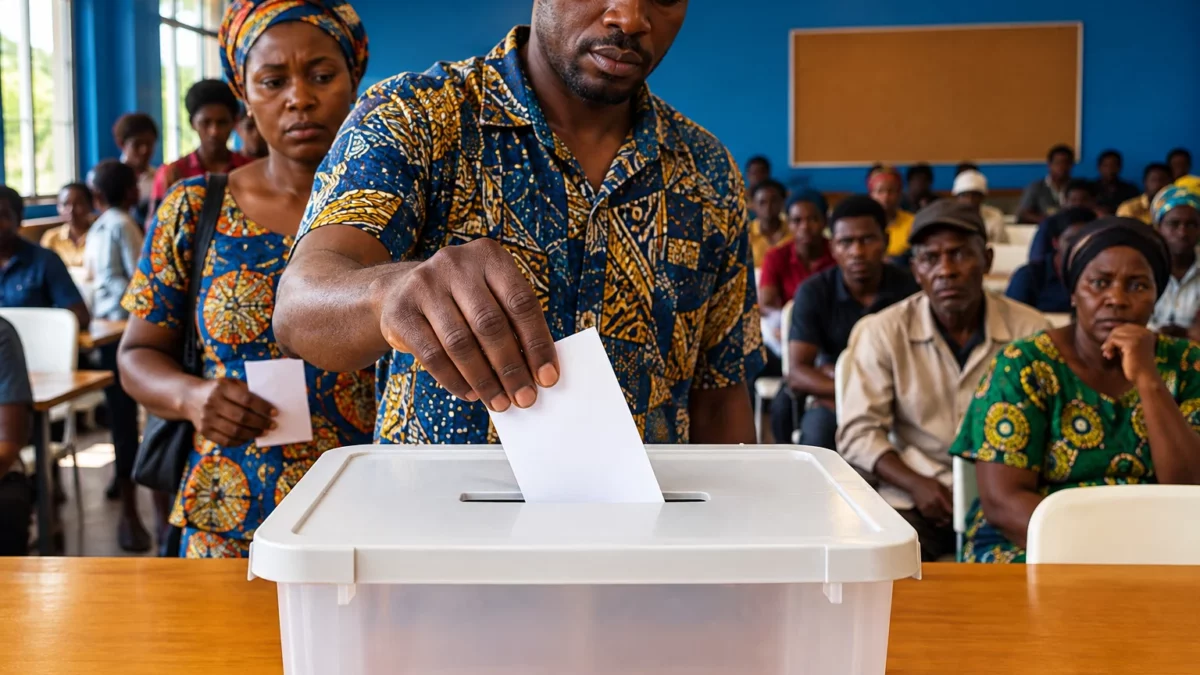
In Sangmélima, the choice of the ruling party’s municipal candidate has exposed an issue that goes beyond competition between two local officials: how much influence can members’ votes have in the face of decisions by the party hierarchy? As lists are prepared for the elections on 7 February 2027, this internal test offers a glimpse of the balance of power in a southern municipality considered an RDPC stronghold.
An internal ballot under disputed rules
The Cameroon People’s Democratic Movement (RDPC), the party of President Paul Biya, held its selection process in November to choose its municipal and parliamentary lists. Its guidelines provide for an attempt to reach consensus, followed by a vote if that fails. The procedure must be recorded in minutes. These rules give members a formal role, but the final composition of the lists remains a major political issue.
In Sangmélima, the administrative centre of Dja-et-Lobo division, the municipal primary on 19 November pitted several lists against one another. Dill Onel Baté Essiane, a local official in the RDPC’s youth organisation, was declared the winner over incumbent mayor Jean Faustin Bekono. Cameroonian media report a result of 141 votes to 6. This tally is attributed to accounts of the internal ballot; it is not an official election result.
The following day, Baté Essiane announced that he was withdrawing his candidacy and list. In a statement addressed to the party’s national president, he said he had faced pressure and threats to merge his list with that of the incumbent mayor. He also disputed the allocation of positions proposed in any such merger. These allegations have not been established by an independent investigation and must remain attributed to their author.
The situation then changed. Reports published on 24 November indicate that the list led by Baté Essiane was eventually filed with the local branch of Elections Cameroon (ELECAM), the body responsible for administering elections. The filing alone does not establish that all internal disputes have been resolved. It does, however, mark a significant change after the withdrawal announcement.
In Sangmélima, the town hall matters in local power balances
In a municipality where the RDPC has a long-standing base, the party’s nomination can count as much as the campaign against rival parties. The town hall has a bearing on local decisions and the municipality’s political representation. Municipal councillors, elected on lists, take part in the administration of municipal affairs, among other things. The order of candidates and the allocation of positions can therefore determine who takes up responsibilities.
Cameroon’s Electoral Code provides for municipal elections by list, without preferential voting. Voters therefore choose an entire list, and seats go to candidates according to their order of presentation. If no list wins an absolute majority, the system combines a bonus for the leading list with a proportional allocation of the remaining seats, subject to conditions. Internal selection is therefore no mere formality: it determines who may take up the elected mandates.
The party, for its part, has declared its aim of renewing its lists, particularly by including young people and women, as well as distributing responsibilities more evenly. These principles appear in its nomination guidelines. In Sangmélima, the candidacy of a young official after an internal victory brings the issue of renewal into view. But the disputes also show that the application of these rules depends on how party committees arbitrate disagreements.
A test for the party ahead of the election
Tensions are not confined to Sangmélima. Cameroonian media report disputes over nominations in other localities, including Ngoumou, as well as appeals to RDPC bodies. These internal disputes must be distinguished from challenges to the results of a public election: primaries are part of how parties operate, while ELECAM administers the electoral process provided for by law.
The case also has national significance. Twenty-seven parties are reported to have filed declarations of candidacy for the combined elections on 7 February, according to reports published by the Cameroonian press. This figure refers to parties that have begun the process, not necessarily those whose lists will all be accepted. The validation of candidacies and the actual contest remain to be seen.
For Sangmélima voters, the concrete outcome will depend in particular on which list is approved, its candidates and the ability of the RDPC’s opponents to present a credible alternative. An internal dispute could weaken the party’s mobilisation or, conversely, be resolved before the campaign. At this stage, it is too early to say that the opposition will benefit: primary results do not determine the municipal vote.
In Yaoundé, the electoral authorities will have to process candidacies according to the applicable timetable and rules. The RDPC’s immediate challenge is to ensure that a procedure it presents in its own guidelines as based on consensus or voting is respected. The credibility of this mechanism will depend as much on how appeals are handled as on the publication of the final lists.
A local issue within the dynamics of Central Africa
The election also matters in the regional political context, although the tensions in Sangmélima cannot be generalised to Cameroon or Central Africa. The country belongs to the Economic and Monetary Community of Central Africa (CEMAC), which brings together six states around economic and monetary cooperation. Municipal and parliamentary elections nevertheless remain national processes, governed by Cameroonian institutions; CEMAC does not arbitrate party nominations.
The next steps are therefore clear: ELECAM’s review of the files, confirmation of the candidacies, and then the campaign ahead of the vote scheduled for 7 February 2027. In Sangmélima, it remains to be seen whether the filing of Baté Essiane’s list ends the stand-off or whether appeals keep the dispute alive. It is in these verifiable decisions, rather than in the camps’ statements alone, that the RDPC’s ability to turn its internal rules into a choice accepted by its members will be measured.
For an explanation of the election rules, the Electoral Code published by ELECAM sets out the municipal voting system. The RDPC guidelines on selecting its lists describe the use of consensus or a vote.