Algeria
 Egypt
 Libya
 Morocco
 Sudan
 Tunisia
 Benin
 Burkina Faso
 Cabo Verde
 Côte d'Ivoire
 Ghana
 Guinea
 Guinea-Bissau
 Liberia
 Mali
 Mauritania
 Niger
 Nigeria
 Senegal
 Sierra Leone
 The Gambia
 Togo
 Cameroon
 Central African Republic
 Chad
 DR Congo
 Equatorial Guinea
 Gabon
 Republic of the Congo
 São Tomé and Príncipe
 Burundi
 Comoros
 Djibouti
 Ethiopia
 Kenya
 Madagascar
 Malawi
 Mauritius
 Mozambique
 Rwanda
 Seychelles
 Somalia
 South Sudan
 Tanzania
 Uganda
 Angola
 Botswana
 Eswatini
 Lesotho
 Namibia
 South Africa
 Zambia
 Zimbabwe
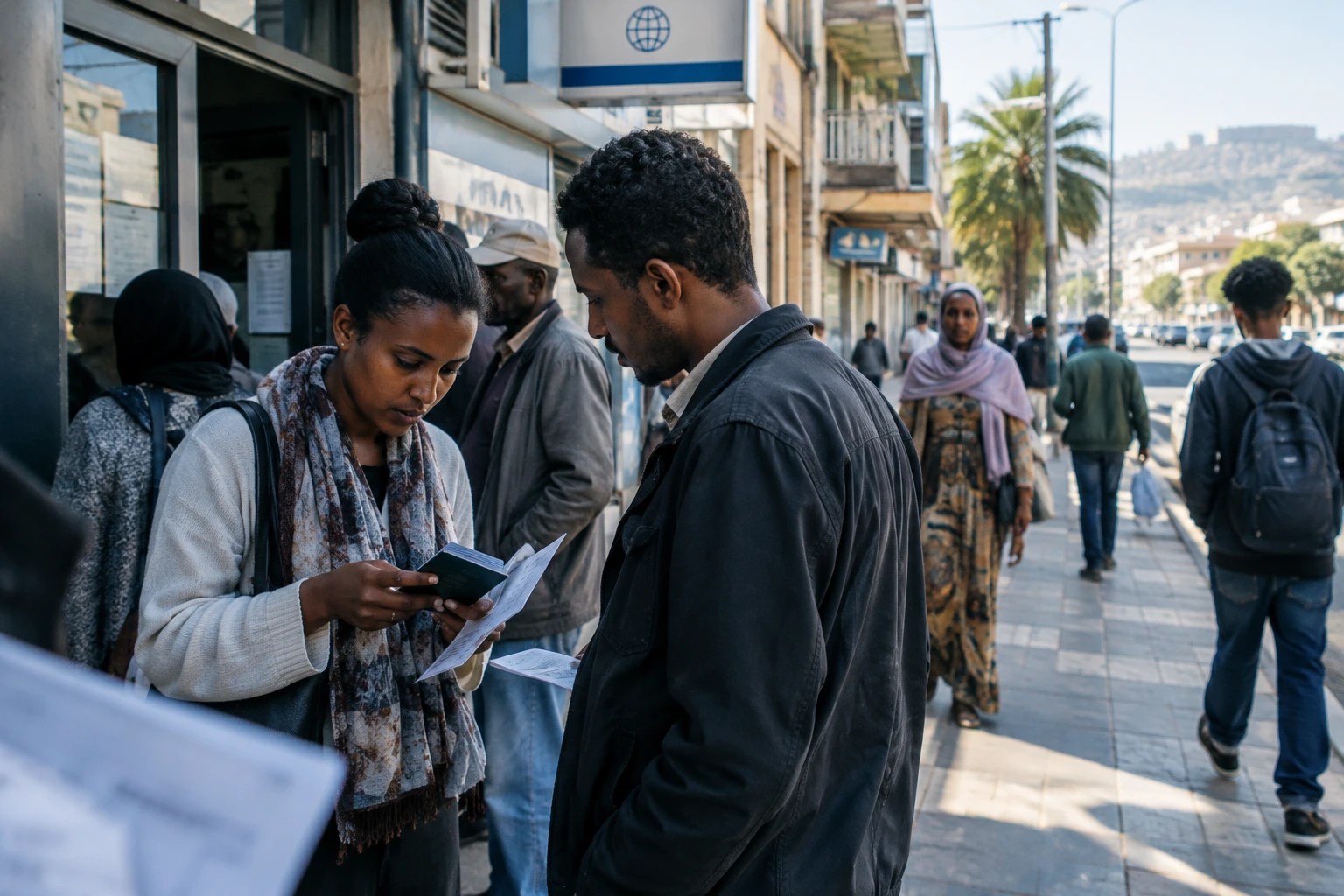
In London, a decision on visas can affect far more than the people the British government wants to remove. It can also affect Eritrean students, families and travellers seeking to enter the UK legally. This is the lever London has chosen in its stand-off with Asmara over deportations.
Diplomatic pressure over returns
On 15 October 2026, British Home Secretary Shabana Mahmood threatened to suspend all visas issued to Eritrean nationals unless their government quickly cooperated in returning people who have no right to remain in the UK. The measure has been announced, but a blanket ban has not yet come into force.
London has, however, already taken two measures. Eritrean officials and public figures no longer benefit from expedited processing of their visa applications. Eritrean diplomats in the UK must obtain permission from the British Foreign Office to travel more than 60 kilometres from London. The British government says comparable restrictions apply to its representatives in Asmara.
The British Home Office says Eritrea halted cooperation on returns earlier in 2026, after discussions failed to produce results. According to its figures, fewer than 4% of the 2,626 Eritrean nationals whose asylum applications were rejected in the UK over the past four years have been deported. London published these figures, which have not been independently confirmed in the information available.
The British justification concerns people whose claims for protection have been rejected and foreign nationals convicted of offences. But these cases are not interchangeable: a person whose claim has been rejected can challenge the decision, and the right to return must be assessed individually. The threat, by contrast, applies to visas for all Eritreans, including those with no connection to these cases.
Crossings do not tell the whole story
According to the British authorities, Eritreans were the most represented nationality among people arriving in small boats in the year ending in June 2026. This ranking does not mean that most Eritrean nationals travel to the UK by this route. Nor does it, on its own, indicate how many people could be deported.
Data from the University of Oxford’s Migration Observatory shed light on asylum, without confirming exactly the 84% figure cited in the original material. For Eritrean applications decided at first instance in 2025, the organisation estimates that 87% resulted in protection being granted. The rate depends on the period, the stage of the procedure and the cases counted. It should therefore not be confused with the proportion of applications accepted upon submission, or with the number of people crossing the Channel.
This high level of protection granted is a reminder that Eritrean claims are considered in a particular context. Departures are linked in particular to national service, which can be of indefinite duration, and to reported political and civil restrictions in the country. The existence of grounds for protection does not automatically determine the outcome of every application, but it makes it inaccurate to equate all arrivals with people liable to deportation.
Across the UK, small-boat crossings account for a significant, but not exclusive, share of asylum applications. Oxford estimates that in 2025, 41% of people who applied for asylum had arrived by this route; 39% had first entered the country on a visa. These figures describe different journeys and show why a blanket visa restriction could affect people with no connection to irregular crossings.
The potential cost of a collective measure
For London, the immediate aim is to obtain travel documents and the agreement of countries of origin in order to organise returns. A visa ban is being used here as a means of diplomatic pressure. The British government cites agreements reached with Angola and Namibia after similar threats, as well as restrictions imposed on the Democratic Republic of the Congo, which were later lifted after increased cooperation. These precedents show that the measure can open negotiations; they do not guarantee the same outcome with Asmara.
For Eritreans, the potential impact extends beyond those facing deportation. A total suspension could close legal routes to students, relatives of UK residents and business travellers. It could also risk conflating a government’s responsibility in discussions on returns with that of individuals applying for visas in their own right. The practical scope will depend on the text ultimately implemented and any exceptions it includes.
No official Eritrean response to the 15 October announcements has been corroborated in the information reviewed. The dispute comes as the country’s regional relations are already strained. In December 2025, the Intergovernmental Authority on Development (IGAD), a cooperation organisation for the Horn of Africa, announced Eritrea’s formal withdrawal. The country had rejoined the organisation in June 2023, but subsequently took part in neither its meetings nor its programmes, according to the IGAD secretariat.
A regional and continental question
This withdrawal narrows a space for regional dialogue at a time when population movements, refugee protection and returns involve several countries in the Horn of Africa. It does not, by itself, mean that Eritrea will refuse all bilateral negotiations with the UK. It nevertheless highlights the limitations of regional mechanisms when relations between a state and its neighbours are strained.
For the African Union, the case raises a broader question: how can cooperation between states on returns be reconciled with individual consideration of the right to asylum and protection against return to danger? British pressure is directed at the Eritrean government, but the potential instrument would apply to nationals who are not all affected by deportation decisions.
The next step will be to see whether Asmara resumes technical discussions with London, and whether the UK turns its threat into an actual ban. Return figures, visa criteria and the Eritrean authorities’ response will show whether this strategy leads to an agreement or mainly penalises legal travel.