Algeria
 Egypt
 Libya
 Morocco
 Sudan
 Tunisia
 Benin
 Burkina Faso
 Cabo Verde
 Côte d'Ivoire
 Ghana
 Guinea
 Guinea-Bissau
 Liberia
 Mali
 Mauritania
 Niger
 Nigeria
 Senegal
 Sierra Leone
 The Gambia
 Togo
 Cameroon
 Central African Republic
 Chad
 DR Congo
 Equatorial Guinea
 Gabon
 Republic of the Congo
 São Tomé and Príncipe
 Burundi
 Comoros
 Djibouti
 Eritrea
 Ethiopia
 Kenya
 Madagascar
 Malawi
 Mauritius
 Mozambique
 Rwanda
 Seychelles
 Somalia
 South Sudan
 Tanzania
 Angola
 Botswana
 Eswatini
 Lesotho
 Namibia
 South Africa
 Zambia
 Zimbabwe
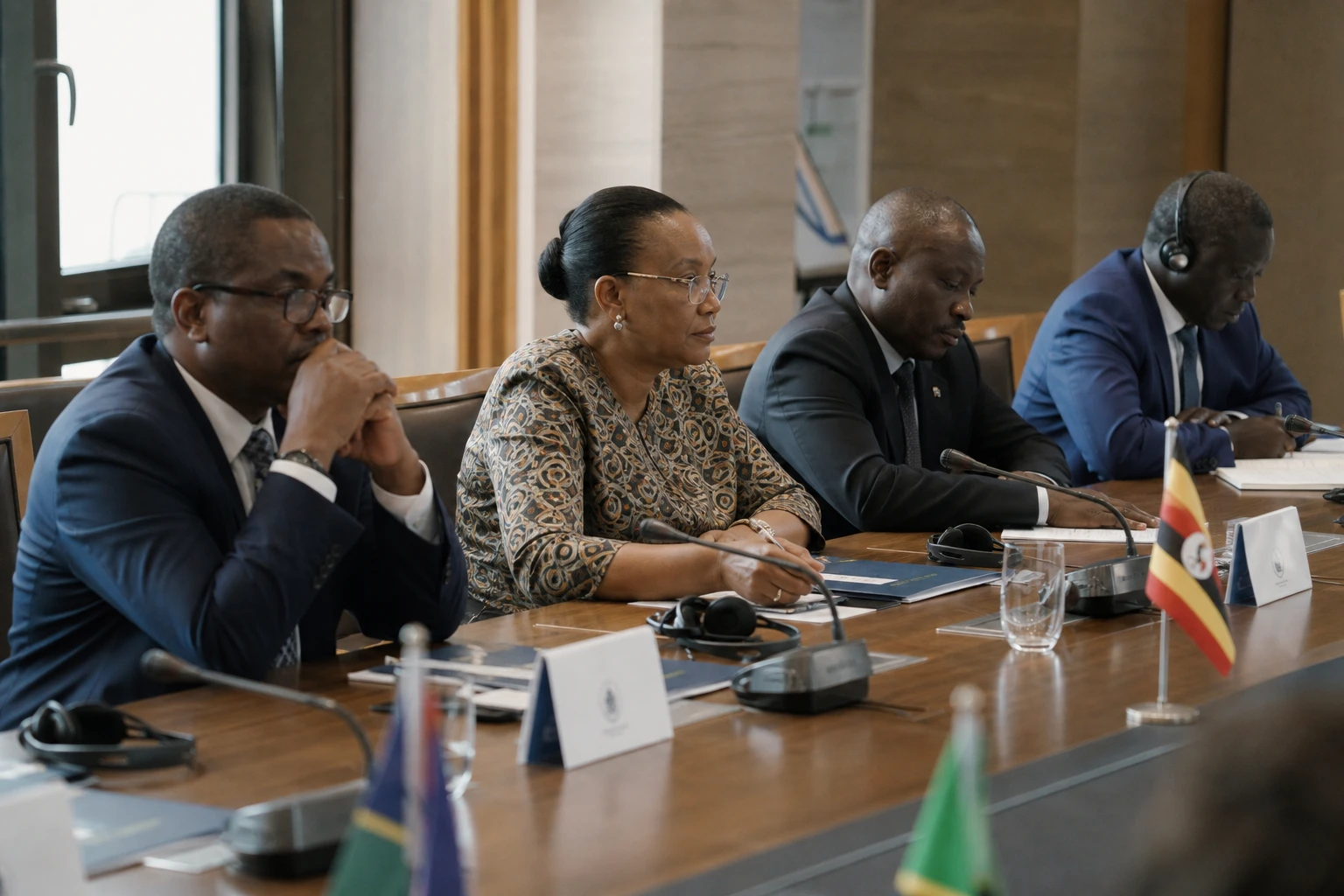
An arms, drugs and power case in Kampala
In Kampala, an extradition to the United States is never viewed solely as a legal matter. It also touches on networks of power, personal alliances and the reputation of a state apparatus already under close scrutiny from Ugandans. In this case, Michael Katungi Mpeirwe, a retired former military officer, left Uganda after proceedings initiated by US justice authorities and approved by the Ugandan authorities.
The regional context matters just as much. Uganda is a founding member of the East African Community, the EAC, an eight-country bloc headquartered in Arusha, Tanzania. This membership places Kampala at the heart of a region through which people, goods, capital… and sometimes cross-border trafficking networks circulate, which judicial services are trying to contain.
What US prosecutors allege
According to the indictment filed in the US District Court for the Eastern District of Virginia, Katungi is one of four men targeted in a case opened around September 2022. US prosecutors allege that they sought to supply the Jalisco New Generation Cartel, or CJNG, with military weapons, forged export documents and other logistical support. The court document lists machine guns, rocket launchers, anti-personnel mines, surface-to-air missiles, drones and anti-aircraft guns.
The same document says the operation was allegedly intended to support cocaine trafficking to the United States and conceal weapons flows using end-user certificates and delivery-verification protocols. US justice authorities describe the CJNG as one of Mexico’s most violent and active transnational criminal organisations. The indictment also notes that Washington designated the cartel as a foreign terrorist organisation on 20 February 2025.
The proceedings do not target Katungi alone. The other names cited are Bulgarian Peter Dimitrov Mirchev, Kenyan Elisha Odhiambo Asumo and Tanzanian Subiro Osmund Mwapinga. The case also mentions a shipment seized in 2024, said to contain around 50 AK-47-type rifles.
Extradition now completed
In Uganda, the case took on a political dimension because Katungi was long close to Muhoozi Kainerugaba, the son of President Yoweri Museveni. Ugandan media reported that he was removed from the leadership of the Patriotic League of Uganda after the US indictment was made public. The split illustrates the sensitivity of the issue in Kampala, where the boundaries between military, diplomatic and political networks remain under close scrutiny.
The judicial process moved quickly. Ugandan media reported that after his arrest in Kampala in late June 2026, the courts subsequently cleared the way for his extradition. On 28 August 2026, the Buganda Road Chief Magistrate’s Court ordered that he remain in custody pending a ministerial decision. On 1 September 2026, Uganda’s Justice Minister, Norbert Mao, signed the handover order. On 12 September 2026, Katungi was handed over to US authorities and left Uganda.
Ugandan justice authorities found that the US request met the conditions set out in the Extradition Act. The Ugandan Ministry of Justice, for its part, says it handles international cooperation cases from Kampala through its services responsible for public international law and judicial cooperation. In other words, the decision was not an isolated gesture: it forms part of existing institutional mechanisms.
Why the case goes beyond the individual
For the Ugandan authorities, the stakes are twofold. The state must show that it cooperates with foreign partners when serious offences are alleged, while preventing the case from turning into a debate about immunity, privileges or closeness to those in power. For the public, the issue comes down to a simple question: who controls the networks that bring together security, money and influence?
The case also says something about Uganda’s place in regional networks. The country lies at the crossroads of East Africa, the Great Lakes and routes leading to the Indian Ocean. The EAC promotes economic integration and free movement, but those same routes can also be used for trafficking if customs, financial and judicial controls remain fragmented.
The fault lines in this case are therefore not only legal. They are institutional. They touch on relations between civilians and former military officers, between national justice and international cooperation, and between the state’s reputation and the influence of circles close to power. In Kampala, cases of this kind often carry more weight than a simple extradition order, because they expose power dynamics that official statements only partly reveal.
A case to follow beyond Kampala
Across the continent, this extradition is a reminder of a broader trend: African states are increasingly cooperating with transnational proceedings involving weapons, drugs and money laundering. In other cases, US justice authorities have already used the charge of providing material support to a terrorist organisation to target networks linked to Mexican cartels. The Katungi case shows that these legal battles now extend well beyond the Americas.
The next point to watch is the progress of the proceedings before the federal court in Virginia. US justice authorities will have to establish the facts, the chain of command and the precise degree of involvement of each defendant. For Uganda, the episode leaves a lasting question: how can the credibility of institutions be protected when an international criminal case involves a former officer and someone close to the centre of power?