Algeria
 Egypt
 Libya
 Morocco
 Sudan
 Tunisia
 Benin
 Burkina Faso
 Cabo Verde
 Côte d'Ivoire
 Guinea
 Guinea-Bissau
 Liberia
 Mali
 Mauritania
 Niger
 Nigeria
 Senegal
 Sierra Leone
 The Gambia
 Togo
 Cameroon
 Central African Republic
 Chad
 DR Congo
 Equatorial Guinea
 Gabon
 Republic of the Congo
 São Tomé and Príncipe
 Burundi
 Comoros
 Djibouti
 Eritrea
 Ethiopia
 Kenya
 Madagascar
 Malawi
 Mauritius
 Mozambique
 Rwanda
 Seychelles
 Somalia
 South Sudan
 Tanzania
 Uganda
 Angola
 Botswana
 Eswatini
 Lesotho
 Namibia
 South Africa
 Zambia
 Zimbabwe
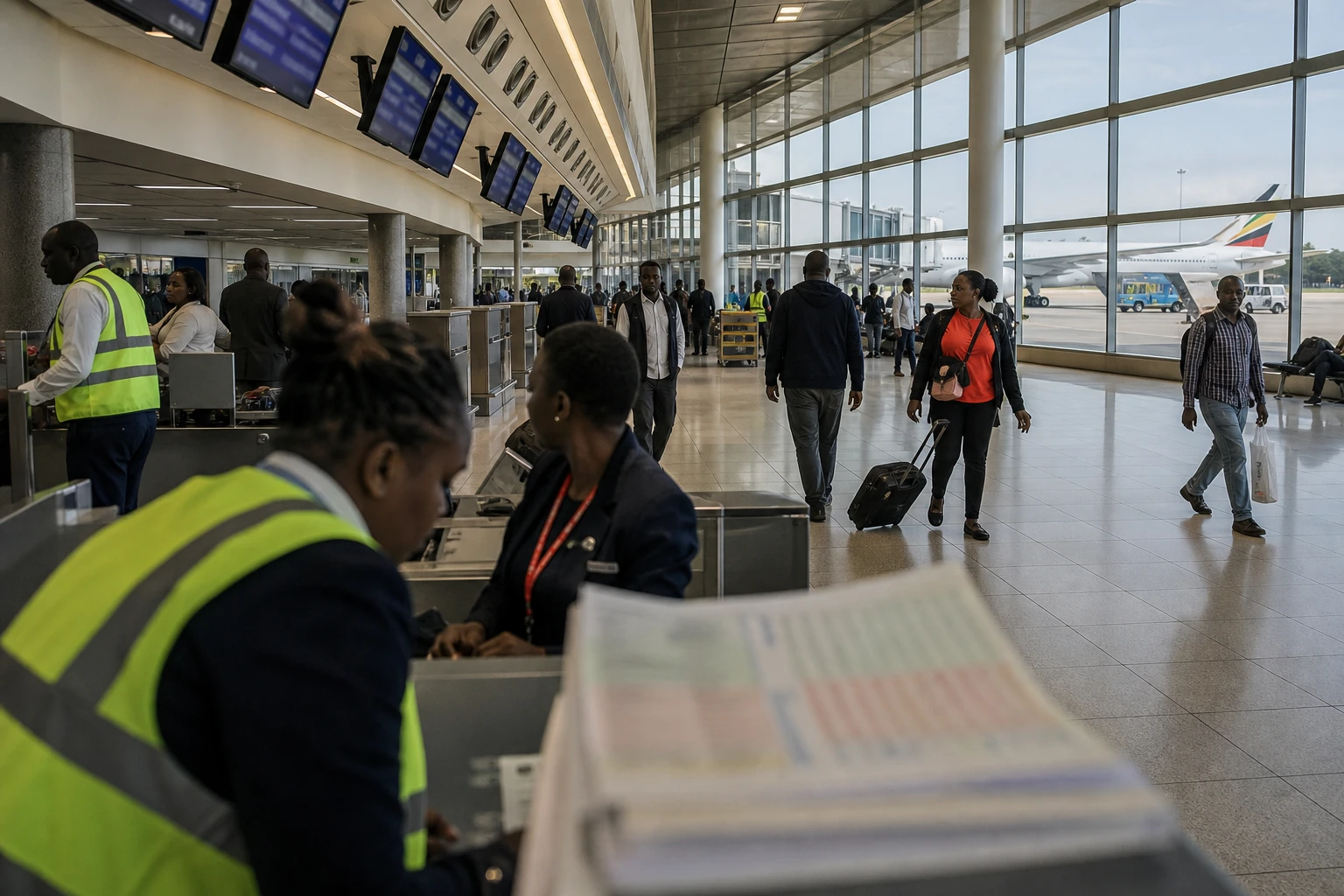
For Ugandan travellers and businesses, the next challenge is no longer simply opening routes. Connections must also be predictable, competitive and reliable enough to rival the major hubs of Nairobi and Addis Ababa.
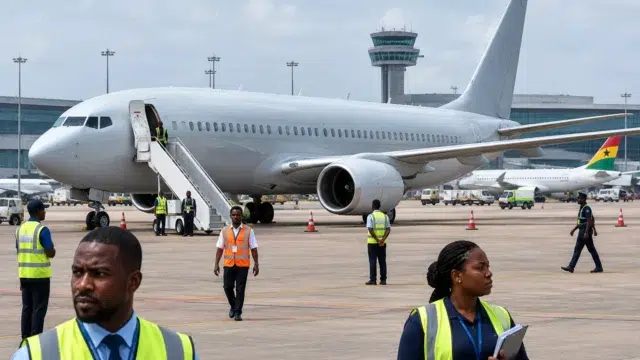
In this race, Uganda Airlines is preparing its next step. From 27 October 2026, the Ugandan national carrier is due to link Entebbe with Accra four times a week, with a stop in Lagos, Nigeria. The route will put East and West Africa on the same itinerary operated by the Kampala-based carrier.
An air bridge between Entebbe and Accra
The announced schedule calls for Boeing 737-800 flights on the Entebbe-Lagos-Accra route. The service is due to operate four days a week from Tuesday 27 October 2026, according to flight schedule data published by AeroRoutes and reports from Uganda.
The choice of Accra is no coincidence. The Ghanaian capital is a major gateway to English-speaking West Africa. It could also serve as a connecting point for business travellers, regional trade players, international organisations and tourism operators.
The stop in Lagos, however, adds a constraint. Passengers will not have a direct flight between Entebbe and Accra. The route’s success will therefore depend on the punctuality of both legs, smooth transit in Nigeria, and the coordination of baggage and formalities.
Uganda Airlines will thus become one of the few East African carriers to offer a service to Accra. Kenya Airways, Ethiopian Airlines and Air Tanzania already serve the Ghanaian capital, according to information available on the regional aviation market.
Entebbe’s strategy in the face of major regional hubs
Since restarting operations in 2019, after nearly 20 years of inactivity, Uganda Airlines has sought to rebuild its international presence. Its network already covers several cities in East Africa and the Red Sea basin, as well as destinations in the Middle East and Asia.
The airline serves Nairobi, Kigali, Lagos, Mogadishu, Dubai and Mumbai, among other destinations. It has also developed a route to London Gatwick. This expansion gives Entebbe a role beyond that of a simple national airport: Kampala wants to make it a transit point for regional and intercontinental traffic.
The strategy aligns with East Africa’s ambitions within the East African Community, or EAC, which facilitates economic cooperation among several countries in the region. However, the EAC alone is not enough to create an integrated aviation market. Airlines still have to contend with traffic rights, airport costs, visa requirements and regulatory differences.
By opening the Accra route, Uganda Airlines is therefore trying to move beyond its natural market. The service could bring two distant economic regions closer, but it will also have to face better-established carriers with larger fleets and denser connecting networks.
Revenues rise, but losses persist
The commercial expansion comes as the carrier’s financial position remains fragile. Uganda’s parliament said Uganda Airlines had recorded a net loss of 237.9 billion shillings in the 2023-24 financial year. At the same time, its revenue had risen by more than 50%, driven in particular by passenger and cargo income.
Results for the 2024-25 financial year show a slight improvement, but not yet a turnaround. According to Ugandan daily Daily Monitor, the loss stood at about 230.8 billion shillings. The reduction remains modest given the cost of operating a long-haul and regional fleet.
The problem is therefore not simply whether planes are full. Fuel, maintenance, spare parts, crew costs, aircraft leasing and the expenses involved in opening new routes all weigh heavily on the accounts.
Operational difficulties can also reduce revenue. A grounded aircraft leads to cancellations, refunds and a loss of confidence. For passengers, the issue is tangible: a useful route on paper becomes a genuine alternative only if it runs reliably.
A fleet set to grow
Ugandan authorities want to support network growth by expanding the fleet. In June 2026, Uganda Airlines signed an agreement with Boeing worth about 3,700 billion shillings for 10 aircraft, including eight passenger planes and two freighters, according to the Uganda Broadcasting Corporation.
The order is intended to strengthen the airline’s capacity and reduce Uganda’s dependence on foreign hubs. However, it carries a significant budgetary risk. A larger fleet offers more commercial opportunities, but it also increases acquisition, maintenance, training and management costs.
Management, now led by Girma Wake, a former head of Ethiopian Airlines, will therefore have to balance expansion with financial discipline. The decision to use a wet-leased aircraft to serve Accra illustrates this tension: it allows the airline to open a route quickly, but it can also increase the cost per seat.
What the Accra route will have to prove
For Kampala, the new service will be a commercial test as well as a regional symbol. Business travellers will need suitable schedules. Companies will look for reliable cargo capacity and business travel options. Tourists, meanwhile, will compare fares and total journey times with routes offered via Nairobi or Addis Ababa.
The airline will also have to gauge actual demand beyond the capital. The benefits of an international service do not automatically accrue in Entebbe. They depend on the ability to connect Uganda’s regions with external markets, either directly or through efficient road and air connections.
At continental level, the opening of the Accra route reflects a wider trend: African airlines are seeking to capture a larger share of intra-African travel. This ambition aligns with the goals of the African Continental Free Trade Area, which depends on smoother trade between economies.
The next milestone will therefore be the launch on 27 October 2026, followed by the regularity of flights in the first few months. For Uganda Airlines, the challenge will be to turn a new destination into sustainable traffic without allowing network expansion to outstrip the airline’s financial and operational capacity.