Algeria
 Egypt
 Libya
 Morocco
 Sudan
 Benin
 Burkina Faso
 Cabo Verde
 Côte d'Ivoire
 Ghana
 Guinea
 Guinea-Bissau
 Liberia
 Mali
 Mauritania
 Niger
 Nigeria
 Senegal
 Sierra Leone
 The Gambia
 Togo
 Cameroon
 Central African Republic
 Chad
 DR Congo
 Equatorial Guinea
 Gabon
 Republic of the Congo
 São Tomé and Príncipe
 Burundi
 Comoros
 Djibouti
 Eritrea
 Ethiopia
 Kenya
 Madagascar
 Malawi
 Mauritius
 Mozambique
 Rwanda
 Seychelles
 Somalia
 South Sudan
 Tanzania
 Uganda
 Angola
 Botswana
 Eswatini
 Lesotho
 Namibia
 South Africa
 Zambia
 Zimbabwe
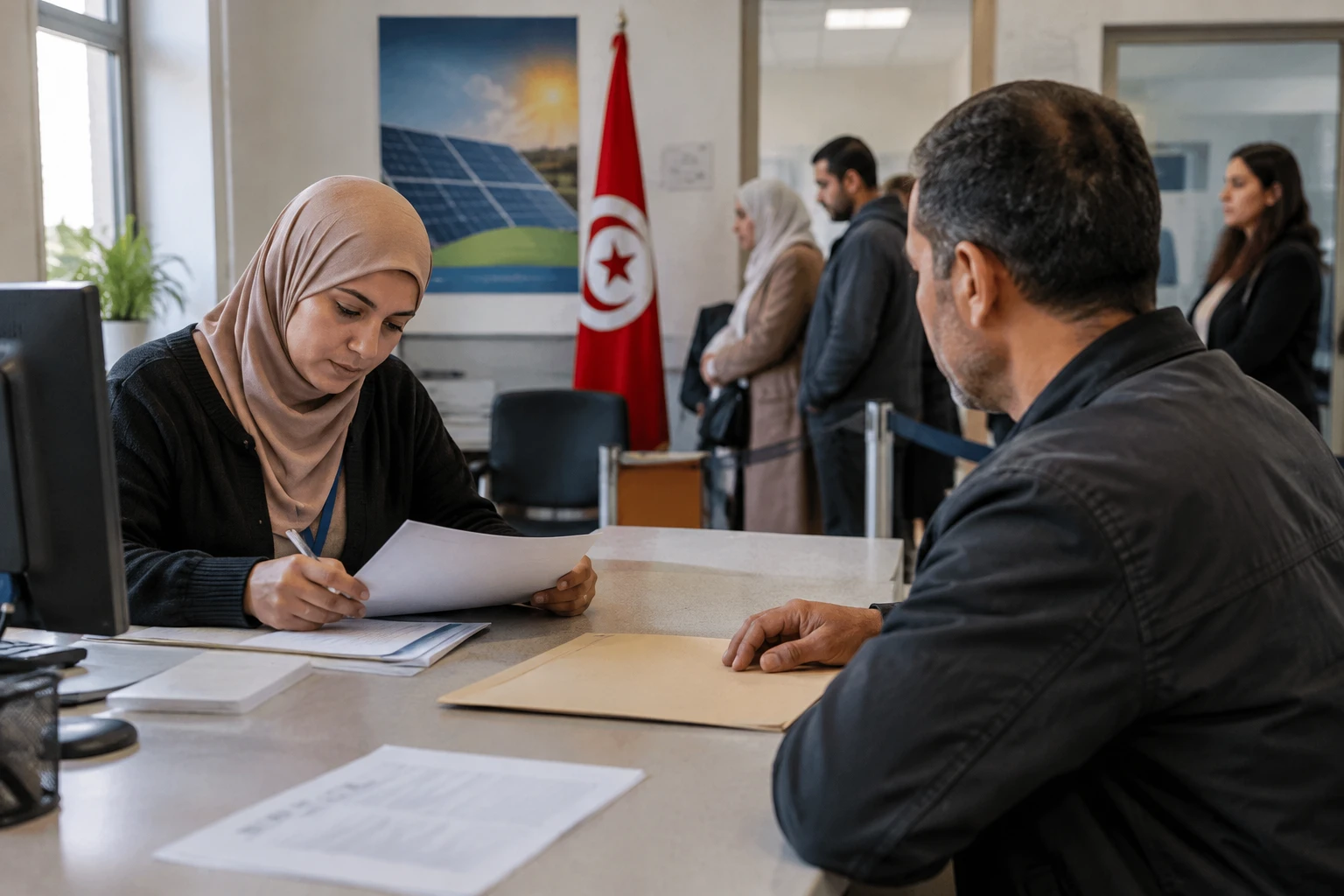
For Tunisian households and businesses, the question is not simply how to generate more electricity: rising demand must also be prevented from undermining supply. The draft economic budget for 2027 puts renewable energy at the heart of this equation, but several announced capacities have yet to be built or awarded.
A target set out in the draft budget
The document submitted to the Tunisian parliament plans to raise the share of renewables in electricity generation to 16% in 2027, from 12% expected at the end of 2026. These figures are targets, not capacity already installed. Tunisia’s TAP news agency confirmed the publication of the 2027 draft economic budget, while Tunisian media report that parliamentary scrutiny is due to begin in mid-October. The detailed energy indicators, meanwhile, are attributed here to the budget document.
The programme forecasts national electricity generation of about 23,200 gigawatt hours in 2027, up from 22,700 GWh expected in 2026. Demand is projected to rise by 4%. The gap between growing needs and the timetable for commissioning projects will therefore be decisive: announcing a power plant is not enough to feed its electricity into the grid.
This trajectory forms part of a longer-term national goal. The Tunisian government aims for renewables to account for 35% of electricity by 2030. The prime minister’s office reaffirmed this target at a ministerial council devoted to energy projects in October 2026. The authorities present this approach as a way to strengthen energy security and reduce the country’s dependence on natural gas.
Power plants at different stages
The draft budget distinguishes between three routes: concessions, permits and self-generation. A concession entrusts an operator with building a facility under a contract with the state. The permits regime governs smaller private projects. Self-generation allows households, businesses or public bodies to produce some of the electricity they consume.
Among the concession projects, the budget document lists a 198-megawatt photovoltaic plant at El Khobna, in Sidi Bouzid governorate, and a 77 MW wind project. It provides for the continuation of award and contracting procedures. These administrative and financial steps are prerequisites for work to begin, followed by connection to the grid.
At Bazma, in Kébili governorate, the Ministry of Industry, Mines and Energy launched a tender in March 2026 for a 300 MW solar plant paired with battery storage. The official project details state that the planned system is designed to provide 150 MW of power and store 540 MWh. Storage can shift some of the electricity generated during the day to periods when solar output falls. It does not, however, replace grid upgrades or other generation sources.
The budget also refers to about 455 MW of new capacity under the sixth round of permits. In September, the ministry published the results of its assessment of applications. Separately, the self-generation programme plans an additional 500 MW, including on homes, public buildings and sites connected to medium- or high-voltage networks. These figures are programme targets: they do not mean that all installations are already funded or operational.
Delivery is also a challenge
Turning announcements into generation will depend on several practical conditions: finalising contracts, securing finance, the availability of equipment and connection to the grid by the Tunisian Electricity and Gas Company (STEG), the state-owned sector operator. Timing matters as much as the volume announced. Construction or connection delays can push new capacity beyond the period when the grid needs it.
The transition will affect different groups in different ways. Large power plants are expected to contribute to the overall supply, while self-generation can reduce bills for some households and businesses. But access to panels, batteries and finance may limit this option for lower-income households and small businesses. In October, Tunisian professional organisations called on parliament to cut customs duties on solar equipment and reduce its VAT. Their request highlights an issue of distribution: who can invest, and who benefits from the savings?
For the grid, the projected 4% rise in demand means managing peak consumption and the variability of solar and wind power. The storage planned at Bazma is a partial response. The grid’s capacity to accommodate new installations, and coordination between power plants, storage and existing generation, will also need to be monitored. Supply difficulties cited in the budget material make these questions particularly tangible, but are not, by themselves, enough to establish a precise record of power cuts.
A North African transition to be measured over time
Tunisia is a member of the Arab Maghreb Union (AMU), a regional organisation in North Africa. For now, the targets described relate primarily to the national electricity system. They nevertheless form part of a context in which energy security, cross-border trade and the role of gas concern the entire region. These prospects should not be conflated: the projects listed do not in themselves constitute an export agreement or a new interconnector.
The next indicator to watch will be delivery: signed contracts, construction work under way, power plants connected to the grid and electricity actually fed into it. Parliamentary debate on the budget and tax measures concerning renewable energy equipment will also shed light on the resources being mobilised. For Tunisians, success will therefore be measured not only by the percentage announced, but by the reliability of supply and the ability of different types of consumer to take part in this shift.