Algeria
 Egypt
 Libya
 Morocco
 Sudan
 Tunisia
 Benin
 Burkina Faso
 Cabo Verde
 Côte d'Ivoire
 Ghana
 Guinea
 Guinea-Bissau
 Liberia
 Mali
 Mauritania
 Niger
 Nigeria
 Sierra Leone
 The Gambia
 Togo
 Cameroon
 Central African Republic
 Chad
 DR Congo
 Equatorial Guinea
 Gabon
 Republic of the Congo
 São Tomé and Príncipe
 Burundi
 Comoros
 Djibouti
 Eritrea
 Ethiopia
 Kenya
 Madagascar
 Malawi
 Mauritius
 Mozambique
 Rwanda
 Seychelles
 Somalia
 South Sudan
 Tanzania
 Uganda
 Angola
 Botswana
 Eswatini
 Lesotho
 Namibia
 South Africa
 Zambia
 Zimbabwe
In Touba, the challenge goes beyond religious fervour: the city must also absorb a massive influx in just a few days
Every year, the Grand Magal puts the holy city of Touba to a practical test: welcoming millions of pilgrims, maintaining essential services and keeping people moving during the rainy season. In 2026, the challenge is even more visible, as preparations advance while rain is already disrupting several parts of Senegal.
The event is scheduled for Sunday 2 August 2026, corresponding to 18 Safar 1448 in the Hijri calendar, following the sighting of the crescent moon. The celebration commemorates the exile of Cheikh Ahmadou Bamba, founder of Mouridism, a major Muslim brotherhood in Senegal that has long shaped the religious, social and economic life of Touba and its region.
In this city in the centre of the country, needs are immense and long-term. Water, sanitation, roads and security cannot be managed for just one day of reflection. They also determine the quality of life for the residents of Touba, the capital of Mouridism, well beyond the period of the Magal.
Works, coordination and trade-offs: the Senegalese state moves at full speed
Preparatory meetings began on 16 April 2026 with the launch of the local development committee’s work. They continued in June and July with coordination meetings involving administrative authorities, religious leaders and technical services. On 11 July, preparatory activities were officially launched in Touba under the framework set by the organising committee.
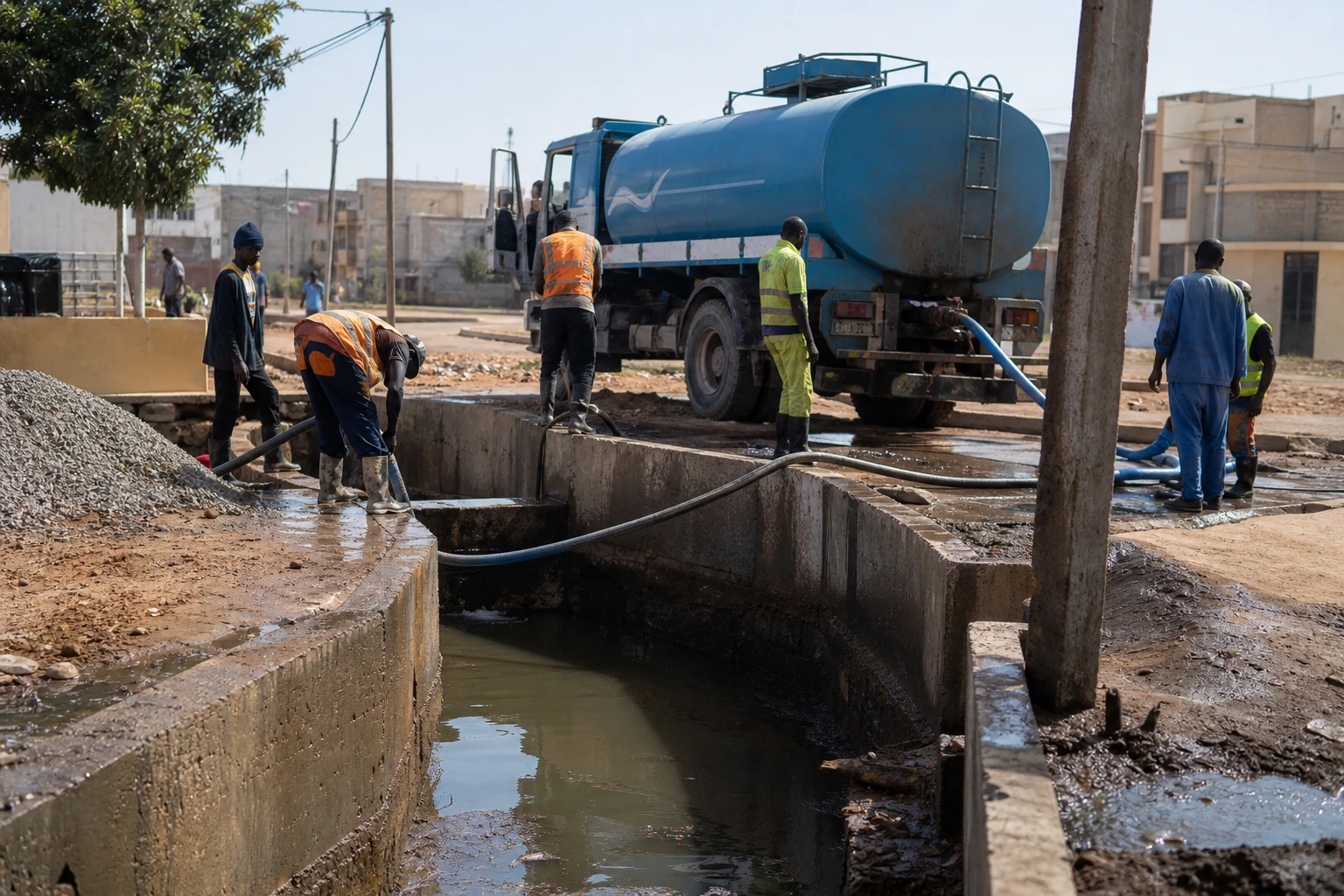
On the ground, the most sensitive projects concern drinking water and rainwater drainage. On 21 July, the Ministry of Hydraulics and Sanitation said it was monitoring progress on ongoing works and reinforcing the arrangements put in place for the Magal. Public services also announced the mobilisation of water tankers and the completion of most of the works before 31 July 2026, in order to ease pressure when pilgrims arrive. The Ministry of Hydraulics and Sanitation gave details of its visit to Touba and the facilities inspected.
The government has also committed substantial financial resources. An initial programme worth 15 billion CFA francs was launched at the end of 2025 for rainwater drainage. Then, on 26 July 2026, President Bassirou Diomaye Faye announced a 60 billion CFA franc programme for Touba over four years, focused on water, sanitation and flood prevention. This funding adds to the emergency response linked to the Magal, but is primarily intended to provide a structural solution to the city’s rapid growth.
On 18 July, the National Hygiene Service launched a disinfection, insect-control and dusting operation around places of worship, homes and accommodation sites. A few days later, the environment minister handed cleaning equipment to the organising committee. In Touba, preparations for a pilgrimage have thus become a multi-layered public operation involving health, cleanliness, traffic, civil protection and logistics.
The rainy season complicates preparations, but also highlights the need for long-term investment
The 2026 edition falls in the middle of the rainy season. This is no mere calendar detail. In western and central Senegal, rain changes routes, slows traffic and more quickly overwhelms drainage networks. In recent days, the National Agency for Civil Aviation and Meteorology has reported storms and rain in several regions of the country, including the south-central area and, at times, Diourbel. ANACIM regularly publishes these bulletins to help travellers and authorities anticipate disruption to journeys.
In Touba, this seasonal constraint acts as a revealer. It exposes the vulnerability of urban infrastructure to an exceptional concentration of people. It also highlights the challenges facing outlying neighbourhoods, where drainage, access to passable roads and water supplies can become immediate concerns for families and informal businesses alike.
Religious authorities, for their part, emphasise the sacred nature of the place and the discipline expected of the faithful. They also point out that the Magal now attracts a vast crowd. For the 2025 edition, the organising committee put the number of pilgrims at about 6.5 million. More than six million visitors are again expected in 2026, confirming the event’s national and regional scale.
This mass gathering has a direct impact on the local economy. Markets come alive, transport operators make more trips, street vendors take over public space, and host families absorb some of the demand. But it also puts heavy pressure on water networks, sanitation facilities and road safety. In Touba, the Magal is both a spiritual celebration and a moment when the state must prove its ability to act in a rapidly expanding area.
A Senegalese gathering with an impact across West Africa and beyond
The Grand Magal of Touba is not only for Senegal’s Mourides. It also draws faithful from the diaspora and several African countries. This is one reason why authorities now describe it as an event of international significance. This reality gives the gathering a reach that extends beyond the Diourbel region and the national organising effort alone.
For the Senegalese state, the challenge is also institutional. The organisation brings together the presidency, the government, local authorities, technical services and security agencies. This coordination says something about Touba’s place in the country’s structure: a religious city, but also a centre of practical decision-making where the administration, customary authorities and public expectations meet.
In a West African context marked by security tensions, tight budgetary trade-offs and very tangible infrastructure needs, Touba offers another way of looking at regional integration: through the movement of the faithful, social solidarity and economic flows. The Magal then acts as a barometer. It measures Senegal’s ability to organise a large gathering, but also to meet long-term urban needs in a city that continues to grow.
The coming days will show whether the promised projects have kept to schedule. Above all, they will show whether the efforts on water, sanitation, security and roads have turned a demanding religious gathering into a demonstration of public service. In Touba, that is often what distinguishes an operation under strain from a well-managed pilgrimage.