Algeria
 Egypt
 Libya
 Morocco
 Sudan
 Tunisia
 Benin
 Burkina Faso
 Cabo Verde
 Côte d'Ivoire
 Ghana
 Guinea
 Guinea-Bissau
 Liberia
 Mali
 Mauritania
 Niger
 Nigeria
 Senegal
 Sierra Leone
 The Gambia
 Cameroon
 Central African Republic
 Chad
 DR Congo
 Equatorial Guinea
 Gabon
 Republic of the Congo
 São Tomé and Príncipe
 Burundi
 Comoros
 Djibouti
 Eritrea
 Ethiopia
 Kenya
 Madagascar
 Malawi
 Mauritius
 Mozambique
 Rwanda
 Seychelles
 Somalia
 South Sudan
 Tanzania
 Uganda
 Angola
 Botswana
 Eswatini
 Lesotho
 Namibia
 South Africa
 Zambia
 Zimbabwe
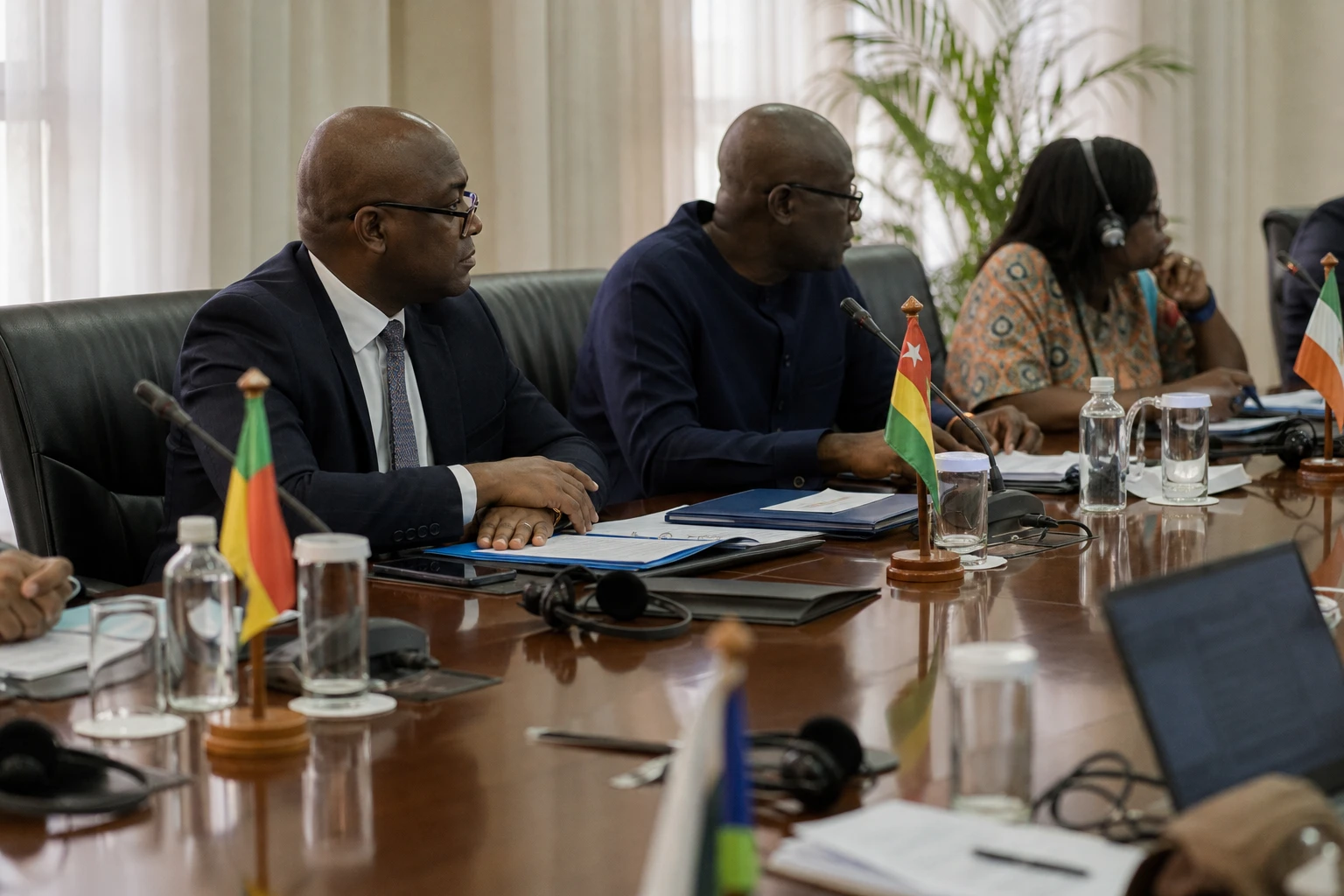
A film shoot can quickly become a test of sovereignty
In Togo, a simple location scout can turn into a matter of state. That is what the provisional release of two French directors, Gaël Mocaër and Sebastian Perez Pezzani, and their Togolese collaborator Fred Vedomey illustrates. They were arrested on 27 July in the north of the country while working on an episode of a documentary series broadcast by France Télévisions. The authorities accuse them of making “false declarations”, a charge their defence contests. AP RSF
The incident comes in a country where an administrative framework governing film shoots is firmly in place. Togo’s Ministry of Tourism, Culture and the Arts notes, in particular, that filmmakers can apply for permission to film and take pictures through the relevant public services in Lomé. This matters because it shows that, beyond the media shock, the case also concerns how the Togolese state controls images produced on its territory. Togolese public service Togolese Ministry of Tourism, Culture and the Arts
What the proceedings say, and what the context says
According to information reported by the Associated Press and Reporters Without Borders, the three men were arrested in northern Togo and then remanded in custody before being granted provisional release in early September. Sebastian Perez Pezzani had already been released earlier under judicial supervision on health grounds, with his passport confiscated. The exact conditions of the new measure have not yet been made public. AP RSF
In Togo, the case is part of a broader period of heightened vigilance around information and the public sphere. In June 2025, the High Authority for Audiovisual and Communication suspended France 24 and RFI for three months, citing shortcomings in their coverage of demonstrations. That precedent, widely discussed in Lomé and across the sub-region, has reinforced the perception that the Togolese authorities are closely monitoring content they consider sensitive. TV5MONDE
Northern Togo is not a neutral backdrop. It is a tense area that has faced incursions by armed men for several years and security risks that have prompted the state to strengthen its presence. In this context, the use of a drone, mentioned by the courts according to initial information reported by the international press, may be seen by the authorities as a matter of national security as much as a documentary issue. AP
A case that involves more than three people
For the families, the immediate concern is human: seeing proceedings that have lasted more than a month ease. For journalists, producers and Togolese fixers, the stakes are broader. They concern working conditions, the safety of crews and the need to plan for permits in a country where even the smallest administrative misstep can lead to legal proceedings. The presence of a Togolese collaborator in the case is also a reminder that in West Africa, the consequences of such a case do not fall only on foreigners, but also on the local professionals who make film shoots possible. Togolese public service Togolese Ministry of Tourism, Culture and the Arts
Togo, governed from Lomé by Faure Gnassingbé, remains a state where political communication, internal security and control of the public narrative are closely linked. The country is still among the lowest-ranked in West Africa in Reporters Without Borders’ 2025 index, placing 121st out of 180 countries. Although it rose to 97th place in 2026, the message remains clear: press freedom there depends heavily on the political climate. RSF
What West Africa is watching in this case
At regional level, this provisional release raises a very practical question: how can security, the movement of journalists and cultural appeal be reconciled? In a West Africa shaped by jihadist threats in the Sahel, political tensions and the growth of local audiovisual production, states are seeking to protect their symbolic as well as their physical borders. The Togolese case shows that a country can seek to regulate filming without turning every permit into grounds for automatic suspicion. AP RSF
The continental significance is clear. Togo, like other African states, is seeking to balance sovereignty, security and openness to outside perspectives. The episode is a reminder that producing images is never an innocuous act on the continent: it involves rules, perceptions and sometimes diplomatic power struggles. In Lomé, what happens next will depend above all on the exact conditions of the provisional release, how the proceedings develop and how the authorities treat film crews coming to document the country in future. Togolese Ministry of Tourism, Culture and the Arts RSF