Algeria
 Egypt
 Libya
 Morocco
 Sudan
 Tunisia
 Benin
 Burkina Faso
 Cabo Verde
 Côte d'Ivoire
 Ghana
 Guinea
 Guinea-Bissau
 Liberia
 Mali
 Mauritania
 Niger
 Nigeria
 Senegal
 Sierra Leone
 The Gambia
 Cameroon
 Central African Republic
 Chad
 DR Congo
 Equatorial Guinea
 Gabon
 Republic of the Congo
 São Tomé and Príncipe
 Burundi
 Comoros
 Djibouti
 Eritrea
 Ethiopia
 Kenya
 Madagascar
 Malawi
 Mauritius
 Mozambique
 Rwanda
 Seychelles
 Somalia
 South Sudan
 Tanzania
 Uganda
 Angola
 Botswana
 Eswatini
 Lesotho
 Namibia
 South Africa
 Zambia
 Zimbabwe
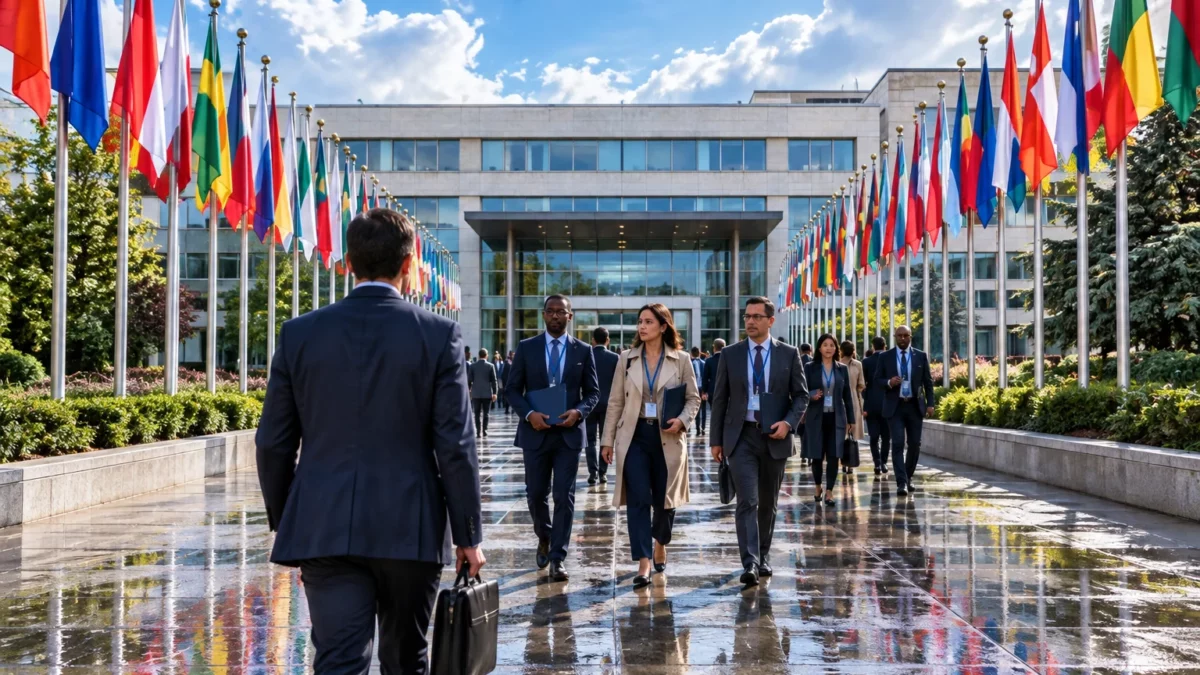
For Togolese workers, as for millions of other employees, the International Labour Organization (ILO) is a forum where rules on work, social protection and dialogue between trade unions, employers and states are discussed. Gilbert Houngbo’s reappointment to its helm gives Togo a familiar voice at the top of the institution, but it also comes amid trade union disagreements and financial constraints.
A renewed term in Geneva
On 16 November 2026, the ILO Governing Body re-elected Gilbert Houngbo for a second five-year term. The Togolese leader received 51 votes out of 56; five members abstained. His new term will begin on 1 October 2027 and end in 2032.
The vote took place in Geneva during the Governing Body’s 358th session. The body includes representatives of governments, workers and employers. This tripartite composition sets the ILO apart from other United Nations agencies: the social partners take part in discussions on labour standards and policies.
Gilbert Houngbo was the only candidate in the running at the time of the vote. Spain’s Labour Minister, Yolanda Díaz Pérez, withdrew her candidacy on the day of the vote. She said she wanted to avoid dividing the international trade union movement and challenged the way some trade union leaders had supported her rival. Peru’s Javier González-Olaechea Franco had already left the race.
The 51 votes represent clear support for the Togolese candidate within the Governing Body. However, the absence of a rival at the time of the vote is not, in itself, grounds for concluding that there is consensus across the trade union movement. Ms Díaz’s withdrawal made visible differences over workers’ representation and the organisation’s governance.
A central institution under financial pressure
Founded in 1919, the ILO has 187 member states. It promotes rights at work, decent employment, social protection and negotiation between workers and employers. Its conventions serve as benchmarks, but their implementation is then dependent on states and national oversight mechanisms.
The campaign took place as the organisation faced budgetary pressures. A fall in external funding, particularly from the United States, has prompted consideration of savings and staffing adjustments. Yolanda Díaz described the situation as a particularly serious financial crisis. This is her assessment; it is not, in itself, an independent financial assessment.
The challenge for the ILO is tangible: to preserve its programmes and expertise while its resources are under pressure. The consequences could affect the organisation’s teams and projects carried out with its members, including those that support labour inspection, vocational training and social dialogue. Budget documents and Governing Body decisions will make it possible to assess the scale of the adjustments more precisely.
What the reappointment means for Togo
A former prime minister of Togo from 2008 to 2012, Gilbert Houngbo has led the ILO since October 2022. His reappointment extends the presence of a Togolese leader at the head of a major multilateral institution. It is a source of diplomatic visibility, but no automatic guarantee of economic or social benefits for the Togolese population.
In Lomé, employment issues play out across diverse realities: public and private sector jobs, agricultural work, formal businesses and the informal economy. International standards have an impact only when translated into national policies, accessible oversight and genuine dialogue between trade unions, employers and authorities. The ILO presidency therefore does not replace decisions taken in Togo.
The regional significance nevertheless extends beyond Togo’s borders. In West Africa, where states cooperate notably within ECOWAS, debates over youth employment, workers’ protection and labour mobility concern several interconnected economies. The ILO can provide common frameworks and expertise; adapting them remains the responsibility of each country’s governments and social partners.
Technology, employment and social dialogue
After his re-election, Gilbert Houngbo highlighted, among other things, the effects of artificial intelligence on work. These tools can transform tasks, the skills in demand and the way businesses are organised. But their effects vary across sectors and workers: some occupations are changing, while others may be weakened or require new training.
The question goes beyond access to technology. It also concerns the distribution of productivity gains, the quality of jobs and the protection of people whose roles are changing. In economies where informal employment accounts for a significant share of work, responses cannot be limited to employees of large companies. Self-employed workers and small businesses also need appropriate support.
The director-general has argued that technological progress must remain at the service of humanity. What happens next will depend on the ILO’s practical work and the ability of its three constituencies to negotiate acceptable rules. In his second term, Gilbert Houngbo will therefore have to pursue two priorities: maintaining the organisation’s work despite its funding constraints, and making the technological transition a subject of dialogue between states, workers and employers.
For Togo and its West African partners, the challenge will be to track how these priorities are reflected in the organisation’s programmes and standards. The reappointment ensures continuity at its helm; it resolves neither the disagreements voiced during the campaign nor the policy choices that will determine working conditions in each country.