Algeria
 Egypt
 Libya
 Morocco
 Sudan
 Tunisia
 Benin
 Burkina Faso
 Cabo Verde
 Côte d'Ivoire
 Ghana
 Guinea
 Guinea-Bissau
 Liberia
 Mali
 Mauritania
 Niger
 Nigeria
 Senegal
 Sierra Leone
 The Gambia
 Cameroon
 Central African Republic
 Chad
 DR Congo
 Equatorial Guinea
 Gabon
 Republic of the Congo
 São Tomé and Príncipe
 Burundi
 Comoros
 Djibouti
 Eritrea
 Ethiopia
 Kenya
 Madagascar
 Malawi
 Mauritius
 Mozambique
 Rwanda
 Seychelles
 Somalia
 South Sudan
 Tanzania
 Uganda
 Angola
 Botswana
 Eswatini
 Lesotho
 Namibia
 South Africa
 Zambia
 Zimbabwe
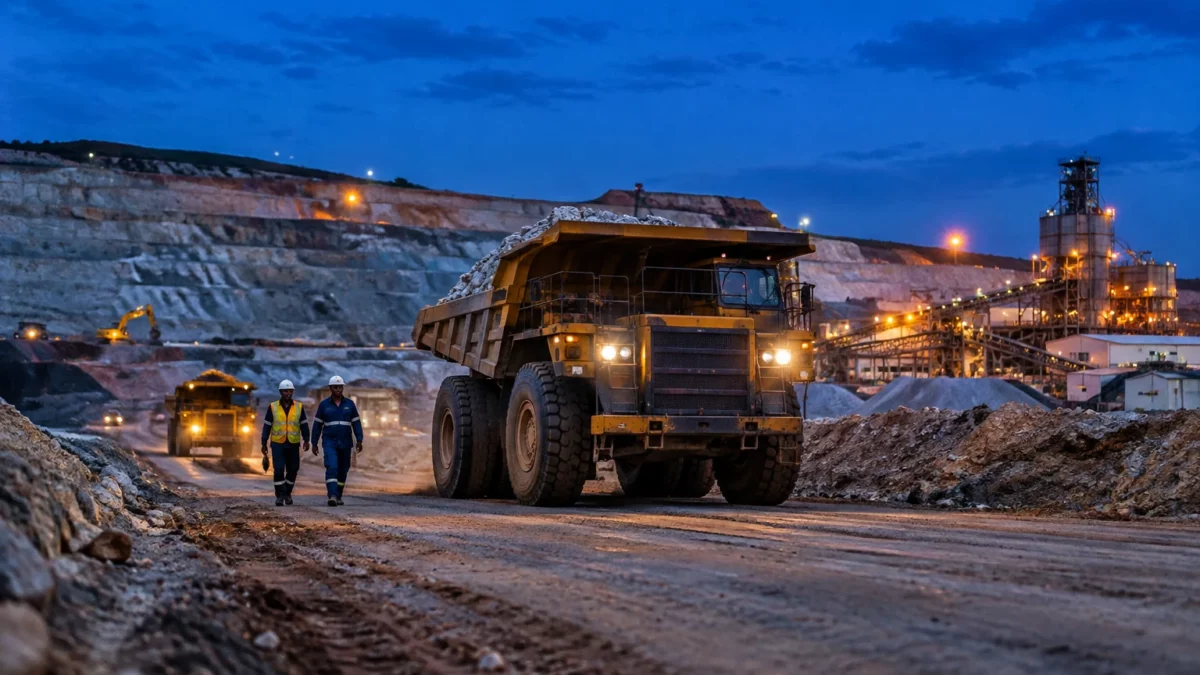
Can a 20.9% year-on-year rise transform the weight of mining in the Togolese economy? The rebound is marked, but the sector remains modest in terms of gross domestic product. And value added alone does not show how much the state collects or what households gain from it.
A rebound in a growing economy
In the second quarter of 2026, the Togolese economy grew by 6.8% year on year, according to quarterly national accounts from the National Institute of Statistics and Economic and Demographic Studies (INSEED). The extractive industries grew by 20.9%, after a decline of 0.8% in the same quarter of 2025. These figures appear in INSEED’s publication, available on its quarterly national accounts portal. Another Togolese source, République Togolaise, also reports the extractive industries’ growth rate.
The rebound contributed to growth of 7.5% in the secondary sector, which includes industry and construction. Extractive industries nevertheless account for 1.2% of real GDP and added 0.3 percentage points to quarterly growth, according to the accounts cited by INSEED. Their strong growth does not therefore mean they have become the main driver of the economy.
In volume terms, the sector’s value added reached 20.8 billion CFA francs in the second quarter, compared with 17.2 billion a year earlier. It remains below the 25.2 billion recorded in the first quarter of 2026 and the 28 billion in the final quarter of 2025. The annual increase compares two corresponding periods; it does not mean activity continued to rise from one quarter to the next.
Phosphate, limestone and clinker: concentrated production
Togo’s exploited mineral resources mainly yield phosphate, limestone and clinker, an intermediate material used to make cement. The 2023 Togo EITI report records production that year of 1,517,448 tonnes of phosphate, 2,936,152 tonnes of limestone and 1,307,590 tonnes of clinker. These figures are published by the Extractive Industries Transparency Initiative in Togo and also appear in the report hosted by the international EITI.
The Société nouvelle des phosphates du Togo (SNPT) and SCANTOGO Mines together accounted for more than 97% of total declared contributions from the extractive sector in 2023, Togo EITI says. This concentration gives a small number of companies significant weight in revenue from mining activities. It also makes the sector’s results sensitive to their production levels, sales and payments to government bodies.
The indicators must, however, be distinguished. Value added measured by INSEED represents the wealth created by a sector, in volume terms and at constant prices. It is neither the value of exports nor tax revenue, and is not a measure of wages or employment. The quarterly increase alone therefore does not allow us to conclude that public finances or workers’ incomes rose by the same proportions.
The challenge of local processing
The contrast with the manufacture of construction materials is notable: this sector contracted by 5% in the second quarter of 2026, according to data reported by INSEED. Extraction can therefore gain ground while some activities further along the processing chain slow. This divergence is a reminder that producing more raw materials does not automatically ensure a more dynamic local industry.
For mining companies, the quarterly result signals a recovery in activity compared with the previous year. For the state, communities in mining areas and workers, the question is different: what share of this activity translates into public revenue, lasting jobs and purchases from Togolese suppliers? Growth data do not answer these questions. EITI reports, which reconcile company and government disclosures, are a complementary tool for tracking declared financial flows.
The simultaneous decline in construction materials does not prove that extracted raw materials are exported without processing. Rather, it highlights the need to track volumes, exports, revenue and manufacturing output separately. This is the scale at which the economic benefits beyond industrial sites can be assessed, particularly for formal businesses and small firms supplying goods and services.
A national and West African issue
In Togo, a coastal West African country whose capital is Lomé, mining is part of an economy in which extractive activities remain a limited component of GDP, despite occasional growth. The concentration of contributions and decline in some manufacturing activities show that growth in one sector does not automatically spread across the productive economy.
The regional dimension also matters. Togo is a member of ECOWAS, the Economic Community of West African States, and shares markets, transport corridors and trade in materials with its neighbours. Clinker produced in the country can supply cement-related value chains across borders; the true scale of these exchanges nevertheless depends on sales, destinations and processing capacity, which value-added figures alone do not detail.
In the next quarterly accounts, extractive industries will therefore need to be tracked alongside exports, budget revenue and the manufacture of processed products. The next EITI report will provide another perspective on declared flows and their concentration. These indicators will help distinguish a simple rebound in activity from a more lasting change in the economic benefits for Togo.