Algeria
 Egypt
 Libya
 Morocco
 Sudan
 Tunisia
 Benin
 Burkina Faso
 Cabo Verde
 Côte d'Ivoire
 Ghana
 Guinea
 Guinea-Bissau
 Liberia
 Mali
 Mauritania
 Niger
 Nigeria
 Senegal
 Sierra Leone
 The Gambia
 Cameroon
 Central African Republic
 Chad
 DR Congo
 Equatorial Guinea
 Gabon
 Republic of the Congo
 São Tomé and Príncipe
 Burundi
 Comoros
 Djibouti
 Eritrea
 Ethiopia
 Kenya
 Madagascar
 Malawi
 Mauritius
 Mozambique
 Rwanda
 Seychelles
 Somalia
 South Sudan
 Tanzania
 Uganda
 Angola
 Botswana
 Eswatini
 Lesotho
 Namibia
 South Africa
 Zambia
 Zimbabwe
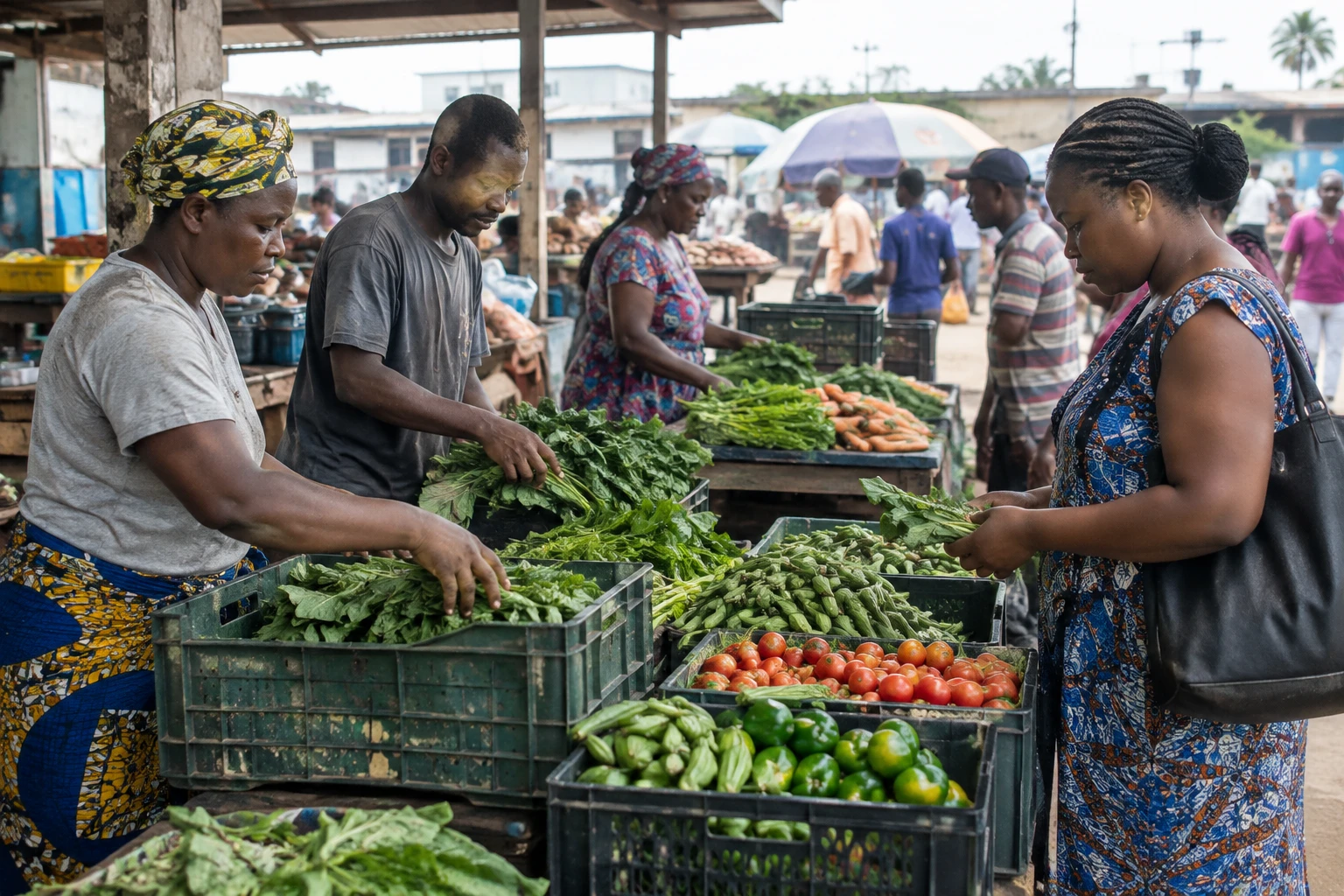
In Lomé, agriculture is not just about the volume of harvests. For Togolese producers, the challenge is also to secure water, access equipment and finance, and then sell and process their crops in better conditions. It is at this practical level that Togo will have to translate the African Union’s agricultural goals into action.
Continental pledges to be put into practice in Togo
Adopted in January 2025 in Kampala, Uganda, the Declaration of the Comprehensive Africa Agriculture Development Programme (CAADP) sets the continental framework for 2026-2035. The African Union programme aims to transform agrifood systems, from production through to trade. Its goals include increasing African agrifood production by 45%, tripling intra-African trade in agricultural products and halving post-harvest losses by 2035.
These shared goals do not relieve each country of the need to define its priorities and resources. In West Africa, where agricultural value chains and markets cross borders, results will also depend on infrastructure, trade rules and co-operation between states. Togo, a member of the Economic Community of West African States (ECOWAS), must therefore align its national policy with trade and regional challenges.
In Lomé, a high-level mission from the African Union Commission brought together Togolese authorities and representatives of the organisation to discuss the implementation of CAADP. Official Togolese information dates the talks from 20 to 22 October 2026; the Ministry of Agriculture says the mission ran from 19 to 23 October. Discussions focus on productivity, food security, climate resilience and the sustainable management of natural resources.
Funding equipment — and access to it
The government intends to draw on the Programme for the Modernisation of Agriculture in Togo (ProMAT), adopted in March 2025 for the 2025-2034 period, according to the Ministry of Agriculture. It is intended to support production, the resilience of farms, the value of agricultural products and access to finance. The Lomé mission is therefore seeking to bring continental pledges closer to existing national programmes.
Regional funding gives an indication of the resources being mobilised. In June 2026, the West African Development Bank (BOAD) approved CFA francs 40bn for the second phase of the Programme to Support Agricultural Mechanisation and Irrigation (ProMAI). This brings the total approved for the programme to CFA francs 60bn, following an initial CFA francs 20bn phase in October 2025. ProMAI is a specific mechanisation and irrigation scheme, not ProMAT, the broader national programme.
This distinction matters: announced funding does not, by itself, mean equipment is available to every farm. Results will depend on the deployment of machinery and services, maintenance, producers’ access to regional centres and financing terms. For small farms, irrigation can reduce dependence on rainfall — provided infrastructure is suitable and accessible. Mechanisation can increase working capacity, but its effect on incomes also depends on costs and market access.
Dindiogue Konlani, chief of staff at the ministry responsible for agriculture, called on non-state actors to move, in remarks reported during the talks, “from a logic of co-operation to a logic of co-construction and co-investment”. This approach involves producers, professional organisations and businesses. It also raises a practical question: who decides on investments, who bears the risks and how do the benefits reach farmers, particularly women and young people?
From harvest to regional markets
Production alone is not enough to guarantee food security. Storage, processing and transport determine what reaches markets and how much value is retained in the country. Reducing post-harvest losses therefore requires investment to complement irrigation and agricultural equipment. This concerns rural producers, but also processors, traders and consumers in urban centres, including Lomé.
At regional level, agricultural trade can widen market opportunities, provided infrastructure and rules genuinely facilitate the movement of goods. The African Continental Free Trade Area (AfCFTA), which aims to develop trade between African countries, provides a framework for this ambition. But tripling intra-African trade will not automatically translate into higher incomes: the ability to process locally, meet standards and transport harvests will also weigh in the balance.
The Kampala Declaration thus takes up a shared challenge without overlooking the differences between African economies. For Togo, the process launched in Lomé will have to lead to funded national priorities, clearly assigned responsibilities and indicators for assessing progress. The mission’s talks are a milestone, not proof that the goals have already been achieved.
Monitoring will focus on the implementation of ProMAT and related programmes: equipment that is genuinely accessible, water management, changes in post-harvest losses and producers’ opportunities to sell their crops. Ultimately, the credibility of the continental agenda will be measured less by declarations than by observable changes on farms, in processing value chains and in trade between West African countries.