Algeria
 Libya
 Morocco
 Sudan
 Tunisia
 Benin
 Burkina Faso
 Cabo Verde
 Côte d'Ivoire
 Ghana
 Guinea
 Guinea-Bissau
 Liberia
 Mali
 Mauritania
 Niger
 Nigeria
 Senegal
 Sierra Leone
 The Gambia
 Togo
 Cameroon
 Central African Republic
 Chad
 DR Congo
 Equatorial Guinea
 Gabon
 Republic of the Congo
 São Tomé and Príncipe
 Burundi
 Comoros
 Djibouti
 Eritrea
 Ethiopia
 Kenya
 Madagascar
 Malawi
 Mauritius
 Mozambique
 Rwanda
 Seychelles
 Somalia
 South Sudan
 Tanzania
 Uganda
 Angola
 Botswana
 Eswatini
 Lesotho
 Namibia
 South Africa
 Zambia
 Zimbabwe
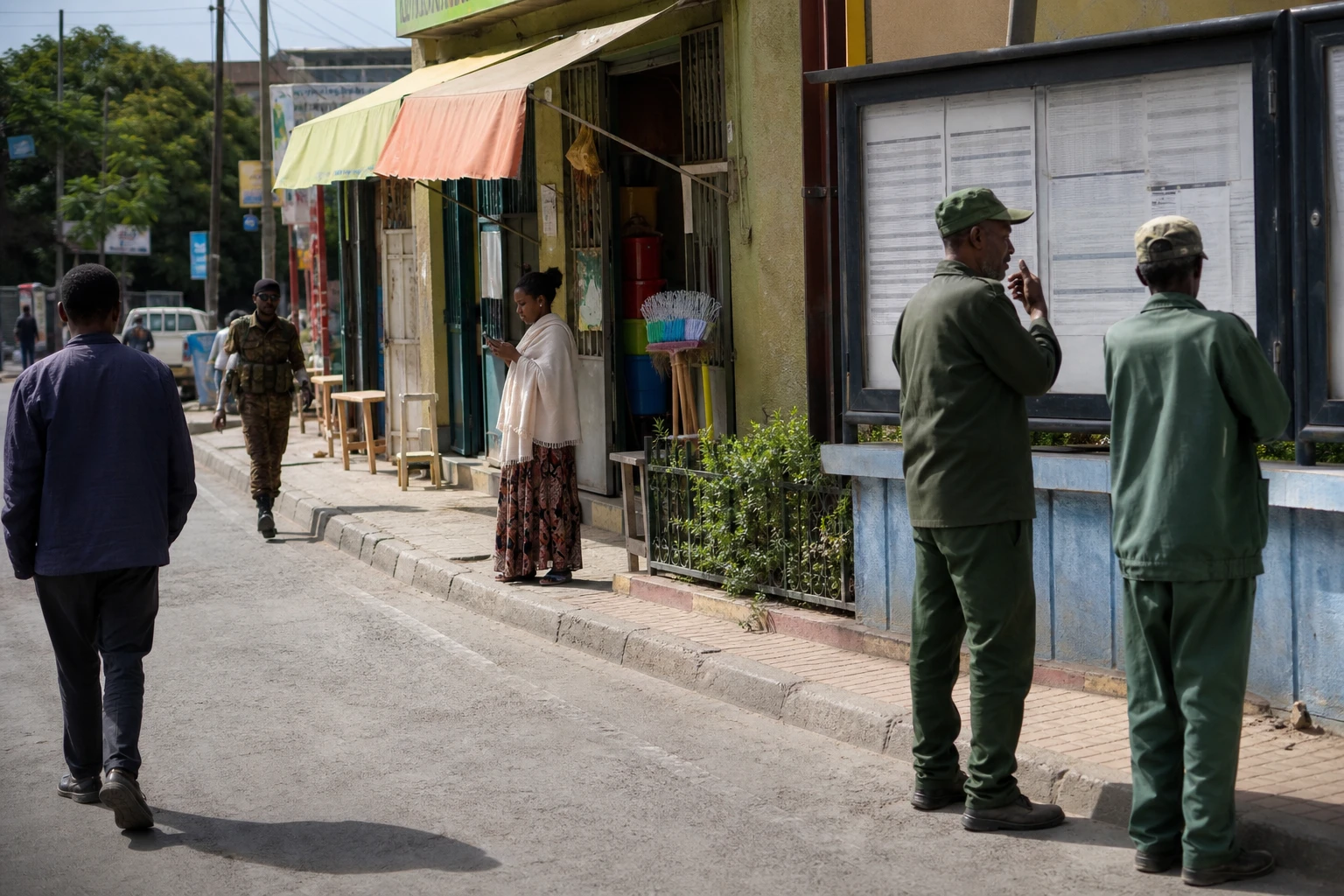
The return of Ethiopian federal forces to Mekelle has not brought the Tigray crisis to an end. Instead, it has shifted the centre of gravity from an internal conflict towards a regional confrontation in a Horn of Africa already riven by tensions over the Nile, the Red Sea and Sudan.
A recaptured capital, but control remains fragile
On Saturday 3 October 2026, Ethiopian federal forces and their allies in the Tigray Peace Force entered Mekelle, the capital of the Tigray region. The Tigray People’s Liberation Front, or TPLF, had announced the withdrawal of its fighters and officials from the city.
The following day, federal troops were patrolling the main thoroughfares. Tigrayan fighters who had sided with the government were guarding several public buildings. However, reports remained difficult to verify. Telecommunications had been severely disrupted since the fighting resumed.
Mekelle was taken after the recapture of Alula Aba Nega airport. Residents quoted by the Associated Press confirmed federal control of the facility, while highlighting uncertainty over the exact circumstances of its change of hands. Commercial flights to Mekelle, Aksum and Shire had been suspended.
Economic activity in the city was sluggish. Several shops remained closed. Residents had moved their goods to safety after reports of looting during a period when no clearly identified security force was in control of the streets.
Tigrayan authorities said they had not given up the fight. They described the move of their structures out of Mekelle as temporary. This announcement suggests that losing the regional capital may amount to an operational retreat rather than a surrender.
A conflict reignited despite the Pretoria agreement
Fighting resumed in northern Ethiopia from 23 September, after several months of political tensions. The TPLF had taken the initiative in several areas of Tigray and neighbouring regions. Federal forces then launched a counter-offensive with the support of the Tigray Peace Force, a breakaway Tigrayan faction backing the government in Addis Ababa.
This latest phase revives memories of the war from November 2020 to November 2022. The conflict pitted the federal government against the TPLF, which then dominated Tigray’s institutions. The agreement signed in Pretoria, South Africa, reduced the intensity of the fighting without resolving all questions of power, security and territorial administration.
The disagreement concerns, in particular, regional authority, the return of displaced people and the status of territories disputed with Amhara. It also reflects the deteriorating relationship between the TPLF and Prime Minister Abiy Ahmed. The battle for Mekelle is therefore about more than military matters. It affects the balance of Ethiopia’s federation.
The consequences vary from one area to another. In the regional capital, people are first seeking to restore functioning services, communications and normal movement. In rural areas, troop movements and shifts in alliances can disrupt access to markets, healthcare and farmland.
Mutual accusations widen the diplomatic front
Ethiopia’s chief of staff accused Eritrea, Egypt and the Sudanese Armed Forces of supporting the federal government’s opponents. The governments accused rejected the allegations. In the absence of publicly available evidence establishing the full extent of any such support, these statements should be regarded as positions taken in wartime and diplomacy.
The most sensitive tension involves Eritrea. The two countries have already fought an open war between 1998 and 2000. Their rapprochement, which began after Abiy Ahmed came to power in 2018, has gradually unravelled. The prospect of Ethiopian access to the Red Sea is now fuelling deep mistrust between Addis Ababa and Asmara.
On 1 October, Ethiopia ordered the expulsion of ten Eritrean diplomats and closed its embassy in Asmara. Eritrea announced a reciprocal measure. The diplomatic rupture comes as explosions have been reported in Addis Ababa and federal forces advance in Tigray. No public link between these events has been established.
Relations with Egypt are also shaped by the dispute over the Grand Ethiopian Renaissance Dam. For Cairo, management of the Nile’s flow is a major national concern. For Ethiopia, the dam is a central project for electricity generation and development. This dispute over water feeds into security calculations around Tigray and the Red Sea.
Sudan and Somalia feature in regional calculations
The war in Sudan adds another source of tension. Since April 2023, the Sudanese Armed Forces have been fighting the Rapid Support Forces. Addis Ababa has been accused of serving as a hub for some networks linked to the paramilitaries. The Ethiopian government disputes this interpretation and, in turn, accuses neighbouring actors of arming its adversaries.
Somalia is also watching the crisis with concern. The rapprochement between Ethiopia and Somaliland, a territory that has claimed independence since 1991, has strained relations between Addis Ababa and Mogadishu. The question of Ethiopian access to the sea adds a strategic dimension to the dispute.
On 4 October, the leaders of Egypt, Eritrea, Somalia and Sudan met in El-Alamein, Egypt. Their joint statement emphasised sovereignty, territorial integrity and non-interference. It also rejected unilateral measures that could affect the water interests of Egypt and Sudan.
At this stage, the meeting does not amount to a formal military alliance against Ethiopia. However, it reveals political alignment among several states concerned about Addis Ababa’s course. The summit took place as federal forces were consolidating their presence in Mekelle, giving it added significance.
The next battle will also be political
For Ethiopia, retaking Mekelle may temporarily strengthen the federal government’s authority. But holding a regional capital is not enough to stabilise Tigray. The government will need to restore services, guarantee the safety of civilians and clarify the role of rival administrations.
The TPLF retains a significant political and military presence. Its withdrawal may allow it to avoid the destruction of the city while maintaining the capacity to operate in rural areas. The risk is a prolonged war, marked by shifting positions, communications blackouts and allegations that are difficult to verify.
The African Union, headquartered in Addis Ababa, has called for restraint and de-escalation. It has a direct interest in preserving the Pretoria agreement. The Intergovernmental Authority on Development, the regional organisation for the Horn of Africa, could also be called upon if tensions spill beyond Ethiopia’s borders.
The coming days will be decisive. Key issues to watch will include the lasting restoration of communications, the resumption of commercial activity, movements around the borders with Eritrea and Sudan, and the course of diplomatic contacts. In Mekelle, the question is no longer simply who controls the city. It is now whether its capture will lead to negotiations or a new phase of war.