Algeria
 Egypt
 Libya
 Morocco
 Sudan
 Tunisia
 Benin
 Cabo Verde
 Côte d'Ivoire
 Ghana
 Guinea
 Guinea-Bissau
 Liberia
 Mali
 Mauritania
 Niger
 Nigeria
 Senegal
 Sierra Leone
 The Gambia
 Togo
 Cameroon
 Central African Republic
 Chad
 DR Congo
 Equatorial Guinea
 Gabon
 Republic of the Congo
 São Tomé and Príncipe
 Burundi
 Comoros
 Djibouti
 Eritrea
 Ethiopia
 Kenya
 Madagascar
 Malawi
 Mauritius
 Mozambique
 Rwanda
 Seychelles
 Somalia
 South Sudan
 Tanzania
 Uganda
 Angola
 Botswana
 Eswatini
 Lesotho
 Namibia
 South Africa
 Zambia
 Zimbabwe
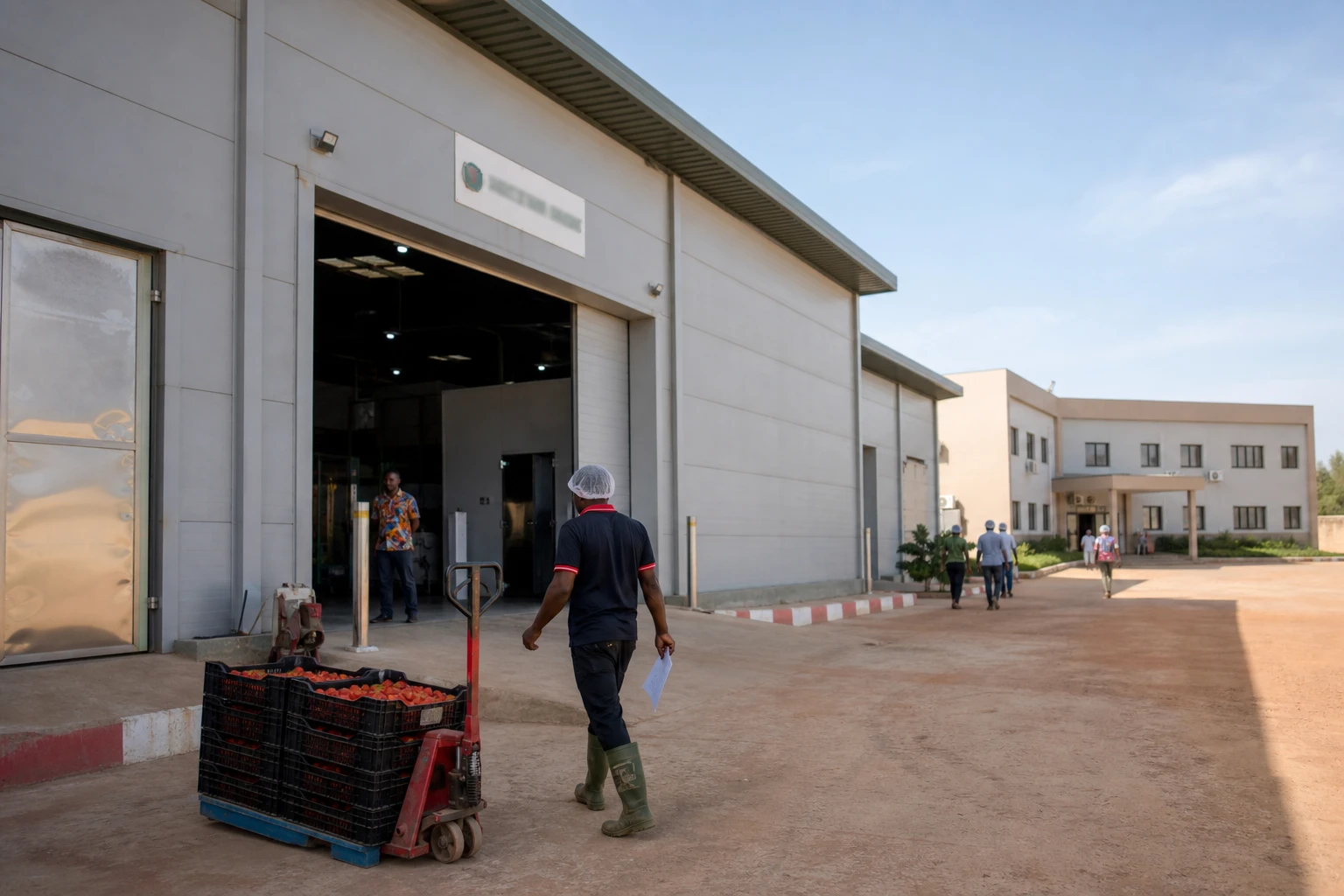
Another plant, but above all a supply chain to secure
In Tenkodogo, in the Nakambé region, the issue goes beyond the arrival of machinery at an industrial site. What is at stake is Burkina Faso’s ability to retain more value from its own agricultural production, rather than allowing some of its harvests to go to external markets or through long, costly supply chains.
Tomatoes are a staple in Burkinabè kitchens, but they are also a strategic product for the local economy. When processing takes place locally, it supports farmers, transporters, handlers, traders and service jobs around industrial sites. The Tenkodogo project fits into this approach, and has been presented as another building block in the agricultural industrialisation sought by the authorities.
An advanced project, following Bobo-Dioulasso and Yako
The project of the Agency for the Promotion of Community Entrepreneurship, or APEC, has been billed as the second agro-food unit directly backed by the organisation, after the Société burkinabè de tomates, SOBTO, in Bobo-Dioulasso. APEC also describes the Tenkodogo plant as the country’s third major tomato plant to open recently, after SOBTO and the Société Faso Tomates, SOFATO, in Yako, inaugurated on 16 December 2024.
The Tenkodogo site is located in Pédogo. Logistically, this matters. The centre of the country does not serve the same purpose as the productive west or the north, which is closer to certain trade routes. By establishing a unit in Nakambé, APEC is also seeking to bring processing closer to production areas and expand the industrial footprint beyond the usual hubs. The organisation says the project has reached what it considers a satisfactory level of progress.
In January 2026, the government reported that the project was 70% complete and that machinery was due to be installed in March 2026. The equipment is now in place, and the first technical trials are expected around mid-September 2026, according to the latest information made public by APEC. This shift in the timetable confirms that work is progressing, but behind the initial announcements.
Project figures and what they say about Burkina Faso’s strategy
The investment is valued at 7.5 billion CFA francs. The site covers three hectares and includes an industrial platform, storage facilities, technical premises, an administrative block and a maintenance workshop. This is therefore not simply a packaging workshop, but infrastructure designed to perform several industrial functions at once.
At this stage, APEC has not disclosed Tenkodogo’s daily capacity. This leaves a significant degree of uncertainty. In Bobo-Dioulasso, SOBTO says it produces 100 tonnes of tomato paste a day. In Yako, SOFATO claims the same processing capacity. This comparison gives an indication of the scale being targeted, but also shows that Tenkodogo will still have to prove its real weight in the supply chain.
The industrial timetable comes with an agricultural one. APEC says it will need more fresh tomatoes from the first week of November 2026. In other words, the project’s success will depend less on the installation of machinery alone than on organising upstream supply: seeds, irrigation, collection, transport, storage and consistent volumes. Without this chain, a plant can be brand new and still be under-supplied.
The decision to ban fresh tomato exports changes the equation
On 17 March 2026, Burkina Faso’s trade ministry announced the suspension of fresh tomato exports until further notice. The measure, confirmed by several local and international media outlets, is intended to reserve more produce for the country’s processing plants.
For the authorities, the objective is clear: to prevent factories from running short of raw materials as the industrial supply chain expands. For producers, the signal is more ambiguous. Stronger local demand can secure outlets. But it can also shift the balance of power over prices, especially if industrial buyers impose their own purchasing terms. Supply-chain observers had already noted tensions over the purchase price of fresh tomatoes in March 2026.
In the short term, the measure protects a nascent industrial base. In the medium term, it makes it necessary to build genuine supply-chain governance. Contracts, delivery schedules, strong co-operatives and greater visibility for producers are needed. Otherwise, local processing risks remaining dependent on administrative decisions rather than a stable supply chain.
Expected benefits for Tenkodogo and the country
On the ground, the expected benefits are significant. In an initial phase, more than a hundred young people and women are expected to be recruited. In the longer term, APEC is targeting around 300 direct jobs and nearly 1,000 indirect jobs. These projections remain to be confirmed through actual operations, but they give an indication of the intended impact on the local economy.
For rural areas, the stakes are broader still. A processing plant absorbs surpluses, reduces some post-harvest losses and can encourage the expansion of cultivated areas. But it also demands new discipline: quality, consistency, sorting, logistics and compliance with standards. Farmers are no longer just selling a harvest; they are entering an industrial supply chain.
Burkina Faso is thus seeking to make tomatoes a test of productive sovereignty. The move is part of a broader push for local industrialisation, import substitution and the promotion of “buy local”. It also resonates across West Africa, where agricultural trade between neighbours is substantial, sometimes informal, and often exposed to price fluctuations, restrictions and seasonal shortages. In this context, ECOWAS remains the natural trading framework, even as Burkina Faso now also operates within the political framework of the Alliance of Sahel States, AES, with Mali and Niger.
The next test will therefore be a straightforward one: can the Tenkodogo plant process Burkinabè tomatoes consistently, profitably and sustainably? The answer will say much more than whether a construction project succeeds. It will show whether the country can bring agricultural production, processing industry and the domestic market together within a single economic strategy.