Algeria
 Egypt
 Libya
 Morocco
 Sudan
 Tunisia
 Benin
 Burkina Faso
 Cabo Verde
 Côte d'Ivoire
 Ghana
 Guinea
 Guinea-Bissau
 Mali
 Mauritania
 Niger
 Nigeria
 Senegal
 Sierra Leone
 The Gambia
 Togo
 Cameroon
 Central African Republic
 Chad
 DR Congo
 Equatorial Guinea
 Gabon
 Republic of the Congo
 São Tomé and Príncipe
 Burundi
 Comoros
 Djibouti
 Eritrea
 Ethiopia
 Kenya
 Madagascar
 Malawi
 Mauritius
 Mozambique
 Rwanda
 Seychelles
 Somalia
 South Sudan
 Tanzania
 Uganda
 Angola
 Botswana
 Eswatini
 Lesotho
 Namibia
 South Africa
 Zambia
 Zimbabwe

When a partner withdraws, field programmes often bear the brunt
In Monrovia, Harare, Dar es Salaam or Maputo, a decision taken in Stockholm can quickly raise a simple question: what happens to a health, institutional support or community-building project when its donor leaves? Sweden has begun winding down its bilateral aid strategies with Liberia, Zimbabwe, Tanzania and Mozambique, a move that illustrates the current reshaping of international aid towards Ukraine and European security.
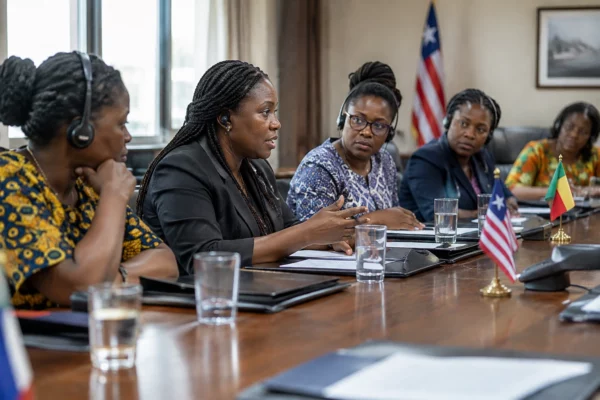
Sweden’s decision is not just about money. It also affects diplomatic presence, political access and the continuity of working relationships between administrations. Unlike multilateral support, bilateral aid often allows for closer dialogue with ministries, local authorities and local organisations. When it is scaled back, the impact can be felt first in capital cities, then in districts, hospitals, women’s associations or oversight bodies.
Stockholm reshuffles its priorities, with tangible consequences for Africa
The decision was announced by the Swedish government in early December 2025, then confirmed in communications from the embassies and Sida, the public agency responsible for aid. The timetable is clear: bilateral cooperation must be fully ended by 31 August 2026 at the latest for the four African countries concerned and for Bolivia. Sweden says humanitarian aid and multilateral channels are not affected by this withdrawal phase.
The Stockholm government justifies this shift on two grounds. First, it is reducing the number of bilateral strategies. Second, security needs are becoming more pressing in its immediate neighbourhood. The Swedish government also says it wants to free up more resources for Ukraine, now its top foreign policy and budgetary priority. According to its own figures, Swedish aid to Ukraine is set to reach at least 10 billion kronor in 2026.
For Liberia and Zimbabwe, the withdrawal is even more significant. Sweden has decided to close its embassies in Monrovia and Harare. Operations at the missions are to cease completely by the end of October 2026, following a gradual phase-out of programmes by 31 August. The two embassies also served as regional missions: Monrovia was also responsible for Sierra Leone, while Harare covered Malawi and Mauritius.
Another signal from an aid system under pressure
The withdrawal comes at a time when several donor countries are cutting or redirecting their budgets. Sweden is not the only country making tougher choices. But its decision matters because Stockholm had built a lasting reputation in sensitive sectors including governance, women’s rights, sexual and reproductive health, institutional support, resource management and post-crisis reconstruction. In its public cooperation portfolio, Sida notes that humanitarian aid remains separate from the bilateral strategies being closed.
In Liberia, the move carries considerable symbolic weight. Sweden’s presence there goes back a long way and supported stages of reconstruction after the civil war and later the Ebola epidemic. Open data on Swedish aid show that funding covered a range of programmes, from public finance reform to support for the representation of people with disabilities, as well as initiatives related to sexual and reproductive rights. This continuity helps explain why the departure is seen as more than a simple budget cut: it marks the end of a working relationship built over several years.
The issue is particularly sensitive in social sectors. Civil society actors and development observers warn that a sudden cut could undermine funding chains in health, local governance or women’s rights. This is especially true in countries with limited fiscal room, where several donors are already adjusting their commitments. In Zimbabwe, for example, US health aid also contracted in 2026, illustrating the accumulated fragility of some sectors.
What this means for the countries concerned, and what Africa should watch
For the governments of Liberia, Zimbabwe, Tanzania and Mozambique, the challenge is twofold. First, they must absorb the loss of targeted funding. They must also ensure that a bilateral exit does not disrupt technical aspects of programmes already under way. In practice, this means finding other partners, strengthening domestic tax mobilisation and securing projects that depended on recurring support. The transition will vary by country: in Mozambique, Sweden says it will maintain its humanitarian aid; in Tanzania, the embassy will remain open but with a changed remit; in Zimbabwe, the embassy closure will reduce Sweden’s permanent presence.
The impact is not the same for all actors. Governments lose a dialogue partner and a funder. NGOs and local organisations sometimes lose flexible support that can be difficult to replace in the short term. In rural areas, where access to public services often depends on a combination of the state, donors and associations, the end of a programme can be felt sooner than in the capital. By contrast, private-sector actors focused on trade or investment may benefit from diplomacy shifting towards commercial ties rather than traditional cooperation, as several Swedish communications suggest.
Ultimately, the debate extends beyond the four countries concerned. It raises a very practical pan-African question: how can useful cooperation be preserved when donors reorganise their priorities in response to their own urgent needs? The answer will probably depend more on regional frameworks, blended finance, African development banks and stronger national strategies. In the region, the next developments to watch are the actual closure of the Swedish embassies, the winding down of former programmes by the end of August 2026, and the ability of African partners to turn an ending bilateral relationship into commercial, diplomatic or multilateral cooperation.