Algeria
 Egypt
 Libya
 Morocco
 Sudan
 Tunisia
 Benin
 Burkina Faso
 Cabo Verde
 Côte d'Ivoire
 Ghana
 Guinea
 Guinea-Bissau
 Mali
 Mauritania
 Niger
 Nigeria
 Senegal
 Sierra Leone
 The Gambia
 Togo
 Cameroon
 Central African Republic
 Chad
 DR Congo
 Equatorial Guinea
 Gabon
 Republic of the Congo
 São Tomé and Príncipe
 Burundi
 Comoros
 Djibouti
 Eritrea
 Ethiopia
 Kenya
 Madagascar
 Malawi
 Mauritius
 Mozambique
 Rwanda
 Seychelles
 Somalia
 South Sudan
 Tanzania
 Uganda
 Angola
 Botswana
 Eswatini
 Lesotho
 Namibia
 South Africa
 Zambia
 Zimbabwe

Liberia wants to turn seismic data and licences into real exploration activity. But off the coast of Monrovia, no commercial discovery has yet confirmed that geological promise can become oil production. The new licensing round marks another step; it guarantees neither drilling nor future revenue.
A new offer in a sector with no production yet
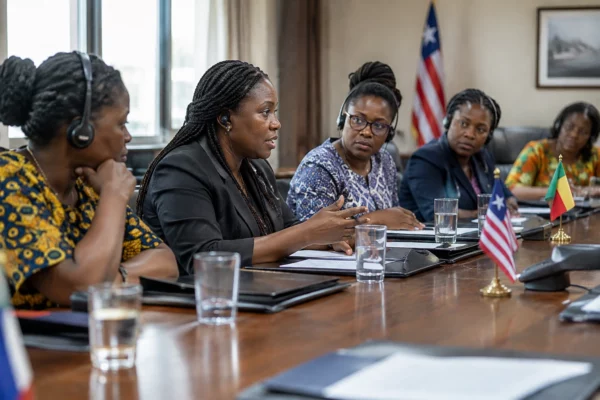
On 14 October 2026, in Cape Town, the Liberia Petroleum Regulatory Authority (LPRA), the body responsible for regulating oil exploration, presented a new negotiation round covering 15 offshore blocks. Interested companies must submit a letter of intent by 15 April 2027. The announcement and deadlines were carried by several specialist publications and APO Group; information available on the LPRA website still relates mainly to the previous round.
Twelve blocks are in the Liberia Basin and three in the Harper Basin, near the maritime border with Côte d’Ivoire. The process is based on direct negotiation: candidates discuss each block with the authorities rather than submitting only competing bids in a conventional auction. Prequalification is to assess, among other things, their financial resources, offshore experience and technical capabilities.
The announced legal framework is based on the 2014 Petroleum Law and its 2019 amendments. The LPRA is highlighting a large body of seismic data, which helps companies map underwater geological structures. This data reduces some uncertainty, but does not prove the presence of an exploitable deposit.
Previous contracts offer an early measure of the stakes
This new round follows the one launched in 2024. In 2025, Liberia signed eight production-sharing contracts, four with TotalEnergies and four with Nigerian company Oranto Petroleum. These agreements set out, among other things, the rules for sharing any eventual production between the state and the companies. The LPRA said Parliament ratified the contracts in December 2025.
TotalEnergies holds blocks LB-06, LB-11, LB-17 and LB-29, covering about 12,700 square kilometres in the southern part of the Liberia Basin. Its work programme provides for a 3D seismic survey. Oranto was awarded blocks LB-15, LB-16, LB-22 and LB-24. The signatures and areas announced for TotalEnergies are also documented by the company itself; they describe exploration licences, not proven reserves or secured production.
The 15 blocks in the new round do not make up the entirety of Liberia’s offshore area. The LPRA presented 29 blocks in the 2024 round; some have since been subject to contracts or other processes. It is therefore important to distinguish the number of blocks offered at a given time from the entire maritime area that could potentially be involved in exploration.
Potential benefits, but still conditional
For the state, the contracts can bring payments and investment commitments even before a discovery. For the eight earlier agreements, the LPRA reported $27 million in signature bonuses and more than $14.6 million in surface rentals. These amounts announced by the regulator should not be confused with sustained revenue from production: that would depend on a commercial discovery, followed by investment and development decisions.
The effects would differ among stakeholders. The central government could collect revenue, while coastal communities could be affected by offshore activities, infrastructure and environmental protection measures. Local companies could benefit from service contracts, but their access would depend on local-content rules and available skills. For households, any increase in public revenue would not automatically mean lower energy costs or improved services.
Block-by-block negotiations can give Liberia room to tailor commitments to the potential and costs of each area. They also make contract transparency, enforcement of obligations and publication of results particularly important. Monitoring should cover the work actually carried out, timelines, payments and environmental commitments, not just the number of blocks awarded.
A Liberian issue in a regional energy landscape
Liberia is moving forward in a region where several coastal countries have already developed oil or gas activities, including Nigeria, Ghana and Côte d’Ivoire. This proximity fuels investor interest, but each basin has its own characteristics: discoveries in neighbouring countries do not predict the results of drilling off Liberia. The Harper Basin, in particular, runs along the Ivorian border, making maritime cooperation and information-sharing useful when operations warrant it.
Within the Economic Community of West African States (ECOWAS), Liberia’s case raises a shared question: how can countries attract capital to the energy sector without reducing economic policy to the export of raw materials? For Monrovia and the coastal regions, the answer will depend on the quality of contracts, the LPRA’s ability to monitor them and the use of any revenue. The next immediate deadline is 15 April 2027, the announced cut-off for letters of intent. After that, the decisive indicator will be the move from negotiations to exploration work, and then, only if successful, to a verified discovery.
Sources consulted: African Energy Week announcement of the 2026 round ; APO Group coverage of the announcement ; LPRA statement on contract ratification ; details of TotalEnergies’ licences ; Liberian Ministry of Information statement on the Oranto contracts ; LPRA overview of the 2024 licensing round.