Algeria
 Egypt
 Libya
 Morocco
 Tunisia
 Benin
 Burkina Faso
 Cabo Verde
 Côte d'Ivoire
 Ghana
 Guinea
 Guinea-Bissau
 Liberia
 Mali
 Mauritania
 Niger
 Nigeria
 Senegal
 Sierra Leone
 The Gambia
 Togo
 Cameroon
 Central African Republic
 Chad
 DR Congo
 Equatorial Guinea
 Gabon
 Republic of the Congo
 São Tomé and Príncipe
 Burundi
 Comoros
 Djibouti
 Eritrea
 Ethiopia
 Kenya
 Madagascar
 Malawi
 Mauritius
 Mozambique
 Rwanda
 Seychelles
 Somalia
 South Sudan
 Tanzania
 Uganda
 Angola
 Botswana
 Eswatini
 Lesotho
 Namibia
 South Africa
 Zambia
 Zimbabwe

In the heart of Kordofan, a road can matter as much as a front line
In central Sudan, a strip of tarmac can change the map of the war. At the end of July, the Sudanese army said it had retaken the Al-Sadarat route between Khartoum and El Obeid, a major logistical artery for reinforcements, fuel and supplies. Behind this corridor lies a city caught in a vice: El Obeid, the capital of North Kordofan, remains a tipping point between the army-controlled east and the west dominated by the Rapid Support Forces, or RSF, a powerful paramilitary force that has become one of the two sides in the war raging since April 2023.
What is at stake in El Obeid goes beyond the local battle. The city commands access to Kordofan and opens the road to Darfur. For the army, retaking this route, sometimes called the “Export road”, means shoring up Khartoum’s defences and reopening a land link to the centre of the country. For the RSF, control of the road has long helped maintain pressure on areas still held by regular forces. IGAD, the regional organisation for the Horn of Africa, warned as early as June of military escalation and drone strikes around El Obeid.
Military gains remain disputed, but their effects are immediate
According to military announcements issued on 26 July, the Sudanese army and its allied forces took control of the Khartoum-El Obeid route after two days of fighting. The clashes involved several localities in North Kordofan, including Bara, Um Sayala and Jabrat al-Sheikh. The same military account describes the recapture of the route as a foothold from which to loosen the siege around El Obeid. Local sources cited by Sudan Tribune also describe a link-up between units advancing from El Obeid and others arriving from west of Omdurman.
At the same time, the RSF have stepped up drone attacks on the city. This pattern is not new. Since June, the United Nations, the Office of the High Commissioner for Human Rights and several humanitarian organisations have reported a sharp increase in strikes on El Obeid and its civilian infrastructure. The office of High Commissioner Volker Türk said on 3 July that 15 drone strikes had been documented between 6 and 28 June, killing at least 45 civilians and injuring 41, a toll the UN said was likely to be an underestimate.
At this stage, the army’s advance should therefore be viewed with caution. The military situation is fluid, lines are shifting quickly, and each side is publishing its own maps of victory. But one fact stands out: the fight for roads immediately becomes a fight for civilians’ survival. When a route falls, prices for fuel, flour and water move too. When drones strike, hospitals, markets and petrol stations pay the price.
El Obeid, a city of refuge under pressure
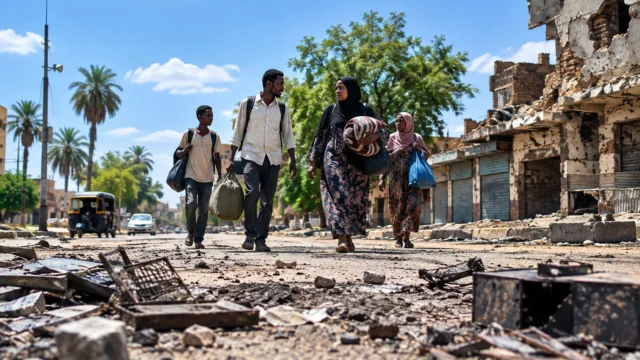
El Obeid is not only a military hub. It is also a relative refuge for displaced people from other parts of Sudan. In late June and early July, humanitarian organisations and Sudanese media described a city already overwhelmed, with more than 100,000 displaced people sheltering in camps or with families, and daily arrivals despite the de facto siege. According to the Red Crescent and humanitarian organisations cited by the local press, needs for healthcare, water and food have risen sharply.
This humanitarian pressure explains why the conflict around El Obeid is causing concern beyond Sudan. A city encircled, cut off from safe roads and exposed to drones can quickly become a trap for civilians. UN reports refer to damaged schools, sites hosting displaced people, fuel depots and water infrastructure. The picture is clear: the front line is not only hitting military positions; it is disrupting the daily lives of residents, traders, transport operators and public services.
For families who have stayed, the question is not diplomatic. It is practical. Will there be water tomorrow? Fuel? An evacuation route? June and July have shown that in North Kordofan, the war is also being waged through strangulation: power cuts, attacks on water points, the destruction of petrol stations and blocked access. This siege logic weighs more heavily on civilians than on armed units, which are more mobile and better supplied.
A local front with regional repercussions
The battle for El Obeid also concerns the Horn of Africa and, more broadly, the African Union. IGAD condemned the deteriorating situation in the city as early as 22 June, while the European Union and the UN Human Rights Council have also warned of an offensive with potentially catastrophic consequences for civilians. This convergence is rare and speaks to the gravity of the moment. Sudan is not facing only an internal conflict; it is enduring a war that destabilises its neighbours, fuels regional displacement and undermines efforts at African mediation.
The precedent of El Fasher, in Darfur, remains uppermost in people’s minds. Several UN observers have warned that El Obeid risks becoming another prolonged siege, with serious violations against civilians. This is precisely the scenario the military authorities say they want to prevent by announcing the recapture of the strategic route. But even if the road is secure on paper, stability has not returned. The RSF retain the capacity to cause disruption with drones and by harassing outlying areas.
The next decisive moment will therefore play out on three fronts at once: whether the Khartoum-El Obeid route is genuinely held, whether the RSF can sustain their drone campaign, and whether lasting humanitarian access can be opened. For Sudan, control of a road is not just a tactical success. It is a test of wartime governance, civilian logistics and the balance of power between two armed forces that continue to redraw the country with artillery and competing accounts.