Algeria
 Egypt
 Libya
 Morocco
 Tunisia
 Benin
 Burkina Faso
 Cabo Verde
 Côte d'Ivoire
 Ghana
 Guinea
 Guinea-Bissau
 Liberia
 Mali
 Mauritania
 Niger
 Nigeria
 Senegal
 Sierra Leone
 The Gambia
 Togo
 Cameroon
 Central African Republic
 Chad
 DR Congo
 Equatorial Guinea
 Gabon
 Republic of the Congo
 São Tomé and Príncipe
 Burundi
 Comoros
 Djibouti
 Eritrea
 Ethiopia
 Kenya
 Madagascar
 Malawi
 Mauritius
 Mozambique
 Rwanda
 Seychelles
 Somalia
 South Sudan
 Tanzania
 Uganda
 Angola
 Botswana
 Eswatini
 Lesotho
 Namibia
 South Africa
 Zambia
 Zimbabwe
Between the front line and aid corridors, a decisive battle
In Sudan, the war is being fought not only with tanks and drones. It is also being fought on roads, in besieged cities and over civilians’ ability to move, receive medical care and get aid. In this country, battered since April 2023, every military advance changes both the balance of power and the room left for diplomacy.
It is in this context that fighting around Kordofan, in the centre of the country, has taken on particular strategic importance. The region links Khartoum to western Sudan and to the routes serving El Obeid, capital of North Kordofan, a major logistics hub for troop movements, supplies and humanitarian aid. Several news and monitoring sources have confirmed in recent days that the Sudanese army has retaken or consolidated positions along the route linking Khartoum to El Obeid.
Mediation under pressure in a conflict spilling across borders
Peace talks are now caught between two irreconcilable positions. The Sudanese Armed Forces want the Rapid Support Forces to leave the cities they occupy before any political progress can be made. The RSF, by contrast, reject a formula they present as capitulation. This divide has already derailed several rounds of mediation since the start of the war. The latest exchanges over a 90-day humanitarian truce, backed by a US initiative, have run into the same deadlock.
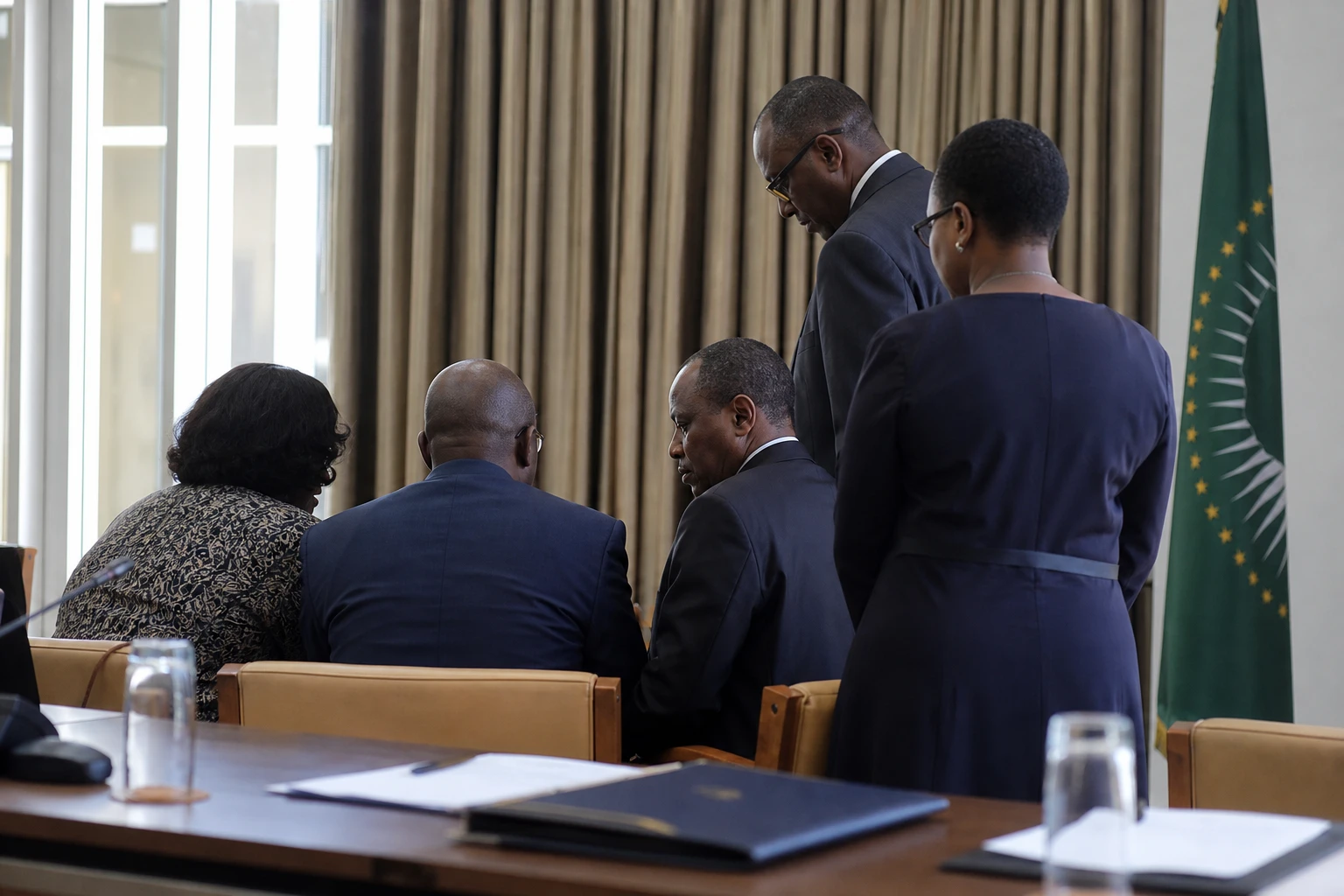
The issue now goes beyond the military standoff alone. In June 2026, the African Union reaffirmed its commitment to Sudan’s territorial integrity and to an inclusive political process. IGAD, the regional organisation for the Horn of Africa, also backed Sudan’s full return to its work in February 2026, a sign that the country remains central to the region’s balance of power. In Addis Ababa, the so-called Quintet — the African Union, IGAD, the Arab League, the United Nations and the European Union — is still seeking to coordinate mediation efforts.
This coordination has become necessary because Sudan’s war is no longer an ordinary internal conflict. It has direct effects on neighbouring countries, refugee flows and the security of trade corridors between the Nile, the Sahel and the Horn of Africa. It also weighs on continent-wide discussions about preventing coups and restoring civilian transitions.
Kordofan, the military crossroads that could also open a humanitarian corridor
On the ground, the army’s recent gains in Kordofan have very tangible consequences. By regaining the initiative along the Khartoum-El Obeid route, it is securing a road used to move personnel, fuel and food. News reports and military sources cited by several media outlets indicate that this advance is easing the pressure on El Obeid, which remains threatened by drone attacks and attempts to encircle it.
For civilians, the stakes are immediate. When a route reopens, even partially, it becomes harder to isolate an entire city. Humanitarian convoys can move more easily. Displaced families can consider returning, at least to some areas, if security allows. But this improvement remains fragile. The conflict continues on several fronts, and the battle for roads is compounded by a battle for urban centres. In El Obeid, as elsewhere in Sudan, a safe road does not yet mean peace.
International organisations describe a crisis of exceptional scale. In 2026, about 33.7 million people in Sudan need humanitarian assistance, according to the World Health Organization, UNICEF and several UN agencies. The conflict has also caused mass displacement, both within the country and across its borders. In this context, any truce, however limited, would first be judged by its ability to let aid through and reduce fighting around populated areas.
What the Sudan crisis reveals for North Africa and the continent
Sudan illustrates a reality already familiar to many African capitals: when institutions collapse, roads replace institutions as objects of power. Whoever controls a route controls a local economy, part of the urban supply chain and often some leverage in political negotiations. In a country the size of Sudan, this dynamic has immediate regional effects, from Egypt to Chad and from Libya to Ethiopia, including along the corridors hosting displaced people.
For the African Union and IGAD, the current phase is also a test of credibility. Mediators can secure commitments in principle. But on the ground, only a real reduction in hostilities, around El Obeid as well as Khartoum, will show whether a humanitarian truce can withstand military interests. The coming days will therefore be decisive: if the gains in Kordofan hold, they could strengthen the army’s position at the negotiating table. If they falter, the war will return to its logic of attrition, with more civilians caught in the crossfire.