Algeria
 Egypt
 Libya
 Morocco
 Tunisia
 Benin
 Burkina Faso
 Cabo Verde
 Côte d'Ivoire
 Ghana
 Guinea
 Guinea-Bissau
 Liberia
 Mali
 Mauritania
 Niger
 Nigeria
 Senegal
 Sierra Leone
 The Gambia
 Togo
 Cameroon
 Central African Republic
 Chad
 DR Congo
 Equatorial Guinea
 Gabon
 Republic of the Congo
 São Tomé and Príncipe
 Burundi
 Comoros
 Djibouti
 Eritrea
 Ethiopia
 Kenya
 Madagascar
 Malawi
 Mauritius
 Mozambique
 Rwanda
 Seychelles
 Somalia
 South Sudan
 Tanzania
 Uganda
 Angola
 Botswana
 Eswatini
 Lesotho
 Namibia
 South Africa
 Zambia
 Zimbabwe
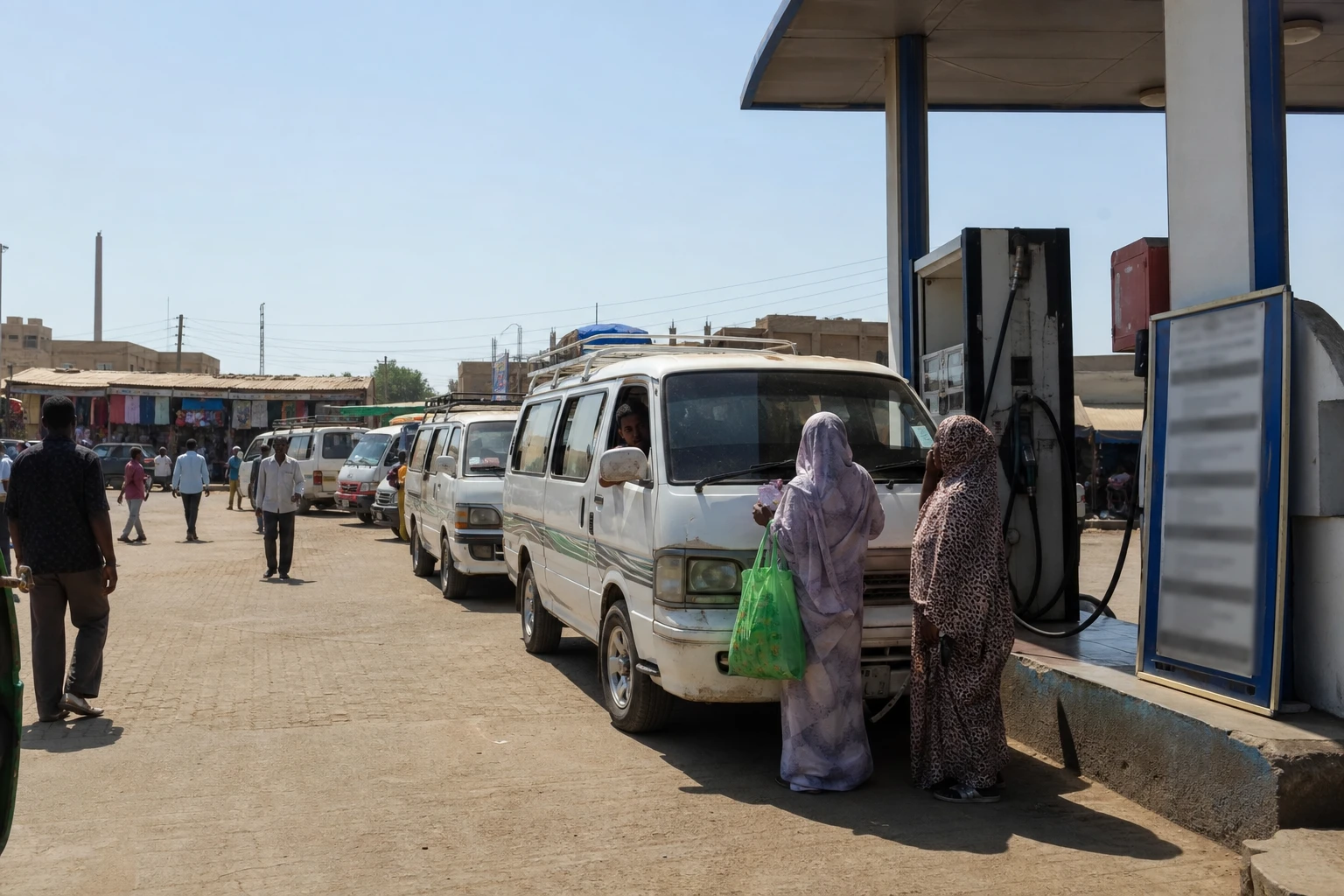
In Khartoum, finding petrol is no longer a matter of making a brief detour to a filling station. Queues are growing, prices are rising and every supply interruption slows travel, deliveries and trade. In a Sudan at war, fuel has become a measure of the country’s economic and logistical fragilities.
A shortage extending beyond filling stations
The crisis is affecting several areas under the control of the Sudanese authorities, including Khartoum and some regional states. Motorists sometimes wait several hours before they can fill their tanks. Transport operators, meanwhile, are cutting back on journeys or passing their costs on through higher fares.
“The impact is significant, both for drivers and passengers,” says Alnazeer Suliman, a transport operator quoted in accounts gathered on the ground. The pressure is being felt on public transport, as well as in the delivery of food and other essential goods.
The consequences are immediate in markets. A vehicle that is off the road can no longer carry goods to neighbourhoods or secondary cities. Traders then have to pay more to replenish their supplies. Households ultimately absorb part of this increase through higher transport fares and prices for goods.
“The transport of goods and people has ground to a halt, and the market is completely paralysed. We need solutions, not promises,” laments Mohamed Hassan, a resident. His account illustrates the direct link between fuel availability and the daily functioning of the economy.
Al-Jaili refinery at the heart of the problem
The current shortage is part of a longer-running crisis, exacerbated by the war between the Sudanese Armed Forces and the Rapid Support Forces, which began on 15 April 2023. The conflict has damaged strategic infrastructure, disrupted trade routes and made it harder to access the foreign currency needed for imports.
Al-Jaili refinery, north of Khartoum, played a central role in national supply. It previously met about 70% of Sudan’s demand for petroleum products, according to several sources specialising in monitoring Sudan’s economy and energy sector.
Its prolonged shutdown has forced the country to import a much larger share of its petrol and diesel. Imports require hard currency, however, while the Sudanese pound remains under pressure and the banking system is severely impaired in several regions.
The Al-Jaili site has also been directly affected by the fighting. United Nations reports documented, in the first months of the war, the Rapid Support Forces’ seizure of the refinery and the division of oil infrastructure between the two sides. The parties continue to dispute precise responsibility for the damage to the complex.
This greater reliance on imports makes the market particularly sensitive to shipping costs, risks along land routes and international fluctuations in energy prices. The regional context also matters. Sudan is part of the IGAD region, the Intergovernmental Authority on Development, which brings together several countries in the Horn of Africa and monitors the cross-border effects of the conflict.
Black market gains ground
When filling stations are no longer supplied regularly, the black market gains ground. In several areas, petrol is reportedly selling for close to twice the official price. The gap attracts resellers but puts further pressure on drivers and businesses that cannot wait several days to obtain fuel.
Transport operators are among the first to be affected. Their costs rise at every stage: buying fuel, maintaining vehicles, securing journeys and paying any additional charges on the roads. Small operators, widespread in urban and intercity transport, have less scope to absorb these costs.
The effects vary from place to place. In Khartoum, the shortage disrupts urban travel, services and access to shops. In rural areas, it poses a greater threat to crop collection, market supplies and the operation of generators. Informal businesses, which depend on the regular movement of people and goods, are also under particular pressure.
The shortage is also affecting essential services. Healthcare facilities, water supply systems and humanitarian operations often rely on generators or vehicles. The United Nations had already reported shortages of fuel, water and medicines, as well as a sharp rise in transport costs, at the start of the war.
Public response constrained by financial pressures
Prime Minister Kamil Idriss ordered increased deliveries to filling stations on 30 September 2026. He also asked distributors to speed up deliveries to reduce queues in the capital.
The intervention is intended to ease an immediate crisis. It does not, however, resolve the sector’s structural difficulties. In June 2026, the government announced plans to import petroleum products directly in order to regulate the market more effectively and ease pressure on the exchange rate.
At the same time, the Central Bank of Sudan has required companies seeking to import fuel to deposit a guarantee equivalent to 200 kilograms of 21-carat gold. The stated aim is to curb manipulation, secure transactions and preserve foreign currency resources.
The measure could strengthen control over imports. It could also reduce the number of companies able to enter the market. Sudanese importers and analysts say this concentration could limit supply and fuel price tensions. The government has therefore begun considering direct state involvement in purchases, with a view to building reserves and reducing reliance on a handful of operators.
Fuel: an economic and regional issue
The situation shows that Sudan’s energy crisis is about more than rising prices at the pump. It combines damaged infrastructure, a weak currency, limited access to foreign currency and insecurity along transport routes.
It is also weighing on economic ties with neighbouring countries. Disruptions in Sudan could slow trade with Egypt, South Sudan, the Central African Republic and Chad. Some border areas rely in part on Sudanese roads to receive goods, fuel and agricultural products.
The next step will be to assess the effectiveness of the additional deliveries announced by the authorities. The restoration of Al-Jaili, changes to import rules and the state’s ability to finance regular stockpiles will also need to be monitored. As long as the war continues to fragment infrastructure and trade routes, any improvement will remain vulnerable to a new disruption.