Algeria
 Egypt
 Libya
 Morocco
 Tunisia
 Benin
 Burkina Faso
 Cabo Verde
 Côte d'Ivoire
 Ghana
 Guinea
 Guinea-Bissau
 Liberia
 Mali
 Mauritania
 Niger
 Nigeria
 Senegal
 Sierra Leone
 The Gambia
 Togo
 Cameroon
 Central African Republic
 Chad
 DR Congo
 Equatorial Guinea
 Gabon
 Republic of the Congo
 São Tomé and Príncipe
 Burundi
 Comoros
 Djibouti
 Eritrea
 Ethiopia
 Kenya
 Madagascar
 Malawi
 Mauritius
 Mozambique
 Rwanda
 Seychelles
 Somalia
 South Sudan
 Tanzania
 Uganda
 Angola
 Botswana
 Eswatini
 Lesotho
 Namibia
 South Africa
 Zambia
 Zimbabwe
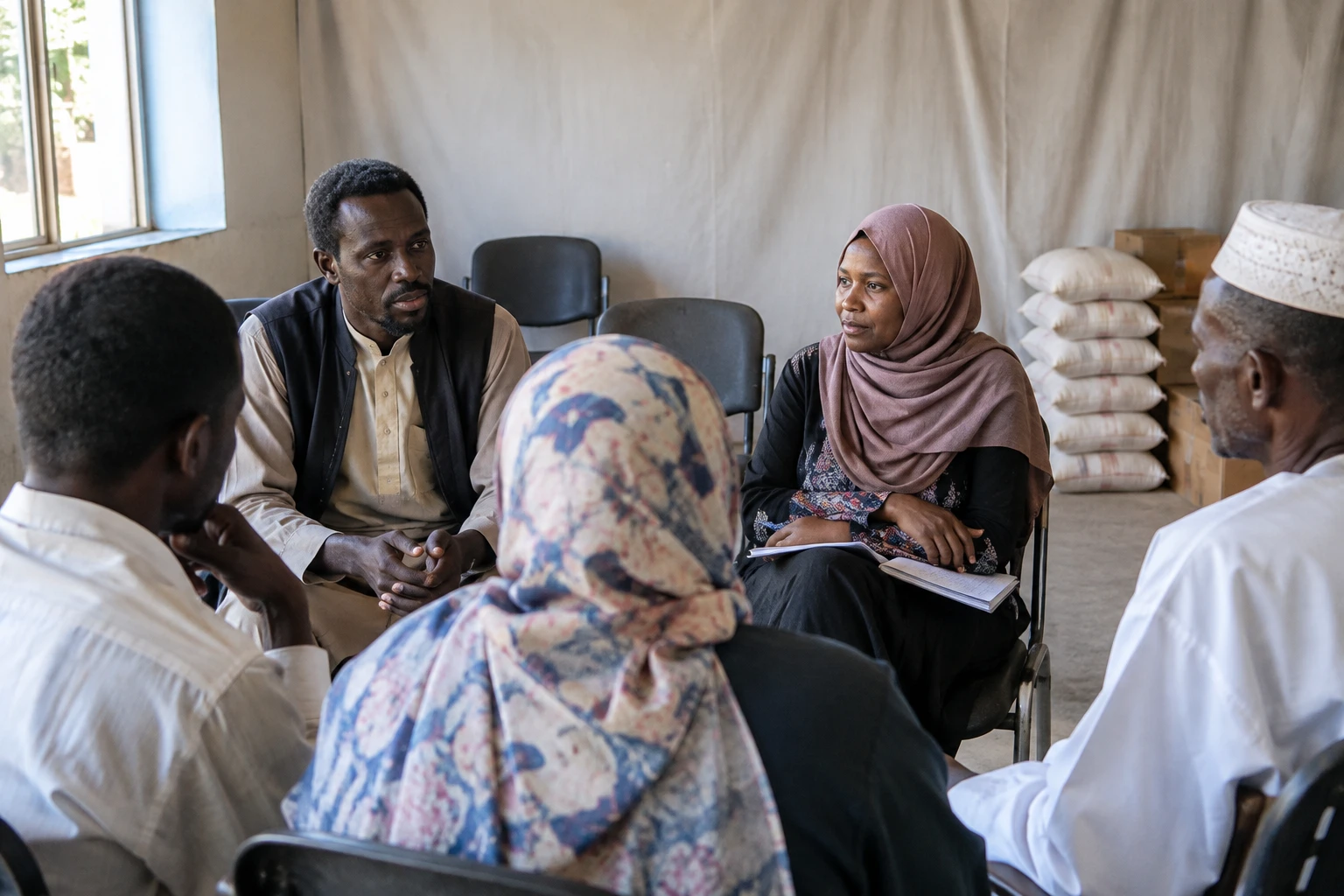
When food distributions stop, displaced families must choose between eating today and protecting their health tomorrow. At Al-Karama 3, in Sudan’s Blue Nile State, residents say they have been living for several months on a reduced ration of maize, while healthcare and clean drinking water remain difficult to access.
In Ed-Damazin, aid is no longer meeting needs
Residents and the camp manager report that no food aid has been distributed at Al-Karama 3 for four months. This timeframe is cited by people interviewed on the ground; available data do not make it possible to verify it independently for this particular camp.
Adam Ahmed, a displaced person, says he eats only maize, despite needing a suitable diet. Babiker Othman Ibrahim, the camp manager, reports cases of malaria, schistosomiasis and allergies. These accounts describe local difficulties but do not constitute an established medical assessment.
Al-Karama 3 hosts about 24,000 displaced people, according to a report on the camp. Families have fled fighting that has continued in Sudan since April 2023 between the Sudanese Armed Forces and the Rapid Support Forces. Other recent reports from the Ed-Damazin region also describe shortages of food, water, shelter and healthcare. These accounts point to similar needs, but do not confirm the details of distributions at the camp.
A national crisis, very different local situations
Blue Nile lies in south-eastern Sudan, near the Ethiopian border. Ed-Damazin, the state capital, is hosting displaced people, while fighting and displacement are disrupting livelihoods elsewhere in the country. The national capital remains Khartoum. The war has also fragmented supply chains and made it harder for humanitarian organisations to gain access.
National figures must be carefully dated. An IPC analysis, produced by the food insecurity classification system to which humanitarian agencies contribute, estimates that 21.2 million people faced acute food insecurity at Phase 3 or above in September 2025. It projected 19.2 million for October 2025 to January 2026, then 19.1 million from February to May 2026. This apparent decline does not necessarily mean conditions improved everywhere: the IPC says some areas of serious concern could not be classified because of a lack of data.
These estimates therefore do not automatically confirm the figure of 19.5 million cited in reports circulated around 24 October. The time periods and methods must be distinguished. However, IPC analyses and UNICEF’s October 2025 report confirm widespread food insecurity, with significant differences between regions.
The national picture does not sum up every locality. In some areas, humanitarian access and food security have followed different trajectories. In Darfur and Kordofan, however, the IPC has documented a deterioration linked to fighting and access restrictions, with famine conditions in El-Fasher and Kadugli in autumn 2025. This contrast is a reminder of why warnings from the camp must be assessed locally, rather than inferred from a national average.
Food, health and access: interconnected needs
A monotonous diet particularly weakens children, pregnant women, older people and those who are ill. When distributions stop, displaced households often have little income to buy a varied diet. People in urban areas may sometimes find food in markets, but prices and a lack of cash limit their access. In camps, dependence on aid is more direct.
Health cannot be separated from food and sanitation. Malaria is transmitted by mosquitoes; schistosomiasis, also known as bilharzia, is caused by parasites found in some contaminated water. UNICEF’s report for October 2025 notes intense pressure on health services nationally and says the organisation was supporting health services in Blue Nile State. This does not show that healthcare is accessible to everyone in Al-Karama 3, but underlines the importance of linking food aid, water, prevention and medical follow-up.
The World Food Programme says it has provided food or nutrition assistance to millions of people in Sudan, despite insecurity and access difficulties. These nationwide operations do not guarantee a regular presence in every camp. Their continuity depends in particular on funding, passable roads and security conditions.
A response that also involves the region
The conflict in Sudan is putting pressure on neighbouring countries, which are hosting people who have crossed borders, while internal displacement is increasing pressure on cities and host communities. IGAD, the Intergovernmental Authority on Development, brings together several states in the Horn of Africa and the region. The crisis therefore calls for regional coordination, alongside the work of Sudanese authorities and humanitarian agencies.
At Al-Karama 3, the next concrete indicator will be whether regular distributions resume, accompanied by healthcare and access to water. The available accounts raise a serious alarm, but are not enough to establish the exact scale of each household’s needs. The priority is to verify those needs on the ground and ensure regular humanitarian access, without conflating national announcements with the reality experienced in the camp.
For context on the data, see the IPC analysis of food insecurity in Sudan, UNICEF’s October 2025 humanitarian report and information from the World Food Programme in Sudan.