Algeria
 Egypt
 Libya
 Morocco
 Tunisia
 Benin
 Burkina Faso
 Cabo Verde
 Côte d'Ivoire
 Ghana
 Guinea
 Guinea-Bissau
 Liberia
 Mali
 Mauritania
 Niger
 Nigeria
 Senegal
 Sierra Leone
 The Gambia
 Togo
 Cameroon
 Central African Republic
 Chad
 DR Congo
 Equatorial Guinea
 Gabon
 Republic of the Congo
 São Tomé and Príncipe
 Burundi
 Comoros
 Djibouti
 Eritrea
 Ethiopia
 Kenya
 Madagascar
 Malawi
 Mauritius
 Mozambique
 Rwanda
 Seychelles
 Somalia
 South Sudan
 Tanzania
 Uganda
 Angola
 Botswana
 Eswatini
 Lesotho
 Namibia
 South Africa
 Zambia
 Zimbabwe
In Sudan, energy becomes an economic frontline again
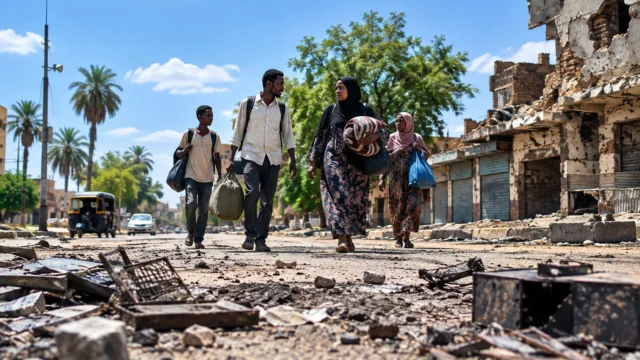
When a country at war is still seeking partners for electricity and oil, the issue goes beyond a simple investment announcement. In Sudan, the question is now what can restart, where and at what pace, as infrastructure has been damaged and Khartoum remains scarred by two years of conflict. The stakes are concrete: without a stable power supply, fuel and repairs to facilities, economic recovery remains stalled.
Sudan’s energy issue is part of a war that has been raging since April 2023 between the Sudanese Armed Forces and the Rapid Support Forces. This rift has affected cities, roads, refineries and investment channels. The International Food Policy Research Institute estimated that, if the war continued until the end of 2025, Sudan’s economy could contract by more than 40% compared with 2022. That projection gives a measure of the shock, far beyond the oil sector alone.
Khartoum seeks capital as Baku makes its move
On 20 August 2026, Sudan’s Energy Minister, Al-Mu’tasim Ibrahim Ahmed, received a delegation from Azerbaijani Energy Solutions Company, an Azerbaijani state-owned company, in Khartoum. According to accounts published in Khartoum and corroborated by regional media, discussions covered electricity, renewables and oil. The head of the delegation said: “Today, we have come to work”.
The company presented two solar projects in Khartoum, with a combined initial capacity of 100 megawatts and a gradual increase to 1,000 megawatts envisaged. The ministry, for its part, referred to opportunities in oil blocks in areas it describes as secure, as well as around the Port Sudan refinery. No agreement has been signed at this stage. Discussions therefore remain exploratory, in a country where investment promises run up against security, financing and technical capacity.
This rapprochement did not come out of nowhere. In May 2026, a joint technical committee had already met in Baku. The two countries then continued their exchanges on the sidelines of meetings related to OPEC+ in the Azerbaijani capital. Sudan is thus trying to reopen several diplomatic channels at once: trade, energy, transport and infrastructure. For Khartoum, every visit counts, as the country lacks partners willing to take on the political risk of a market under reconstruction.
A battered oil sector, with figures that speak for themselves
The situation on the ground remains deeply degraded. The International Food Policy Research Institute estimates that the conflict could reduce the size of Sudan’s economy by more than 40% by the end of 2025. At the same time, industrial and energy capacity has fallen, especially around Khartoum, where some of the productive assets and company headquarters were concentrated. The formal economy has been hit hard, while the more mobile informal economy has often served as a safety net.
The case of the Al-Jaili refinery sums up this fragility. The country’s largest refinery, with a capacity of 100,000 barrels per day before the war, was badly damaged and has remained out of service. Specialist sources and reports published after the fighting confirmed attacks, fires and the site’s lasting disorganisation. In addition, recent analyses of Sudan’s oil sector describe national production as having fallen to about 24,000 barrels per day, while the country’s six refineries are operating at only 15% to 20% of their combined capacity of 144,000 barrels per day.
The shock is not confined to factories. It affects public finances, household energy bills and transport. When fuel is scarce, food prices rise, power cuts drag on and urban services deteriorate. In Khartoum’s neighbourhoods and in more distant states, everyday economic life becomes more expensive and slower. Rural areas often pay a particularly high price through isolation, rising mobility costs and pressure on irrigated agriculture.
The departure of major operators makes the picture even more complicated. In December 2025, China National Petroleum Corporation requested the early termination of its contracts on Block 6 in West Kordofan, citing the impossibility of continuing operations amid war and destruction. The decision confirmed that some foreign capital prefers to withdraw rather than remain exposed to an environment where infrastructure and security are no longer guaranteed. Baku’s declared interest is therefore emerging in a vacuum left by others.
What this opening says about Sudan and the region
For Sudan, the search for an Azerbaijani partner says two things at once. First, the country wants to show that it remains open to investment despite the war. Second, it is seeking to diversify its interlocutors as some Asian companies reassess their positions. This diversification could help restart solar projects or prepare for the partial restoration of oil facilities. But it cannot replace a stable security framework, financing guarantees or clear contract governance.
For the population, the stakes are more immediate. A refurbished power station, even a small one, can ease pressure on a city. Restarting an oil supply chain can reduce pressure on transport and prices. But the benefits will not be evenly distributed. Large cities and logistics corridors will be the first to benefit from any possible restart. Peripheral areas will see the effects later, if roads, security and distribution networks follow.
At the continental level, Sudan’s case is a reminder of a reality that is often underestimated: in a protracted conflict, energy is not just an economic sector but a lever of sovereignty. For the African Union, regional peace mechanisms and investors across the continent, Sudan poses a simple question: how can a country at war be re-engaged without confusing a diplomatic announcement with a genuine resumption of production? The answer will depend on the coming months, security around strategic assets and the authorities’ ability to turn discussions into visible projects.