Algeria
 Egypt
 Libya
 Morocco
 Tunisia
 Benin
 Burkina Faso
 Cabo Verde
 Côte d'Ivoire
 Ghana
 Guinea
 Guinea-Bissau
 Liberia
 Mali
 Mauritania
 Niger
 Nigeria
 Senegal
 Sierra Leone
 The Gambia
 Togo
 Cameroon
 Central African Republic
 Chad
 DR Congo
 Equatorial Guinea
 Gabon
 Republic of the Congo
 São Tomé and Príncipe
 Burundi
 Comoros
 Djibouti
 Eritrea
 Ethiopia
 Kenya
 Madagascar
 Malawi
 Mauritius
 Mozambique
 Rwanda
 Seychelles
 Somalia
 South Sudan
 Tanzania
 Uganda
 Angola
 Botswana
 Eswatini
 Lesotho
 Namibia
 South Africa
 Zambia
 Zimbabwe
As war empties cities, who really controls the ground?
In Al-Rahad, in North Kordofan, a health centre reduced to rubble tells a story that goes beyond a single episode of war. It speaks of a country where front lines run not only through barracks, but also through pharmacies, markets and feeder roads. In Sudan, the military battle has become a battle for authority, and civilians pay the price every day.
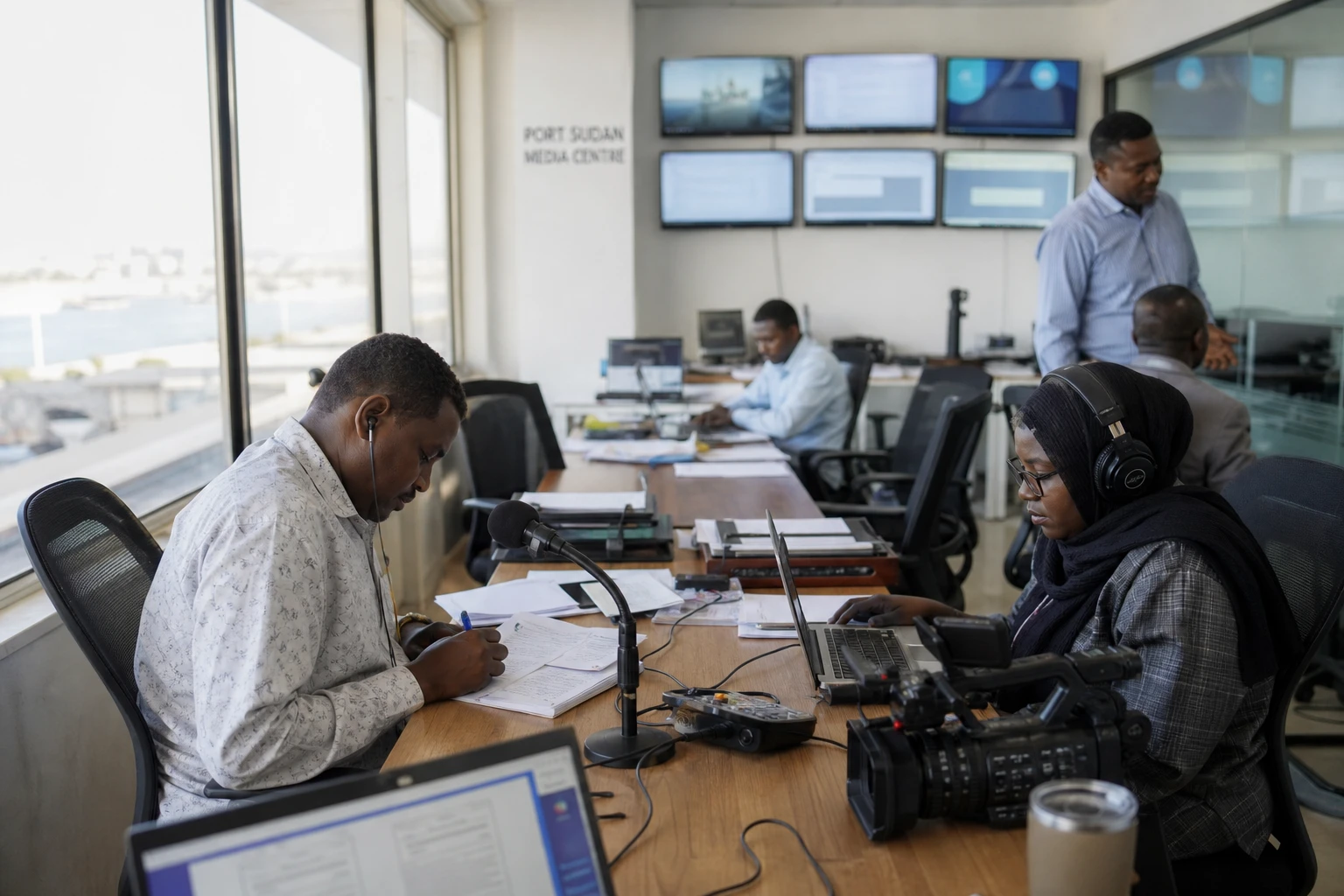
This reality is part of a war that began on 15 April 2023 between the Sudanese Armed Forces and the Rapid Support Forces, with Khartoum as the contested political centre, Port Sudan as the base of military power, and regions such as Kordofan and Darfur turned into areas of shifting control. The International Organization for Migration estimates that the crisis displaced more than 11 million people at its peak, while the UN continues to describe it as the world’s largest displacement crisis.
In Kordofan, war first hits what heals and what connects
In the town of Al-Rahad, residents and local officials describe a medical centre destroyed in an attack attributed to the Rapid Support Forces. Essential infrastructure was hit, from the pharmacy and examination rooms to the inpatient areas and administrative offices. This kind of destruction is not incidental: in wartime Sudan, health facilities are often among the first casualties, with closures, looting and services suspended for weeks, sometimes longer.
Municipal services are also suffering. In Al-Rahad, the authority responsible for urban sanitation was targeted, according to a local official. This means less rubbish collection, less street maintenance and greater health pressures on families already weakened by displacement and rising prices. In a protracted conflict, war does not only destroy visible buildings; it also disrupts the ordinary functions of a city, the ones that allow people to live without relying entirely on emergency aid.
Kordofan is now the site of some of the fiercest fighting. International agencies and conflict-monitoring media have reported a succession of air attacks and drone strikes on residential areas, transport routes and medical facilities there since the start of 2026. In this pivotal region between the country’s centre and Darfur, control of territory shapes military operations as well as people’s access to healthcare, trade and local markets.
Allies of convenience, but the same old playbook
The heart of the problem also lies elsewhere: in the fragmentation of the pro-army camp. Several armed groups have gained in importance since the start of the war, rallying around General Abdel Fattah al-Burhan. The Joint Forces, formed from former Darfur rebel movements, the Sudan Shield Forces and the Baraa ibn Malik Brigade are among the most prominent formations in this arrangement. They fight alongside the army, but retain their own chains of command, networks and, often, political interests.
This is no minor matter. In Sudan’s war, the army is seeking to retake cities without always having a unified force at its disposal. It therefore relies on auxiliary forces capable of holding a neighbourhood, a bridge, a supply line or a checkpoint. The problem has long been familiar in Khartoum: when a central government relies too heavily on militias, they can end up wielding as much influence over it as they provide protection. This is precisely the precedent that now worries some Sudanese civilians and analysts.
The country’s history is a stark reminder. The Rapid Support Forces themselves grew out of a strategy of arming auxiliaries in the 2000s, when Omar al-Bashir’s regime mobilised the Janjaweed in Darfur. These groups were later institutionalised, then turned into an autonomous force before turning against the centre of power. The open conflict between Abdel Fattah al-Burhan and Mohamed Hamdan Dagalo, known as Hemeti, in April 2023 revived this pattern of intertwined rivalries, in which alliances shift faster than institutions can take root.
The current fear therefore stems from a double risk. On the one hand, armed groups allied with the army are establishing a presence in cities such as Khartoum, Wad Madani and Port Sudan. On the other, there is no clarity over how they might eventually be integrated into a national army, with no credible timetable or genuinely established disarmament mechanism. In practice, the question is not only how to win the war against the Rapid Support Forces. It is also who will control the weapons tomorrow, and under what chain of accountability.
What this fragmentation means for Sudan and the region
For civilians, the effect is immediate. The more armed groups proliferate, the more checkpoints multiply, the more costly travel becomes and the further economic recovery recedes. Traders have to contend with roadblocks, families pay more to travel, and public services wither in rural areas and state capitals alike. In North Kordofan, this means less access to healthcare. In Khartoum, it means a difficult return to normal urban life. In Al-Jazira, it means competition for territory between forces that were allies yesterday and may be rivals tomorrow.
This fragmentation also has regional implications. Sudan sits at the crossroads of the Horn of Africa, the eastern Sahel and the Red Sea. As its front lines shift, the effects spread to Chad, Egypt, South Sudan, Ethiopia and Libya, bringing refugee movements, pressure on border markets and the risk of weapons trafficking. The UN has also stressed that the crisis continues to weigh on the wider region, even as humanitarian needs in the country remain immense.
Politically, the issue goes beyond the war against the Rapid Support Forces. It concerns the future form of the Sudanese state. A government that depends on parallel forces to retake territory can hardly claim, overnight, to have established a stable monopoly on the use of force. That is where part of Sudan’s challenge lies: not only in retaking cities, but in preventing today’s auxiliaries from becoming tomorrow’s rivals.
The next key test is therefore less about military victory than political coherence. As long as the integration of armed groups remains uncertain, any territorial gains by the army camp risk resting on a fragile foundation. And as long as public services continue to collapse in cities such as Al-Rahad, the war will remain visible where it does the most damage: in healthcare, water, transport and Sudanese people’s confidence in the very idea of a return to order.