Algeria
 Egypt
 Libya
 Morocco
 Sudan
 Tunisia
 Burkina Faso
 Cabo Verde
 Côte d'Ivoire
 Ghana
 Guinea
 Guinea-Bissau
 Liberia
 Mali
 Mauritania
 Niger
 Nigeria
 Senegal
 Sierra Leone
 The Gambia
 Togo
 Cameroon
 Central African Republic
 Chad
 DR Congo
 Equatorial Guinea
 Gabon
 Republic of the Congo
 São Tomé and Príncipe
 Burundi
 Comoros
 Djibouti
 Eritrea
 Ethiopia
 Kenya
 Madagascar
 Malawi
 Mauritius
 Mozambique
 Rwanda
 Seychelles
 Somalia
 South Sudan
 Tanzania
 Uganda
 Angola
 Botswana
 Eswatini
 Lesotho
 Namibia
 South Africa
 Zambia
 Zimbabwe
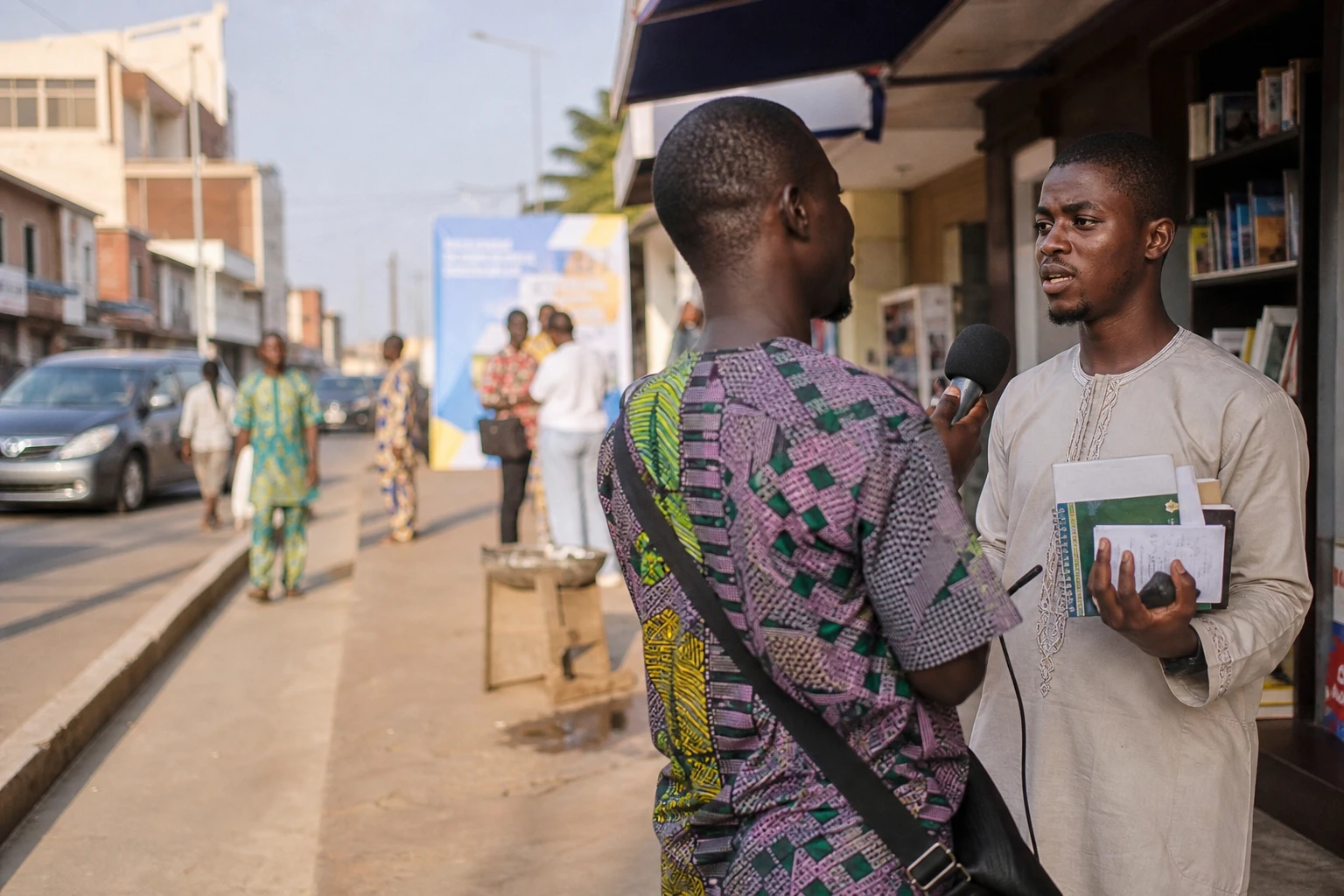
In Porto-Novo, books are not confined to the shelves of bookshops. They are also a space for transmission, debate and memory. In this landscape, Stephens Akplogan occupies a distinctive place: as a writer, biographer, essayist and publishing professional, he works at the intersection of literary creation and the circulation of knowledge.
His career reflects an important evolution in Benin’s cultural sector. Book professionals are no longer just authors. They are also becoming publishers, project advisers, event organisers and intermediaries between institutions, researchers and the public.
A career spanning philosophy, teaching and publishing
Originally from Porto-Novo, Stephens Akplogan studied psychology and education sciences in Cotonou, then philosophy at Cheikh Anta Diop University in Dakar, Senegal. This dual education informs writing attentive to individual life stories, ideas and social change.
He describes himself as a writer-biographer and says he has produced around 15 books. His work spans several genres, including essays, novels and biographies. He also teaches at the National Institute of Arts, Archaeology and Culture at the University of Abomey-Calavi.
For several years, he has directed L’Harmattan’s activities in Benin. The collection dedicated to the country brings together works of literature, humanities and political thought. The publisher’s official catalogue also lists several books by Stephens Akplogan, including a biography of former Togolese Prime Minister Edem Kodjo. The publisher’s page for the book on Edem Kodjo gives its publication date as September 2025.
Publishing as a space for public discussion
In Benin, the publishing house’s activities go beyond publishing and selling books. They also include a bookshop and an intellectual salon, which hosts discussions on social issues, culture and specialised knowledge.
The first events held there brought together figures from politics, academia, religion and culture. The programme reflects a desire to foster regular dialogue between knowledge producers and a wider public.
This role is important in a country where public debate is often concentrated in political institutions or the media. An intellectual salon can offer a different pace. It allows people to revisit a work, explain a concept or compare experiences without reducing discussion to the immediate news cycle.
The initiative also aligns with an effort undertaken with the National Assembly. In August 2024, Stephens Akplogan presented a project to make laws passed by parliament more accessible to the public. The aim was to publish the texts in a more readable form to facilitate their circulation and understanding. The account of this meeting with the institution describes this approach to legal communication.
Writing biographies to preserve African life stories
Biography is the most prominent part of his work. Stephens Akplogan says he distinguishes biography from assisted autobiography, often called “ghostwriting”, in which a person entrusts a writer with the task of telling their own story.
In his case, he says he signs the biographies he writes. He has worked on several African figures, including former Togolese Prime Minister Edem Kodjo and Congolese minister Henri Djombo. He has also written about former Archbishop of Cotonou Antoine Ganyé and Beninese actor of Nigerian origin Djimon Hounsou.
Biography is not simply a matter of listing dates. It requires placing a life in its time. For a political figure, this means revisiting the institutions, crises and decisions that shaped their career. For an artist or writer, it is also necessary to reconstruct their influences, turning points and creative milieus.
This approach gives biography documentary value. It helps preserve testimonies, archives and interpretations that might otherwise disappear. It also enables new generations to discover figures who have contributed to the continent’s political, cultural or intellectual history.
Paul Hazoumé, an unfinished body of work
Among Beninese writers, Paul Hazoumé occupies a central place in Stephens Akplogan’s thinking. Born in Porto-Novo in 1890 and dying in Cotonou in 1980, Paul Hazoumé was a writer, ethnologist, teacher and politician. His historical novel Doguicimi and his studies of Dahomean societies left their mark on African literature and social sciences. A biographical entry on Paul Hazoumé highlights the importance of his work in African literary history.
Stephens Akplogan has devoted several books to him. He sees Paul Hazoumé’s work as an undertaking that is both anthropological and philosophical. In this reading, his texts do more than describe an earlier society. They also explore culture, transmission, identity and the relationship between particular experiences and the universal.
This reassessment comes at a time when African literatures are seeking to reclaim their archives and analytical categories. The challenge is not to isolate African works from the rest of the world, but rather to study them through their own historical, linguistic and intellectual contexts.
A new book by Stephens Akplogan on Paul Hazoumé was announced for March 2026. It explores initiatory literature and the dialectic of the universal. The publisher’s listing for the book confirms that it is published in French.
A profession seeking economic sustainability
Beyond vocation, Stephens Akplogan argues that writing can be a profession. He speaks of “business writing”, linked to commissions, editorial advice and supporting individuals or organisations in developing their books.
This position highlights a reality that is often little discussed: Africa’s book sector relies on several complementary professions. The author writes. The publisher selects and structures. The proofreader improves the text. The designer prepares the book. The bookseller organises its distribution. Each contributes to creating value.
In West Africa, this chain continues to face practical challenges: printing costs, distribution between countries, access to bookshops and the limited reach of public reading networks. Local initiatives nevertheless also show a determination to build solutions suited to the realities of the regional market.
Stephens Akplogan’s career is part of this momentum. Based in Benin, a member of the Economic Community of West African States, he works on Beninese, Togolese and Congolese figures. His work is a reminder that the circulation of African ideas does not rely solely on major foreign publishing capitals.
It can also be built in Cotonou, Porto-Novo, Dakar, Lomé or Brazzaville, through collaborations, books and events. In the years ahead, the challenge will be to strengthen these bridges so that African works are increasingly produced, distributed and discussed from within the continent.