Algeria
 Egypt
 Libya
 Morocco
 Sudan
 Tunisia
 Burkina Faso
 Cabo Verde
 Côte d'Ivoire
 Ghana
 Guinea
 Guinea-Bissau
 Liberia
 Mali
 Mauritania
 Niger
 Nigeria
 Senegal
 Sierra Leone
 The Gambia
 Togo
 Cameroon
 Central African Republic
 Chad
 DR Congo
 Equatorial Guinea
 Gabon
 Republic of the Congo
 São Tomé and Príncipe
 Burundi
 Comoros
 Djibouti
 Eritrea
 Ethiopia
 Kenya
 Madagascar
 Malawi
 Mauritius
 Mozambique
 Rwanda
 Seychelles
 Somalia
 South Sudan
 Tanzania
 Uganda
 Angola
 Botswana
 Eswatini
 Lesotho
 Namibia
 South Africa
 Zambia
 Zimbabwe
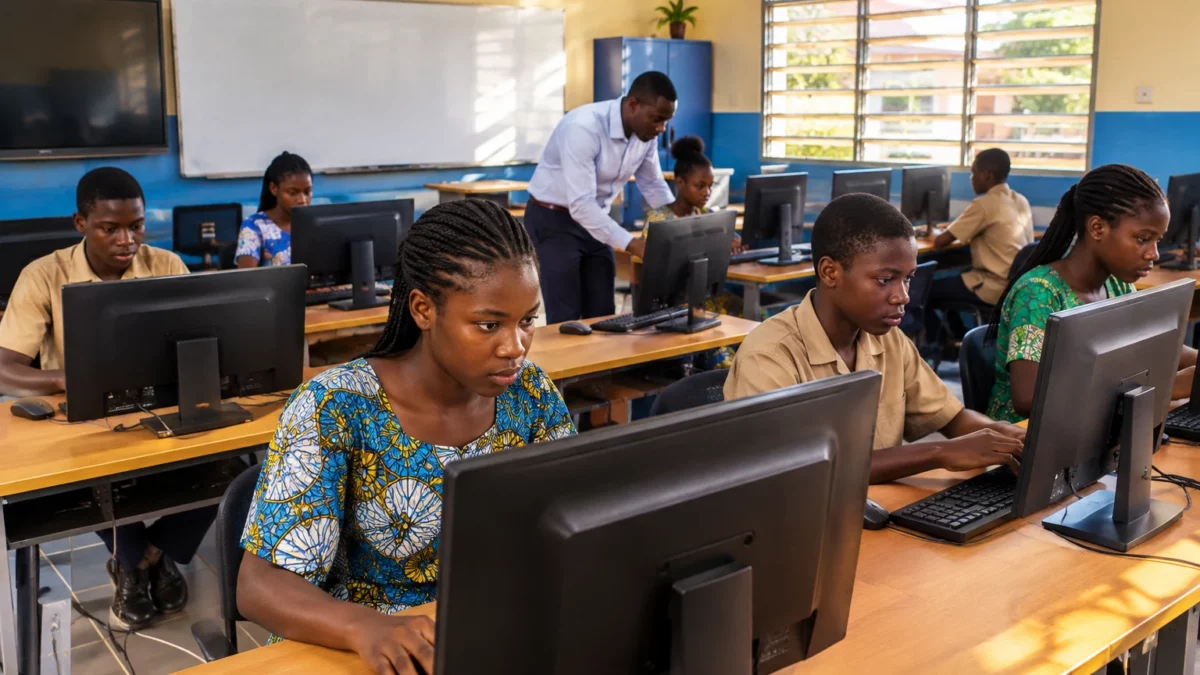
In a classroom, an internet connection alone is not enough to guarantee digital learning. The equipment must work, teachers must be able to integrate it into lessons, and pupils must know how to use the tools safely. In Benin, a new agreement between UNICEF and the MTN Benin Foundation aims to address these different factors.
Classrooms already installed, access still to be secured
The partnership is part of a school equipment drive pursued with the Beninese authorities and several partners. In September 2026, the ministry responsible for secondary education announced that 55 digital classrooms had already been set up in UNICEF’s areas of intervention. The same programme then planned to install 12 additional classrooms, with 628 computer devices provided by the organisation.
The challenge, therefore, is not limited to providing computers. Without regular network access, suitable educational resources and support for teaching staff, an equipped classroom risks remaining underused. The new agreement focuses on this transition from equipment to use.
Benin, whose capital is Porto-Novo, has pursued a digital transformation policy for several years. In schools, this ambition meets differing realities across institutions and regions. Connectivity, electricity and maintenance constraints can weigh more heavily outside major urban centres. Access for girls, children with disabilities and pupils in rural areas is also an issue of equity.
Two years of cooperation, nine months of connectivity announced
Signed in Cotonou on 17 November 2026, the framework agreement between UNICEF and the MTN Benin Corporate Foundation is set to last two years. Among other provisions, it includes providing an internet connection to 55 digital classrooms for nine months. The organisations also say they will promote MTN Skills Academy among beneficiary schools to facilitate access to digital training.
The partnership does not rely on the operator alone. UNICEF is to draw on its expertise in education and youth engagement, as well as on teachers and U-Reporters, young people involved in civic participation initiatives. The partners also cite YOMA, a platform designed to link learning, experience and employment prospects. The precise arrangements for implementation at each school were not detailed in the announcement.
The agreement thus combines three objectives: improving access to digital technology in schools, developing young people’s skills and better protecting children online. For pupils, the practical challenge will be to use the classrooms over the long term. For teachers, it will be a matter of integrating digital resources into learning rather than limiting their use to occasional sessions.
From training students to training pupils
The MTN Foundation had already invested in vocational training. Its TITA Digital Skills programme, launched in 2022 with Beninese partners, is aimed at students and recent graduates. In 2024, 205 young people were trained, according to reports published by Beninese business media. The new partnership extends the initiative to younger pupils who are still at school.
This expansion could bring digital training closer to the needs of the labour market, but training does not automatically lead to employment. The skills on offer must match local uses and job opportunities. Access to a platform is a first step; the quality of the content, supervision and the possibility of obtaining a recognised certification will also matter.
The financial contribution under the agreement was not detailed in UNICEF’s press release. It is therefore better not to present as confirmed an amount that is not corroborated by the public information consulted. To assess the programme’s impact, information will also be needed on classroom attendance, continuity of connectivity and the number of pupils and teachers who actually receive support.
Online protection, an aspect to monitor
The partnership provides for strengthening the actions of the PARE project, launched by the Beninese government in June 2022 with support from partners, including MTN Benin. PARE stands for “Protected, Alerted, Empowered, Educated”. The campaign aims to raise citizens’ awareness, particularly that of young people, of internet-related risks and digital safety practices.
The new agreement focuses on risks associated with social media and the protection of personal data. It announces particular attention to girls, children living in rural areas and those with specific needs. This dimension is essential: connecting more children also increases the need to teach them how to protect their privacy, recognise harmful content and seek help if a problem arises.
Protection, however, does not depend solely on individual behaviour. It requires trained adults, clear reporting procedures and appropriate responses when children are exposed to abuse. Results will therefore depend on coordination between schools, families, public services and programme partners.
A Beninese issue with West African significance
In Benin, these commitments will be implemented in a school system where needs vary between cities and rural areas. Connectivity at a school does not guarantee that all pupils benefit equally. Access hours, the condition of equipment, teacher availability and the needs of girls or pupils with disabilities will all affect genuine inclusion.
At regional level, the issue also concerns ECOWAS countries, where access to digital skills is playing an increasingly important role in education and employment. But solutions cannot be transferred mechanically from one country to another: infrastructure, languages of instruction and educational priorities differ.
The next step will be to verify whether the 55 classrooms are actually connected for the period announced, and then whether pupils and teachers receive regular support. An assessment will also need to show who uses the services, and under what conditions. The agreement’s significance for Beninese schools will be measured by these results, rather than by its signature alone.
The UNICEF–MTN Benin Foundation agreement on digital education · The equipment and digital classrooms announced by Benin’s ministry · The 2024 results of TITA Digital Skills in Benin · The government launch of the PARE campaign