Algeria
 Egypt
 Libya
 Morocco
 Sudan
 Tunisia
 Benin
 Burkina Faso
 Cabo Verde
 Côte d'Ivoire
 Ghana
 Guinea
 Guinea-Bissau
 Liberia
 Mali
 Mauritania
 Niger
 Nigeria
 Senegal
 Sierra Leone
 The Gambia
 Togo
 Cameroon
 Central African Republic
 Chad
 DR Congo
 Equatorial Guinea
 Gabon
 Republic of the Congo
 São Tomé and Príncipe
 Burundi
 Comoros
 Djibouti
 Eritrea
 Ethiopia
 Kenya
 Madagascar
 Malawi
 Mauritius
 Mozambique
 Rwanda
 Seychelles
 Somalia
 Tanzania
 Uganda
 Angola
 Botswana
 Eswatini
 Lesotho
 Namibia
 South Africa
 Zambia
 Zimbabwe
A border serving as a full-scale test
In western South Sudan, the border with the Democratic Republic of the Congo is more than a line on a map. It is an area of transit, trade, public health and vigilance. In Western Equatoria, residents of Nabiapai, Ezo and Yambio live by the rhythms of cross-border markets, family travel and health checks. When a haemorrhagic virus is circulating in the region, this reality immediately becomes political.
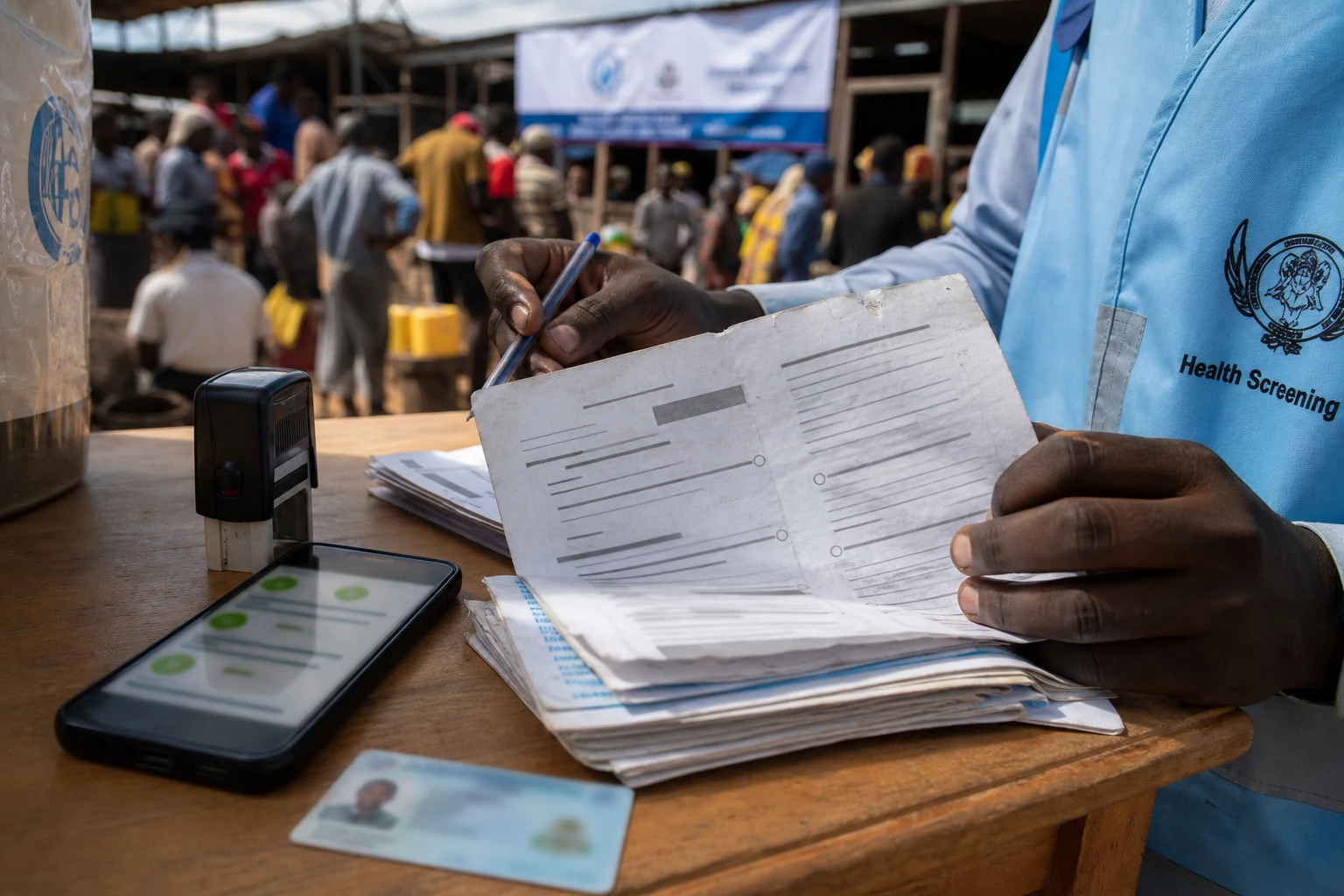
It was against this backdrop that a United Nations delegation led by Ramanathan Balakrishnan, Deputy Special Representative of the Secretary-General, visited to work with state authorities on three connected issues: local peace, the security of humanitarian aid and preparedness for Ebola. The visit included a stop in Nabiapai, a border crossing and transit market in the west of the country, to assess the capacity to detect and direct travellers in an area where movement is constant.
The context is regional as well as national. South Sudan shares borders with the DRC, Uganda, Kenya, Ethiopia, Sudan and the Central African Republic. In this setting, any health alert from eastern Congo or the Ugandan corridor can spread quickly to South Sudan’s south-western states. The World Health Organization (WHO) also lists South Sudan among neighbouring countries at high risk in its assessment of the Ebola outbreak caused by the Bundibugyo virus, which emerged in 2026 in the DRC and Uganda.
What the UN visit says about conditions on the ground
The message delivered in Western Equatoria is simple: prevention costs less than containment. Local health authorities say no confirmed Ebola cases have been recorded in the state, but they have stepped up border surveillance, coordination with partners and community awareness-raising. In May, the state health ministry in Yambio said additional personnel had been deployed at entry points, alongside an emergency coordination unit to prepare for a possible introduction of the virus.
The situation on the ground remains difficult to control, however. Radio Tamazuj has previously reported that posts such as Nabiapai and Sakure are among the screening points set up in the west of the country, precisely because exchanges there are daily and unofficial crossings remain the main concern for health workers. At Nabiapai, one health worker described a flow of 200 to 500 people on weekdays, and many more on market days. This kind of traffic explains why the UN places such emphasis on screening, information and coordination with local authorities.
The humanitarian stakes extend beyond Ebola. South Sudan remains one of the region’s most fragile countries, with extensive assistance needs, persistent internal displacement and recurring tensions over humanitarian organisations’ access to certain areas. In recent reports, the UN has highlighted the overall deterioration in the humanitarian situation and the continued occurrence of security incidents in several states, including Western Equatoria. Securing humanitarian corridors is therefore no abstract matter: it is what makes it possible to deliver medicines, food and field teams without putting communities or staff at risk.
Health prevention is also part of a broader regional picture. WHO has pointed out that there is no licensed vaccine or widely established specific treatment for Bundibugyo, the strain circulating in 2026. This makes border surveillance, rapid detection and the isolation of suspected cases all the more important. In a country such as South Sudan, where health facilities are unevenly distributed between the capital, Juba, and border areas, even a small delay can complicate the response.
The political dimension is just as clear. By working with the state government, the UN is underscoring that local peace, public health and humanitarian aid are part of the same ecosystem. A safe road, an equipped checkpoint, a trained worker and a clear message to communities can prevent a health incident from turning into a social crisis. Conversely, a porous border, rumours and a lack of coordination encourage mistrust and clandestine crossings. This is especially true in regions where markets, families and informal networks cross the border every week.
A signal for all of East Africa
This episode points to a broader issue for East Africa. Since South Sudan joined the East African Community, the movement of people and goods has become a tangible matter of cooperation, but also of shared vulnerability. When an epidemic hits a neighbouring country, the response can no longer remain strictly national. It must be coordinated among health ministries, border services, regional organisations and humanitarian partners.
In this context, the UN visit to Western Equatoria serves as a reminder of how to respond. Health crises are not managed only in Juba or in foreign capitals. They also play out in border markets, health posts, road corridors and transit villages. For South Sudan, the question now is whether this on-the-ground cooperation will translate into sustained surveillance, adequate resources and regular coordination with neighbouring countries, while the regional Ebola risk remains active.