
 Algeria
 Egypt
 Libya
 Morocco
 Sudan
 Tunisia
 Benin
 Burkina Faso
 Cabo Verde
 Côte d'Ivoire
 Ghana
 Guinea
 Guinea-Bissau
 Liberia
 Mali
 Mauritania
 Niger
 Nigeria
 Senegal
 Sierra Leone
 The Gambia
 Togo
 Cameroon
 Central African Republic
 Chad
 DR Congo
 Equatorial Guinea
 Gabon
 Republic of the Congo
 São Tomé and Príncipe
 Burundi
 Comoros
 Djibouti
 Eritrea
 Ethiopia
 Kenya
 Madagascar
 Malawi
 Mauritius
 Mozambique
 Rwanda
 Seychelles
 Somalia
 South Sudan
 Tanzania
 Uganda
 Angola
 Botswana
 Eswatini
 Lesotho
 Namibia
 Zambia
 Zimbabwe
When access is no longer enough
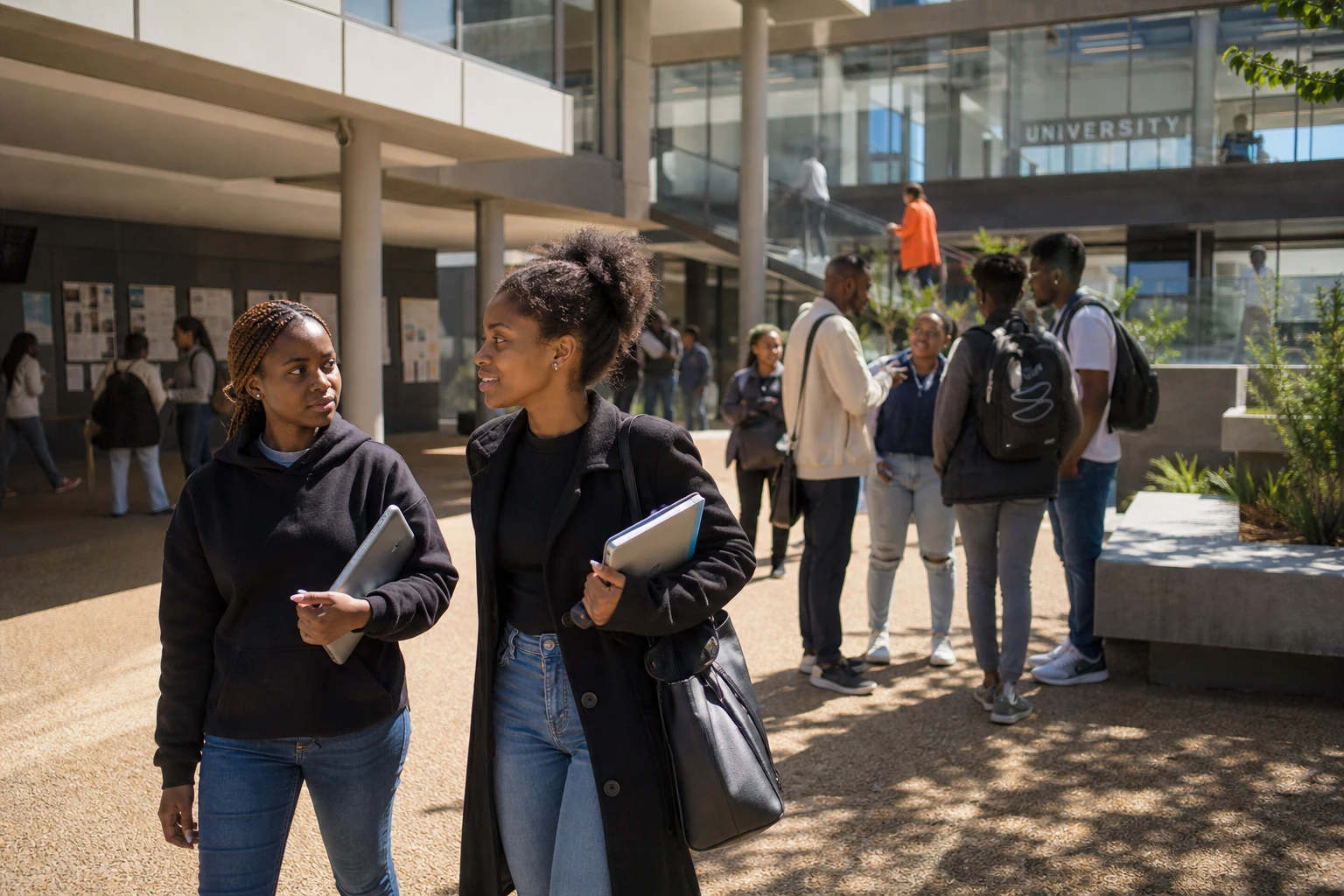
In South Africa, the real barrier is no longer the university gates. It comes after enrolment, in lecture halls, residences, on public transport and in students’ bank accounts. In 2025, the country produced more than 656,000 secondary school graduates eligible to pursue higher education, but the gap between entry and completion remains stark. A significant proportion of first-year students still drop out before establishing a stable path through their studies.
This divide is not confined to campuses. It affects the administrative capital, Pretoria, major university cities such as Johannesburg, Durban and Bloemfontein, and the wider South African post-school system. As a member of SADC, the Southern African Development Community, the issue of higher education also bears on regional mobility, workforce skills and the ability to retain young talent in the formal economy.
A pact for what happens after enrolment
Gathered in Johannesburg around the Siyaphumelela network, the higher education sector sought to shift the debate. The challenge is no longer simply to open universities, but to ensure that students succeed there. Launched in 2014, the network works with 20 of the country’s 26 public universities, at the heart of South Africa’s public system. It is led by Saide, an organisation based in Johannesburg, and financially supported by the US-based Kresge Foundation.
This framework was not improvised. The network’s work has already shown that closer monitoring of students’ progress can change an institution’s trajectory. In the programme’s second phase, six of the seven partners achieved first-year retention rates above 90%. Three institutions also improved graduation rates by 15% in three- and four-year programmes, according to figures released by the organisers. The message is clear: student success can be managed, provided institutions track data, dropouts and learners’ real needs.
At the heart of this discussion, the Department of Higher Education and Training spoke of a “national pact for skills and knowledge”. The phrase says much about the shift under way. The state, universities, philanthropists, the private sector and civil society are being asked to share the responsibility. The aim is to move away from a model in which universities admit students alone, then improvise in response to dropouts, debt and disengagement.
Why so many students leave the system
University dropout rates in South Africa cannot be explained by academic ability alone. Network and ministry officials point above all to financial pressure, housing, transport and mental health. These factors weigh heavily on first-generation students, many of whom come from households already under strain. In this context, entering university guarantees neither stability nor social mobility.
Public funding nevertheless plays a major role. The National Student Financial Aid Scheme, or NSFAS, supports a large share of public university students. But aid does not solve everything. The country is also grappling with student debt that has become a heavy burden for institutions. In May 2026, Parliament cited total outstanding debt of 59 billion rand across the post-school system, including 29 billion rand linked to students funded by NSFAS. This shows that in South Africa the issue is not just tuition fees. It also concerns universities’ financial sustainability and continuity in students’ studies.
The social picture makes the challenge even more urgent. In the first quarter of 2026, unemployment among 15- to 24-year-olds stood at 60.9%, while the share of young people not in employment, education or training was 37.6%. In this context, a degree offers relative protection, not an absolute guarantee. But without one, exclusion from the labour market becomes almost automatic. The task facing universities is therefore also an economic one.
What this shift means for the country
The pact discussed in Johannesburg has implications beyond educational reform. It seeks to bring together several public policies: student funding, psychological support, housing, transport, tutoring, guidance and data collection. This also requires a cultural shift within universities. The challenge is no longer simply to admit more students, but to organise support for cohorts that are more diverse, more vulnerable and larger.
The timetable adds to the pressure. The Kresge Foundation said it had invested nearly $40 million in Siyaphumelela, with funding running until 2027. The network must therefore prove that it can move beyond being a project backed by an external donor and become a sustainable national approach. That is where the “pact” takes on political significance: it must distribute responsibility rather than concentrate it in a handful of foundations or pilot universities.
For public universities, the stakes are immediate. Large institutions absorb most enrolments and requests for aid. Institutions outside major centres, meanwhile, must contend with students who sometimes arrive with fewer material resources, less preparation and greater transport difficulties. The gap between urban centres, the periphery and remote areas therefore remains real, even within a unified national system.
A South African issue, but an African one too
This debate extends beyond South Africa. Across the continent, universities are taking in more students, but success, employment and financial sustainability are becoming the main pressure points. The South African case is therefore of interest to SADC and the African Union, as it raises a simple question: how can educational expansion be turned into genuine mobility, rather than simply longer queues outside unemployment offices?
South Africa’s response will be closely watched. If the announced pact leads to practical coordination between the state, universities and the private sector, it could serve as a model for other countries facing the same dilemma. If it remains another slogan, the system will continue to open its doors wide while leaving too many students short of a degree. For Pretoria and the rest of southern Africa, an important part of the educational and social future is at stake.



