
 Algeria
 Egypt
 Libya
 Morocco
 Sudan
 Tunisia
 Benin
 Burkina Faso
 Cabo Verde
 Côte d'Ivoire
 Ghana
 Guinea
 Guinea-Bissau
 Liberia
 Mali
 Mauritania
 Niger
 Nigeria
 Senegal
 Sierra Leone
 The Gambia
 Togo
 Cameroon
 Central African Republic
 Chad
 DR Congo
 Equatorial Guinea
 Gabon
 Republic of the Congo
 São Tomé and Príncipe
 Burundi
 Comoros
 Djibouti
 Eritrea
 Ethiopia
 Kenya
 Madagascar
 Malawi
 Mauritius
 Mozambique
 Rwanda
 Seychelles
 Somalia
 South Sudan
 Tanzania
 Uganda
 Angola
 Botswana
 Eswatini
 Lesotho
 Namibia
 Zambia
 Zimbabwe
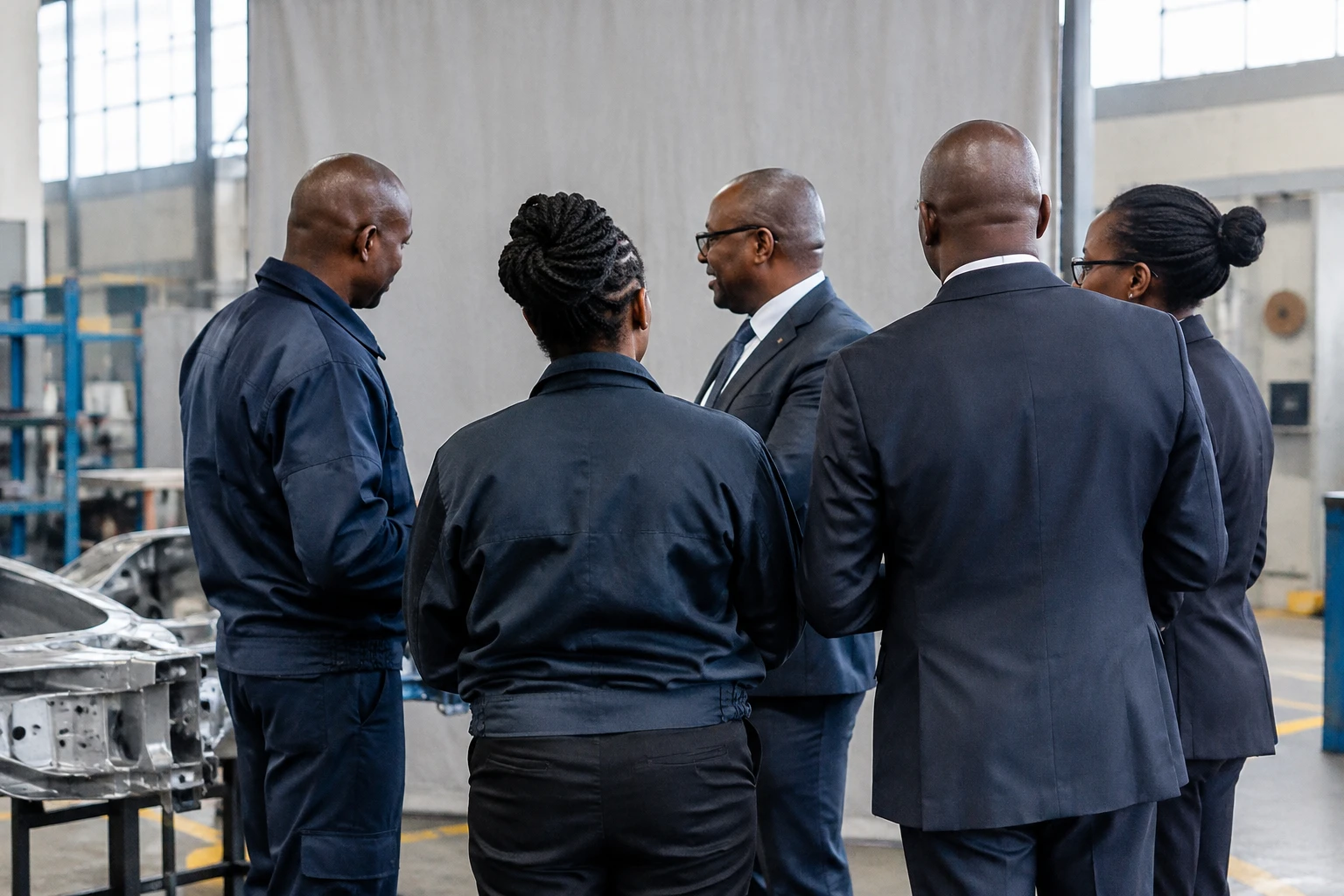
A factory running below capacity is more than a falling line in the statistics: it can affect suppliers’ orders, workers’ incomes and activity in industrial hubs. In South Africa, the latest figures reveal this contrast: a slightly better quarter, but a sharp annual fall in output in September.
Quarterly growth, September decline
South African manufacturing output fell by 3.5% in September 2026 compared with September 2025, according to Statistics South Africa, the national statistics agency. This figure compares two months a year apart. It therefore does not mean that output fell by 3.5% between August and September: adjusted for seasonal variations, it was unchanged month on month.
The steepest declines were in vehicles, parts and transport equipment, down 15%. Wood, paper, publishing and printing fell by 11.2%. Furniture and other manufacturing activities dropped by 19%. Iron and steel, metal products and machinery also weighed on the index. These figures are set out in Statistics South Africa’s report on manufacturing production and sales.
The third-quarter picture was less bleak. Between July and September, output rose by 0.9% compared with the previous three months. Food and beverages supported this trend, rising by 4.9%. Iron and steel, and the manufacture of metal products and machinery, also contributed to the increase.
Sales followed a similar trajectory, but should not be confused with production volumes. They fell by 2.2% in September compared with the previous month, after rising by 1.3% in August and 4.8% in July, according to Stats SA’s monthly data. Over the quarter, however, they increased by 3.2% compared with the second quarter. Vehicles and transport equipment, petroleum and chemical products, rubber, plastic, food and beverages drove this rise.
Challenges extend beyond one month’s results
The sector entered this period after a difficult first half. Manufacturing contracted by 1.8% in the second quarter of 2026, according to Stats SA. The South African Reserve Bank also describes a fourth consecutive quarterly decline in secondary-sector activity, which includes manufacturing. At the same time, the country’s gross domestic product fell by 0.2%, after growing by 0.4% in the first quarter. National statistics and the central bank point to weak activity, although their indicators do not measure exactly the same thing.
The pressure is also evident in formal employment. In the second quarter, manufacturing lost 20,000 jobs, the largest decline among the sectors covered by the quarterly survey of non-agricultural employment. This figure does not describe all work in South Africa: it concerns formal employment measured by the survey. It nevertheless offers a concrete indication of how an industrial slowdown can affect workers and their households.
Manufacturing accounts for about 13% of South Africa’s GDP and more than 1.6 million direct jobs, according to the Department of Trade, Industry and Competition. It also links very different activities: processing mineral resources, automotive production, agriculture, transport and services. A decline can therefore spread to suppliers and subcontractors, while a recovery does not necessarily benefit all industries or regions at the same pace.
Industrial strategy put to the test
In June 2026, the government approved a revised industrial strategy built around three priorities: decarbonising production, diversifying the economy and accelerating its digitalisation. The plan identifies steel, automotive, manufacturing and mining as strategic sectors. The South African Cabinet statement confirms its adoption. It is a policy direction; September’s figures are not yet sufficient to assess its results.
The strategy aims in particular to expand local processing, rather than limiting the country’s role to extracting or exporting raw materials. It also focuses on activities related to electric vehicles and the energy transition. But intentions are not enough: companies need reliable infrastructure, investment and markets to maintain or increase production. The parliamentary committee responsible for trade has also warned that austerity measures could complicate the plan’s implementation.
Pretoria therefore faces a dual challenge: supporting activities exposed to current declines while developing new industrial capacity. Large exporting companies, local suppliers and workers are not affected in the same way. National data alone do not detail the consequences for each employment hub or for informal workers connected to production chains.
An issue extending beyond South Africa’s borders
South Africa occupies a distinctive position in southern African industry, particularly in automotive manufacturing. The Southern African Development Community (SADC), a regional economic co-operation organisation, is seeking to strengthen value chains and trade among its member states. Its industrialisation strategy aims to better link national and regional production capacity. A slowdown in South African factories could therefore affect suppliers and cross-border trade, although the extent of these effects depends on the companies and industries involved.
The next question is whether quarterly growth of 0.9% will become established or whether declines in automotive, wood, paper and furniture will continue. Statistics South Africa’s next releases will make it possible to track production, sales and employment. For SADC, the challenge is broader: to turn regional resources and markets into sustainable productive activity, without industrialisation depending on a single country or industry.



