
 Algeria
 Egypt
 Libya
 Morocco
 Sudan
 Tunisia
 Benin
 Burkina Faso
 Cabo Verde
 Côte d'Ivoire
 Ghana
 Guinea
 Guinea-Bissau
 Liberia
 Mali
 Mauritania
 Niger
 Nigeria
 Senegal
 Sierra Leone
 The Gambia
 Togo
 Cameroon
 Central African Republic
 Chad
 DR Congo
 Equatorial Guinea
 Gabon
 Republic of the Congo
 São Tomé and Príncipe
 Burundi
 Comoros
 Djibouti
 Eritrea
 Ethiopia
 Kenya
 Madagascar
 Malawi
 Mauritius
 Mozambique
 Rwanda
 Seychelles
 Somalia
 South Sudan
 Tanzania
 Uganda
 Angola
 Botswana
 Eswatini
 Lesotho
 Namibia
 Zambia
 Zimbabwe
In Pretoria, health vigilance adapts to regional movements
When an epidemic spreads in Central and East Africa, borders do not always close. They are reorganised. That is the approach taken by South Africa, which is now stepping up health screening for travellers arriving from the Democratic Republic of the Congo and Uganda. In a densely connected mobility zone, linking capitals, aviation hubs and trade corridors, prevention often relies on targeted checks rather than general bans.
This tightening also comes amid a broader regional context. Southern Africa, guided by SADC, is closely monitoring health alerts that emerge far beyond its borders but can quickly travel there. Pretoria, the administrative capital of the Republic of South Africa, is seeking to protect its points of entry without cutting off essential flows of people, business and healthcare. The aim is straightforward: maintain movement while reducing the risk of importing a highly lethal virus.
What Pretoria is putting in place for travellers from the DRC and Uganda
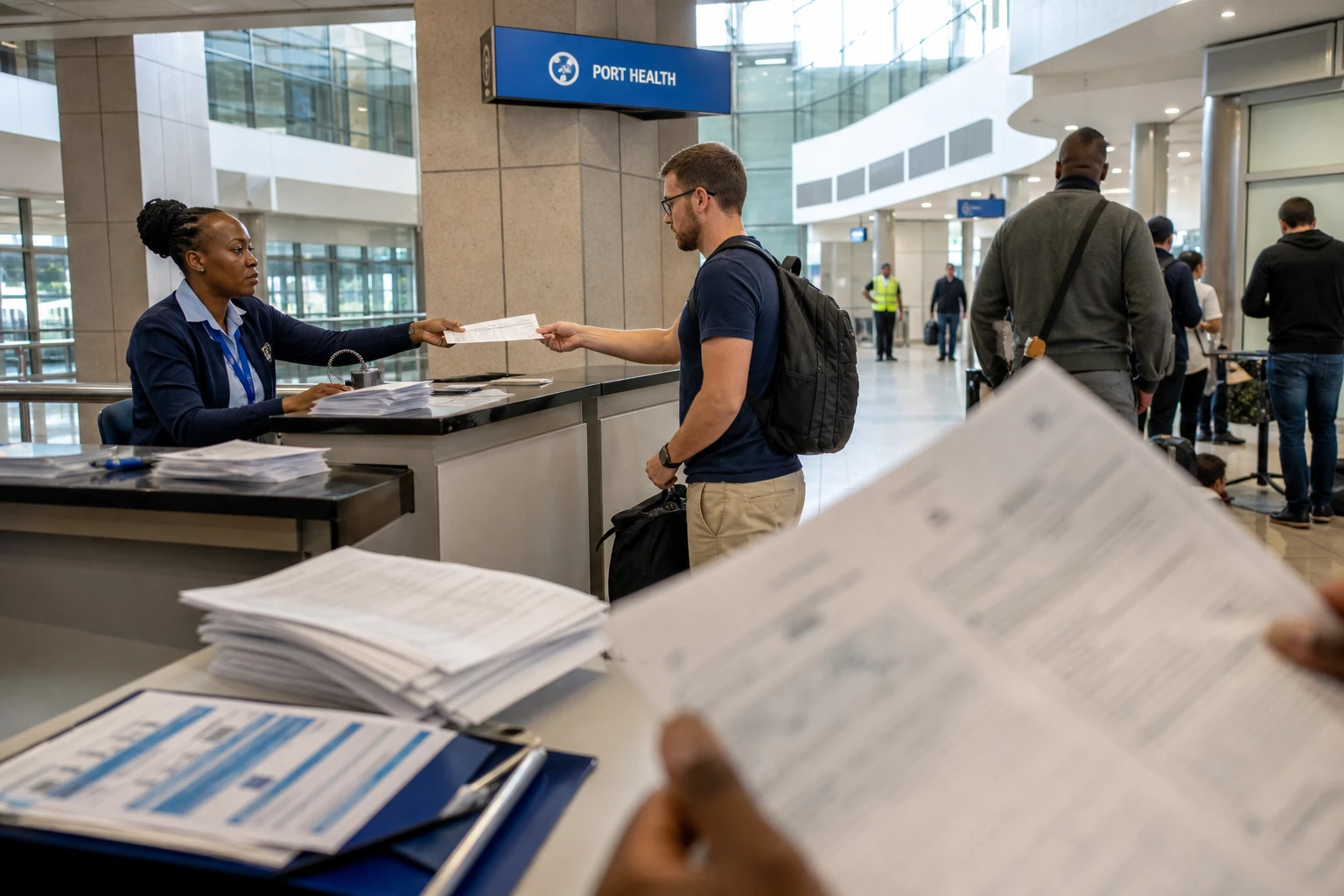
Since Monday 20 July, anyone travelling to South Africa from the DRC or Uganda has had to complete a Travel Health Questionnaire within 24 hours before departure. South Africa’s health ministry describes the form as a pre-screening tool. It is intended to help health surveillance teams on arrival while speeding up formalities at airports and other points of entry.
The measure does not amount to a travel ban. It adds a screening step. That distinction matters, because South Africa remains a major aviation hub on the continent. Its health authorities are therefore seeking to avoid unnecessary disruption for passengers, airlines and border services. In practice, the form is intended to identify symptomatic or exposed travellers more quickly, and then trigger care protocols if necessary.
The South African government says it is responding to the spread of the epidemic in the two countries concerned. It cites more than 2,000 confirmed cases and more than 800 deaths since the outbreak began in May. WHO figures show, however, that the situation is changing very quickly: as of 19 July 2026, the DRC had recorded 2,344 confirmed cases and 930 deaths, according to the World Health Organization, while Uganda had, on 16 July, entered the 42-day countdown to the possible end of the epidemic, with 20 confirmed cases and two deaths recorded by that date. The two sets of figures are therefore not identical because they cover different dates and scopes.
Why Ebola is a regional issue, not just a local one
South Africa’s alert is explained by the nature of this outbreak. WHO says that the Bundibugyo subtype of the Ebola virus, which is involved in this crisis, has no vaccine or validated specific treatment at this stage, although trials are under way. The organisation also points to a difficult context: a remote area, high population density, insecurity and significant cross-border movements. In other words, the virus is not circulating only in remote villages. It also travels along roads and with markets, health workers and travellers.
For the DRC, the challenge is primarily a public health one. In the east of the country, affected areas are already facing major constraints: access to healthcare, security, community surveillance and fragile supply chains. Uganda faces a different but related challenge: as of 16 July, the country had reported that 15 of the confirmed cases resulted from an importation from the DRC, evidence that an epidemic of this kind crosses borders through human mobility. Uganda’s response therefore relies on rapid screening, contact tracing and cross-border co-operation.
For South Africa, the challenge is preventive and institutional. The country wants to prevent an imported case from triggering a chain of transmission on its territory, even though the risk is contained by health checks and a health system better resourced than those in other crisis settings. But the measure also has economic implications. In an open economy, airport formalities, waiting times and health screening procedures have a direct effect on business travellers, students, families and air transport operators. Pretoria’s approach is therefore designed to reduce the risk without abruptly slowing trade and travel.
What this decision says about Africa’s response to public health emergencies
This episode is a reminder of a reality that is often underestimated: African responses to health crises are not only national. They are regional, and then continental. WHO says it is also strengthening surveillance, contact tracing, clinical preparedness and cross-border co-operation between the DRC and Uganda. Meanwhile, WHO Africa and national health authorities are publishing regular updates. This framework matters because it makes it possible to act quickly before cases cross new geographical thresholds.
The continental implications are clear. When an outbreak affects the Great Lakes region, its effects extend beyond the countries directly affected. Regional capitals, airlines, border health services and mobile communities adjust their alert levels. In Southern Africa, as elsewhere, the issue is not to stigmatise travellers from affected areas. Rather, it is to maintain safe travel corridors, with clear, proportionate rules that are reassessed as the epidemic evolves.
Two developments now need to be monitored. One is the true scale of the outbreak in the DRC, where the latest available figures show it continuing to spread rapidly. The other is Uganda’s ability to stay on course towards ending its epidemic without a new chain of transmission. If these trends hold, South Africa’s measures can remain targeted. If they worsen, Pretoria will probably have to adjust its border screening arrangements again.



