Algeria
 Egypt
 Libya
 Morocco
 Sudan
 Tunisia
 Benin
 Burkina Faso
 Cabo Verde
 Côte d'Ivoire
 Ghana
 Guinea
 Guinea-Bissau
 Liberia
 Mali
 Mauritania
 Niger
 Nigeria
 Senegal
 Sierra Leone
 The Gambia
 Togo
 Cameroon
 Central African Republic
 Chad
 DR Congo
 Equatorial Guinea
 Gabon
 Republic of the Congo
 São Tomé and Príncipe
 Burundi
 Comoros
 Djibouti
 Eritrea
 Ethiopia
 Kenya
 Madagascar
 Malawi
 Mauritius
 Mozambique
 Rwanda
 Seychelles
 Somalia
 South Sudan
 Tanzania
 Uganda
 Angola
 Botswana
 Eswatini
 Lesotho
 Namibia
 South Africa
 Zambia
 Zimbabwe
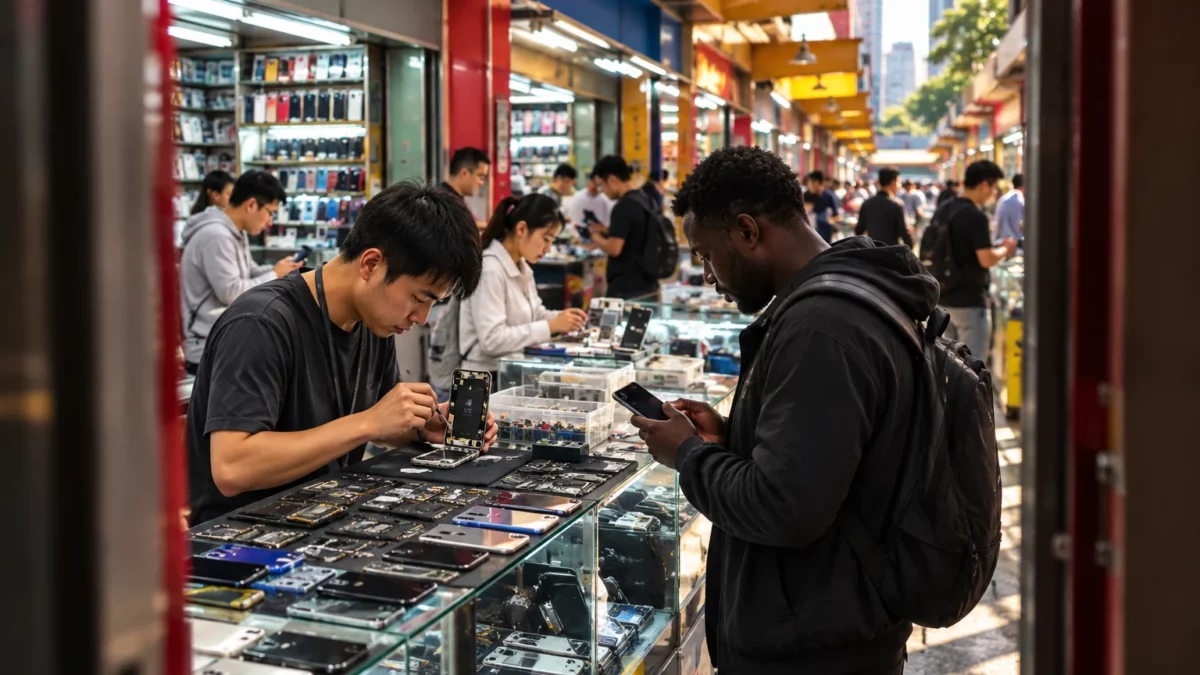
In Shenzhen, a cracked screen does not always mean a phone cannot be sold. For traders from Nigeria, Algeria or Pakistan, repairing a device bought in China can provide access to more affordable smartphones in their local markets, while sustaining a specialised cross-border trade.
From Shenzhen to shops in Lagos and Algiers
The Huaqiangbei district in the Chinese metropolis of Shenzhen brings together component sellers, repairers and electronics wholesalers. Foreign buyers inspect devices individually or in batches, sometimes damaged, intending to repair them before resale. The city also hosts more organised spaces, where phones are displayed alongside inspection reports that can be viewed via QR code.
This supply chain links distinct economic hubs. Shenzhen has a large supply of phones and spare parts; Nigerian, Algerian or Pakistani traders then handle sourcing, repair or distribution in their countries. The benefits and risks are not shared equally: the importer advances the funds and bears responsibility for defects, while the end customer seeks a working device at a lower price than a new one.
Accounts from traders at the market offer a concrete picture of these purchases, but are not enough on their own to estimate export volumes to each country. A Nigerian trader says he bought about 40 phones in one day. An Algerian buyer describes frequent trips to China to stock his shop. These accounts illustrate individual journeys, not a representative measure of the sector as a whole.
Low prices are not enough: a phone’s condition matters
The second-hand market encompasses several realities. Some devices are resold as they are; others are repaired, tested and graded according to their condition. A damaged phone may cost less to buy, but replacing a screen, battery or other components reduces the margin and may delay resale. Buyers must also check that the device works, establish its origin and ensure that the previous owner’s data has been erased.
Vendors at a specialised commercial space in Shenzhen say they offer more than 20,000 used phones. iPhones are said to make up a large share, alongside models from Huawei, Xiaomi, Oppo and Vivo. This structured offering exists alongside the more informal negotiations in Huaqiangbei: the two channels may meet different needs, but their guarantees and inspection procedures are not necessarily equivalent.
The context helps explain the appeal of these devices. A GSMA study on smartphone adoption in Africa finds that access to devices remains a barrier to mobile internet use. It distinguishes phones simply resold from devices refurbished by specialists and certified models, which are generally associated with more robust checks and guarantees. The informal market can offer lower prices, but exposes buyers to greater uncertainty over quality and after-sales service.
A second life for devices, in a trade still hard to measure
China has a vast pool of used devices. The China Association of Circular Economy estimates that more than 400 million phones are discarded in the country each year. This figure refers to devices taken out of use, not to as many phones being exported or necessarily recycled: some are kept, reused or channelled through different collection and resale routes.
The global second-hand market is also growing. Counterpoint Research tracks second-hand smartphone volumes and estimates that global sales reached 150 million units in the first half of 2026, up 13% year on year. This total covers the global market; it does not specify the share destined for African countries. The research firm also highlights the growth of refurbished phones in India, where the price of new devices is pushing consumers towards higher-end second-hand models.
For traders, sourcing takes time and careful inspection. Purchase prices cited by some sellers do not automatically correspond to the final price: transport, possible duties, repairs, unsold stock and exchange-rate fluctuations all affect the calculation. A margin cited by one buyer therefore cannot be generalised to all transactions.
A question of trust and digital access
Consumers in urban centres and remote areas do not always have the same choices. Specialist shops may offer a wider range of models and quick repairs, while access to a reliable seller or compatible parts may be more limited elsewhere. In formal economies and informal markets alike, a phone’s actual lifespan also depends on repair costs and the availability of software updates.
Resale extends a device’s use and can prevent it from becoming electronic waste too soon. But resale alone does not constitute a recycling chain: irreparable phones, batteries and components still need to be handled properly. Traceability, data protection and clear inspection criteria are therefore essential to ensure that a lower price does not come at the cost of a breakdown, data loss or poorly managed disposal.
Across the continent, this movement is part of a broader debate on digital inclusion and the cost of devices. In Nigeria, the Democratic Republic of the Congo, Ethiopia, Rwanda, Tanzania and Uganda, industry players have launched initiatives to improve access to affordable 4G smartphones. The second-hand trade can complement these efforts, but cannot replace policies to improve access to new devices, local repair networks or warranty schemes.
The next stage will play out as much in destination markets as in Shenzhen: buyers will seek to secure quality, while consumers weigh price against reliability and length of software support. The growth of the second-hand market will be measured less by the number of phones shipped than by their ability to remain useful, repairable and safe once they reach their new owners.