Algeria
 Egypt
 Libya
 Morocco
 Sudan
 Tunisia
 Benin
 Burkina Faso
 Cabo Verde
 Côte d'Ivoire
 Ghana
 Guinea
 Guinea-Bissau
 Liberia
 Mali
 Mauritania
 Niger
 Nigeria
 Senegal
 Sierra Leone
 The Gambia
 Togo
 Cameroon
 Central African Republic
 Chad
 DR Congo
 Equatorial Guinea
 Republic of the Congo
 São Tomé and Príncipe
 Burundi
 Comoros
 Djibouti
 Eritrea
 Ethiopia
 Kenya
 Madagascar
 Malawi
 Mauritius
 Mozambique
 Rwanda
 Seychelles
 Somalia
 South Sudan
 Tanzania
 Uganda
 Angola
 Botswana
 Eswatini
 Lesotho
 Namibia
 South Africa
 Zambia
 Zimbabwe
The first challenge is not simply to raise chickens in Gabon. The country must also produce enough at an affordable price, and have the feed, veterinary care and abattoirs required. With six weeks to go before the announced deadline for reducing dependence on imports, the arrival of chicks in Libreville is putting this ambition to the test.
A sector to build before the 2027 deadline
Gabon is preparing to ban imports of broiler chicken from 1 January 2027. The measure is part of a national plan to develop poultry production. It concerns a widely consumed product and a sector that still depends heavily on external supplies.
The timetable is ambitious. Demand figures vary according to the sources and scope used: a Gabonese budget report estimates requirements at about 100,000 tonnes a year, while figures cited in the national press give different volumes for broiler chicken. These estimates are therefore not directly comparable. The government, for its part, puts current local production at about 5,000 tonnes a year, against estimated demand of 100,000 tonnes. Gabon’s economic and financial report thus highlights the considerable gap to be bridged.
This strategy is unfolding in a country that is a member of CEMAC, the Economic and Monetary Community of Central Africa, which brings together six states around a common market and currency. For Gabon, the issue extends beyond farms: it affects regional trade, commercial rules and the ability of domestic producers to meet demand without supply disruptions.
First batch distributed to farmers
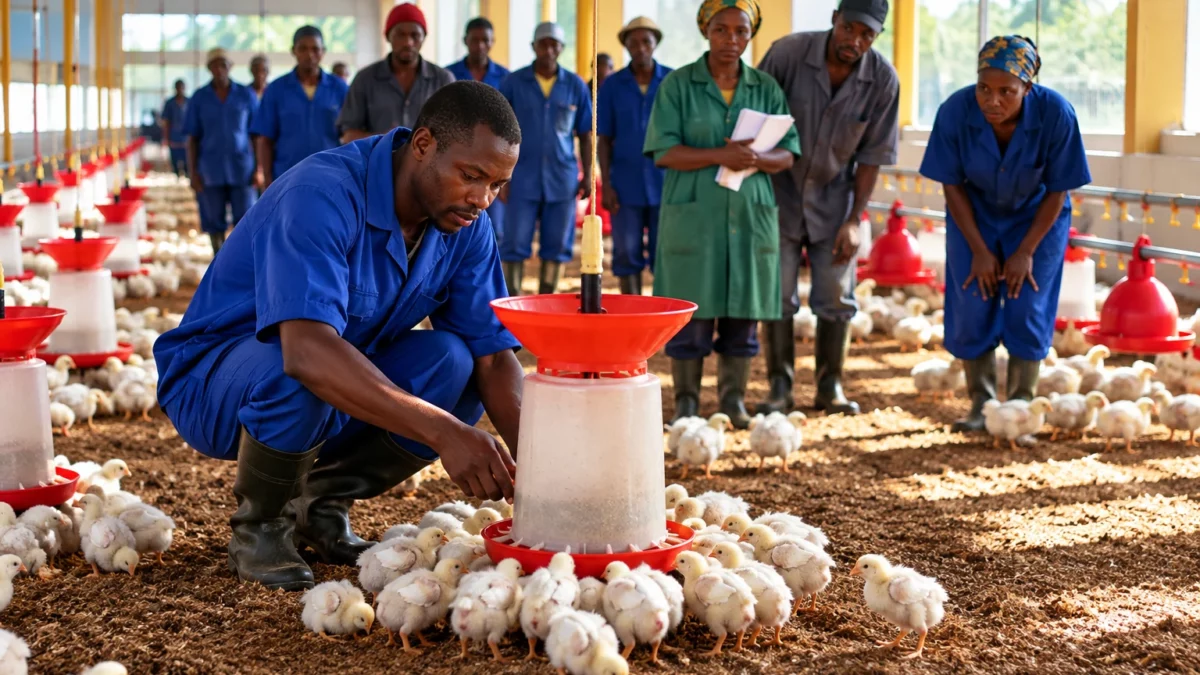
On Thursday 19 November 2026, a first batch of 37,600 day-old chicks, shipped from France, was received at Léon-Mba International Airport in Libreville. Pacôme Kossy, the Minister of Agriculture, Livestock and Rural Development, supervised the operation. Several Gabonese media outlets confirmed the date and volume, although some reports rounded the figure down to 37,000. Gabonews reports the arrival of 37,600 chicks, a figure also confirmed by GabonReview.
The delivery is part of the Emergency Operational Plan for the Poultry Sector, or POUFA. The first phase provides for the delivery of 262,400 chicks between 19 November and 17 December. It forms part of a total order of three million chicks, along with poultry feed and veterinary products for selected farms.
The first birds were handed to farmers whose farms are considered ready to receive them, particularly in and around Libreville and Ntoum. According to information published by the government, 81 farms are gradually benefiting from this initial supply scheme. Subsequent deliveries are to extend distribution beyond the capital region. The government sets out the farms involved and the timetable.
From farm to plate: the steps still to come
Distributing chicks is not enough to establish a poultry sector. They must be fed regularly, diseases prevented, farms financed, and slaughter, cutting, packaging and distribution organised. Without these links in the chain, increased farm production does not guarantee either a stable supply or affordable prices for households.
The public programme provides for feed and veterinary products. But regular deliveries will be crucial. Small producers rarely have the same storage and financing capacity as integrated businesses. A disruption to feed supplies or a lack of working capital can therefore have a greater impact on their farms. In time, access to abattoirs and sales channels will also matter for farms far from Libreville.
The authorities have announced investments in abattoirs and cutting and packaging facilities. These are intended to ensure that locally produced chicken reaches the market in a form comparable to imported products. Their commissioning timetable, capacity and geographical distribution remain to be verified. Consumers in Libreville do not necessarily face the same supply constraints as those in other provinces.
Official projections call for caution. The coordination committee estimates that production from the first scheme could reach about 448.7 tonnes by the end of December 2026 and the beginning of January 2027. Including local production outside the programme, national output is forecast to approach 796.7 tonnes by that point, according to the same assessment. These forecasts remain far below the government’s estimate of annual demand of 100,000 tonnes. The gap underscores that the first chicks mark a starting point, not an immediate answer to all needs.
A national deadline under regional scrutiny
For the authorities, reducing imports is intended to keep more value in the Gabonese economy and develop local agricultural businesses. For farmers, the immediate challenge is more concrete: receiving the promised inputs, selling their poultry and securing regular outlets. For households, success will also be measured by product availability and price.
1 January 2027 is therefore an implementation test. At a meeting on 11 November, the government stood by the deadline and ruled out a postponement. But the available information points to a gradual start, with forecast production volumes still modest compared with estimated demand. The announced date and the actual capacity to replace imports are two distinct questions.
Gabon’s progress will be watched across the sub-region, where food trade and ambitions to boost local production concern several CEMAC countries. The next indicators will be the deliveries scheduled through 17 December, the ramp-up of farms, feed availability and the effective opening of processing facilities. These are the steps that will determine whether Gabon can turn a trade measure into a sustainable local supply.