
 Algeria
 Egypt
 Libya
 Morocco
 Sudan
 Tunisia
 Benin
 Burkina Faso
 Cabo Verde
 Côte d'Ivoire
 Ghana
 Guinea
 Guinea-Bissau
 Liberia
 Mali
 Mauritania
 Niger
 Nigeria
 Sierra Leone
 The Gambia
 Togo
 Cameroon
 Central African Republic
 Chad
 DR Congo
 Equatorial Guinea
 Gabon
 Republic of the Congo
 São Tomé and Príncipe
 Burundi
 Comoros
 Djibouti
 Eritrea
 Ethiopia
 Kenya
 Madagascar
 Malawi
 Mauritius
 Mozambique
 Rwanda
 Seychelles
 Somalia
 South Sudan
 Tanzania
 Uganda
 Angola
 Botswana
 Eswatini
 Lesotho
 Namibia
 South Africa
 Zambia
 Zimbabwe
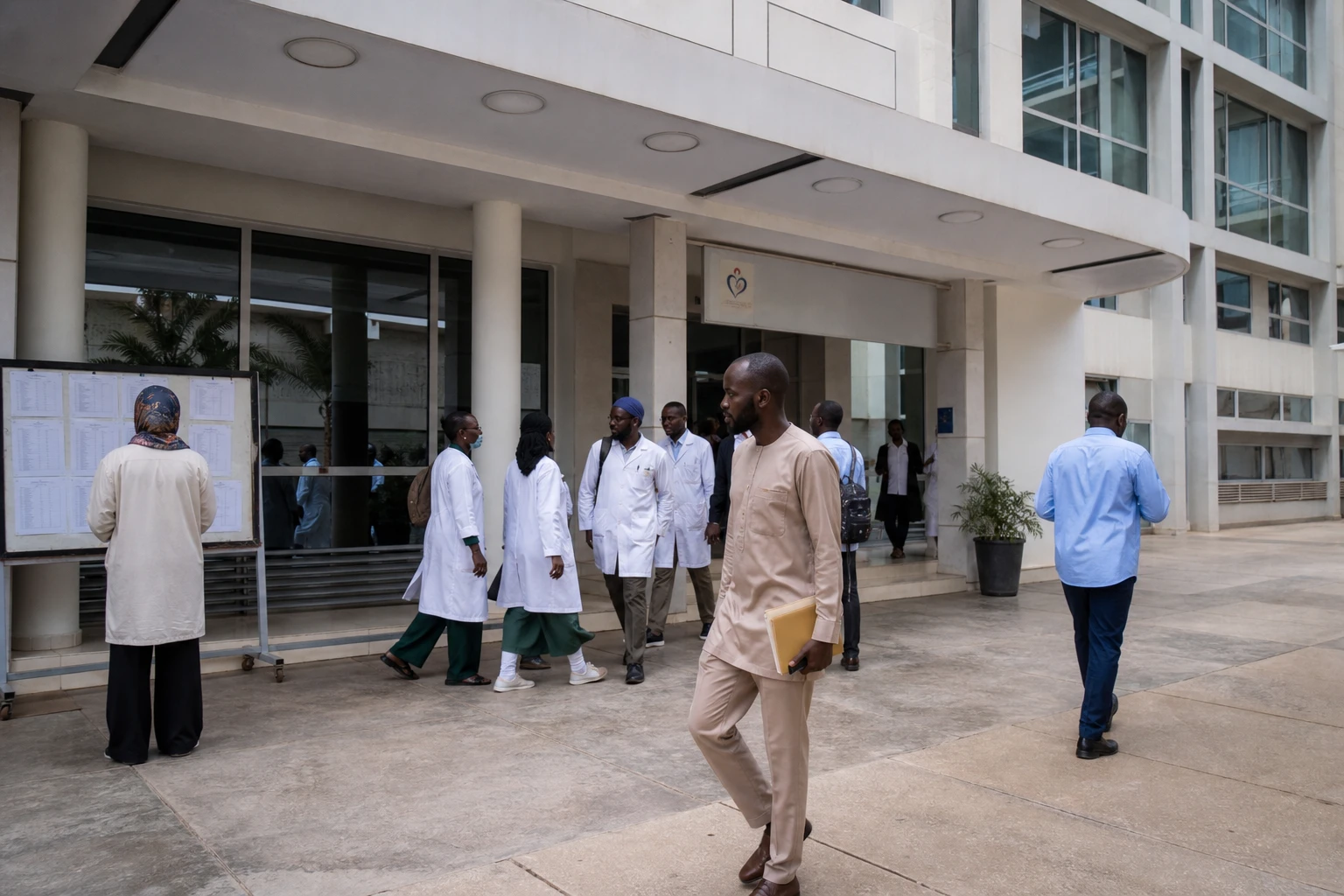
Young people trained, but still too few absorbed
In Dakar, as in several African capitals, one question keeps coming up: how can graduates be turned into health workers who remain in the health system over the long term? In Senegal, the answer now involves a broader bet than public-sector jobs alone: bringing training, employment and entrepreneurship closer together in a sector where needs remain high.
It is in this spirit that the Africa Health Collaborative programme is emerging as a route into work for young health professionals. Implemented since April 2024, it aims to support 7,000 young people in Senegal by 2027, after the health authorities reported that 1,037 beneficiaries had already been enrolled. The programme brings together the Ministry of Health, the Mastercard Foundation and AMREF, a public health organisation operating in several countries across the continent.
A national undertaking within a broader reform
Senegal is not addressing this issue in isolation. The country has embarked on a transformation of its health system, with a new 2026-2030 health map, discussions on universal health coverage and a stated effort to address imbalances between Dakar and the regions. The logic is simple: distribute skills more evenly, plan recruitment better and serve areas far from the capital more effectively.
This approach also aligns with the regional trajectory. ECOWAS, through its West African Health Organisation, is urging member states to strengthen health co-operation. At the same time, the African Union and WHO are calling for health workforces to be scaled up, a link that has become central after successive health crises across the continent.
In this context, the AHC programme is about more than employment. It is part of a public policy seeking to make the health sector a source of jobs, as well as a space for innovation, entrepreneurship and a stronger presence across the country.
What the programme involves
According to details made public in Dakar, the programme rests on three pillars. The first concerns employment and employability, through support for young people and the training of trainers. The second aims to promote entrepreneurship in health, to reduce reliance on public-sector recruitment alone. The third focuses on strengthening the health ecosystem, including institutional capacity, the quality of the working environment and alignment with the national strategy for transforming the health system.
The announced budget for the programme is CFAF 4bn, or about $6m. The authorities have already cited 80 supported entrepreneurial initiatives. This deserves attention. In a country where some graduates wait a long time for a job in the administration, support for private or mixed-economy activities could offer a quicker route into work, provided that guidance, financing and regulation keep pace.
The Ministry of Health has also expanded the programme to all 14 regions of Senegal. The project, initially limited to Dakar, Diourbel and Kaolack, now follows a nationwide approach. This is an important change, since needs are not concentrated in the capital. They are also evident in the southern and eastern regions, where access to care remains more fragile.
Regional imbalance remains the real test
Figures from the National Agency for Statistics and Demography show the scale of the challenge. In 2022, the number of doctors in Senegal rose to 2,057, from 1,707 in 2021, an increase of 20.5%. But this growth did not eliminate geographical disparities. Dakar accounted for 42.4% of health workers, compared with 10% for Thiès. Sédhiou and Kédougou were at the bottom of the list, with 2.5% each.
In other words, the country does not simply lack staff. It also lacks staff where needs are most pressing. This reality weighs on rural communities, pregnant women, obstetric emergencies and primary care facilities. It also affects municipalities far from major urban centres, where the cost of medical transport and the time it takes to reach care remain high.
WHO’s annual report on the health workforce in Africa helps explain this tension. In 2024, the continent had 5.72 million health professionals, but met only about 46% of estimated needs. The organisation also notes that many trained professionals remain unemployed or are considering migration. The paradox is clear: training is expanding, but the labour market is not absorbing enough people.
A social, budgetary and political issue
In Senegal, the issue also intersects with the budget. The 2026 finance bill provides for the recruitment of 2,250 technical staff and 250 support staff in the health sector. The budget document also mentions the construction of 35 health centres in rural areas. This is an important signal, showing that the state is seeking to link employment, health coverage and infrastructure.
But the equation remains a difficult one. Public-sector recruitment will not be enough to absorb all young graduates. It can, however, support the most understaffed services, provided it is backed by a retention policy. Salaries, working conditions, housing, equipment and career prospects matter just as much as the number of vacancies.
The private sector also has a role to play. The 2025-2029 sector policy letter says it can create jobs and expand the provision of care. In practice, this means more clinics, practices, diagnostic centres and local facilities, but also greater access to them in secondary cities and rural areas.
What Senegal could contribute across Africa
Senegal’s experience is attracting interest beyond Dakar. Many African countries face the same sequence of challenges: rising numbers of graduates, a shortage of jobs, health workers concentrated in cities, departures abroad and pressure on public hospitals. If the programme succeeds in creating lasting career opportunities, it could serve as a model for the transition from training to employment in health.
What happens next will depend above all on two milestones. First, the practical implementation of the 2026 budget, which will show whether announcements translate into jobs, equipment and visible projects. Second, the monitoring of the 2026-2030 health map, which will need to show whether the least well-resourced regions finally receive a fairer share of resources.
Ultimately, Senegal faces a dual challenge: giving a trained generation a genuine place in the workforce, and making the health system a more equitable service between Dakar and the rest of the country. Only then will jobs for young health workers cease to be a promise and become a public health lever.



