
 Algeria
 Egypt
 Libya
 Morocco
 Sudan
 Tunisia
 Benin
 Burkina Faso
 Cabo Verde
 Côte d'Ivoire
 Ghana
 Guinea
 Guinea-Bissau
 Liberia
 Mali
 Mauritania
 Niger
 Nigeria
 Sierra Leone
 The Gambia
 Togo
 Cameroon
 Central African Republic
 Chad
 DR Congo
 Equatorial Guinea
 Gabon
 Republic of the Congo
 São Tomé and Príncipe
 Burundi
 Comoros
 Djibouti
 Eritrea
 Ethiopia
 Kenya
 Madagascar
 Malawi
 Mauritius
 Mozambique
 Rwanda
 Seychelles
 Somalia
 South Sudan
 Tanzania
 Uganda
 Angola
 Botswana
 Eswatini
 Lesotho
 Namibia
 South Africa
 Zambia
 Zimbabwe
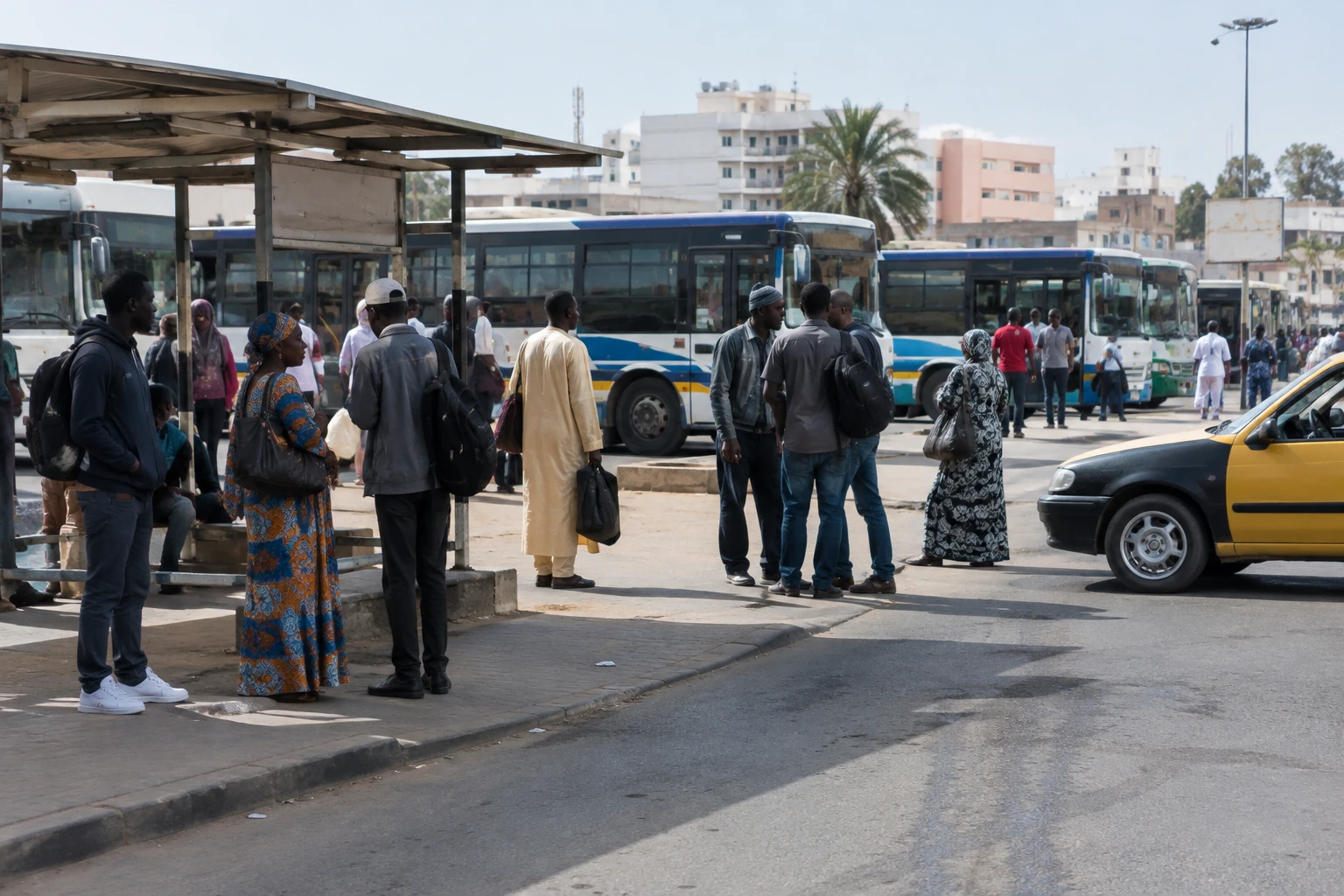
In Dakar, a strike is measured not only by the number of workers absent. When buses become less frequent, pupils miss lessons and public services slow down, its effects extend beyond workplaces. In Senegal, the three-day action is also testing the ability of the government and unions to resume substantive social dialogue.
A strike affecting several services
The strike call by the Trade Union Front for the Defence of Labour (FSDT) covers 21, 22 and 23 October 2026. The platform brings together trade union organisations from several sectors, including education, health, transport and justice. The action comes just days before the opening of the Youth Olympic Games (YOG), scheduled to take place in Dakar on 31 October.
The FSDT described the first day as “well followed”. This remains the organisers’ assessment: no independent overall rate measuring participation has been established in the information cross-checked. The level of participation also varies from one service to another. A teacher interviewed in Ouakam said she had chosen to remain in the classroom, believing that previous strikes had not led to lasting commitments.
In the capital, disruption to public transport has affected travel. Passengers have had to find alternative routes or allow more time for their journeys. But the picture is not uniform: before the action began, the minister in charge of transport had said the sector would not be affected. Information subsequently published by Senegalese media reports that workers at Dakar Dem Dikk were requisitioned, a sign of tensions over maintaining services.
Dakar’s governor announced on 21 October that certain employees of the state-owned transport company had been requisitioned. RTS has also reported measures targeting employees of Dakar Dem Dikk and Senelec, the national electricity company. The authorities cite the need to maintain essential services. The FSDT contests the measure and calls it abusive. These positions, as reported by the parties concerned, are not in themselves enough to determine its legality.
Demands that extend beyond the strike
The action comes amid an already tense social climate. In April 2026, unions in Dakar called for commitments made under a national social stability pact signed with the government in May 2025 to be honoured. They cited difficulties relating in particular to purchasing power, working conditions and the implementation of agreements. This precedent helps explain the current mistrust: for some workers, the issue is not simply securing a new promise, but making sure previous commitments are followed through.
The cost of the strike is unevenly distributed. Workers taking part can defend their demands, but stoppages can also affect their incomes and expose some employees to requisition measures. For residents, transport interruptions make it harder to get to work, access healthcare and attend to administrative matters. Families and pupils risk falling behind at school, although some teachers have decided to keep classes running.
In Dakar, where public transport plays a central role in daily travel, the disruption particularly affects people with few alternatives. Outside the capital, the scale and impact of the action may vary according to the services available and the level of local participation. The information available does not provide a detailed nationwide breakdown by sector.
The Youth Olympics add to the pressure
The Youth Olympic Games will be held in Senegal from 31 October to 13 November 2026. They will be the first YOG organised in Africa. Their proximity gives the strike particular visibility, but does not reduce workers’ demands to a question of image or the sporting calendar.
A municipal employee on strike, quoted in accounts gathered in Dakar, contrasted the resources committed to the Games with workers’ sense that they are not recognised. The remark reflects a tangible political tension: an international event can command substantial resources, while public service employees are asking for their working conditions and the agreements reached to be treated as priorities.
For the authorities, requisitions are intended to prevent the interruption of services deemed essential. For unions, they risk restricting the right to strike. What happens next will therefore depend as much on the resumption of services as on the opening of talks capable of addressing the demands and disagreements over the measures taken.
A test for social dialogue in West Africa
Senegal is a member of the Economic Community of West African States (ECOWAS), a regional co-operation organisation. The labour dispute is not, in itself, a regional crisis. It does, however, speak to a broader question for West African countries: how to reconcile the continuity of public services, workers’ rights and the implementation of social agreements.
In the short term, the dates are clear: the strike is due to end on Friday 23 October, and the YOG open in Dakar on 31 October. The points to watch are participation in the remaining sectors affected, whether requisitions remain in force or are lifted, and whether talks between the government and unions resume. Without a verifiable agreement on the demands, the end of the strike call will not be enough to resolve the disagreement.
Cross-checked sources: Senegalese Press Agency on the transport minister’s position, RTS on requisitions at Dakar Dem Dikk and Senelec, SenePlus on the action and its social background and official Dakar 2026 Games document on the YOG dates.



