
 Algeria
 Egypt
 Libya
 Morocco
 Sudan
 Tunisia
 Benin
 Burkina Faso
 Cabo Verde
 Côte d'Ivoire
 Ghana
 Guinea
 Guinea-Bissau
 Liberia
 Mali
 Mauritania
 Niger
 Nigeria
 Sierra Leone
 The Gambia
 Togo
 Cameroon
 Central African Republic
 Chad
 DR Congo
 Equatorial Guinea
 Gabon
 Republic of the Congo
 São Tomé and Príncipe
 Burundi
 Comoros
 Djibouti
 Eritrea
 Ethiopia
 Kenya
 Madagascar
 Malawi
 Mauritius
 Mozambique
 Rwanda
 Seychelles
 Somalia
 South Sudan
 Tanzania
 Uganda
 Angola
 Botswana
 Eswatini
 Lesotho
 Namibia
 South Africa
 Zambia
 Zimbabwe
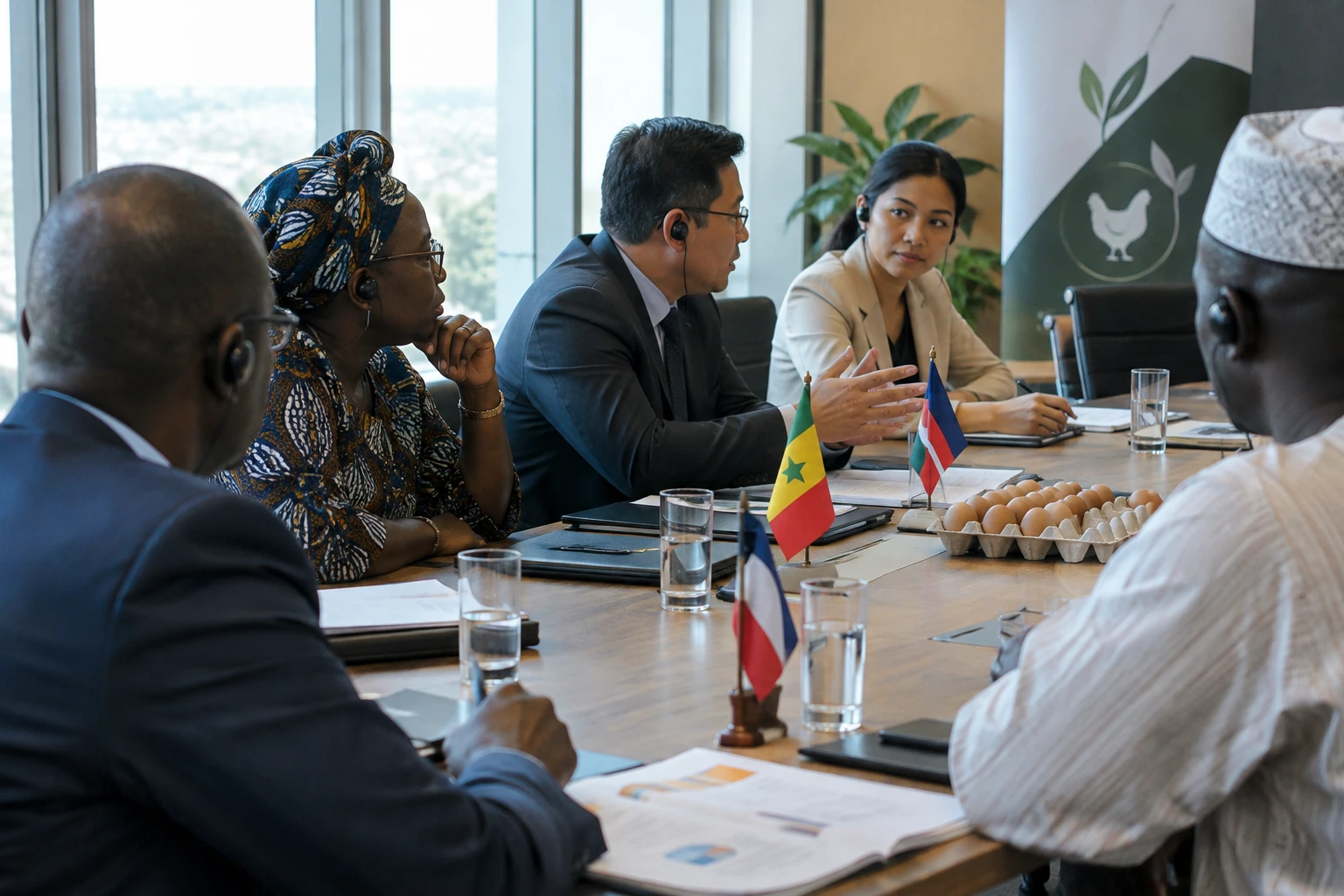
Could a new poultry plant in Senegal boost local supply without undermining businesses already established there? That is the question behind food group Charoen Pokphand’s declared interest, as the sector also attracts investors and producers call on the authorities to regulate its expansion.
A sector shaped by market protection
Since 2005, Senegal has suspended imports of several poultry products intended for consumption, notably poultry meat and table eggs. The measure, introduced amid health concerns linked to avian flu, has helped develop domestic production. It does not, however, mean the sector is entirely closed to trade: some inputs, such as hatching eggs, remain necessary for breeding.
This policy protects producers from competition with imported products, but also leaves local businesses responsible for meeting demand. The cost of animal feed, access to chicks, health standards and market outlets therefore account for a substantial part of poultry farms’ competitiveness.
The issue is part of a regional context in which Senegal is a member of ECOWAS, the Economic Community of West African States. The movement of goods and agricultural policies raise a fundamental question: how can robust local production be developed while preserving regional trade and consistent health rules?
Charoen Pokphand studies a move, but has no detailed plan
On the sidelines of an Indonesia–West Africa business meeting held in South Tangerang, Alex Rudini Sulaiman, economic affairs coordinator at Indonesia’s embassy in Dakar, said Charoen Pokphand was conducting a feasibility study to assess entering the Senegalese market.
The group operates across several poultry activities: animal feed production, poultry farming and chick production, as well as meat processing. But the information made public does not specify which segment is under consideration in Senegal, where a possible facility might be located, or its cost or timeline. At this stage, it is a study, not a confirmed investment.
Mr Sulaiman described Jakarta’s interest as a desire to encourage its companies to invest directly in manufacturing activities in West Africa. In his view, production based in Senegal could reduce costs. That prospect will nevertheless depend on industrial choices, the supply of inputs and the conditions for accessing the market.
Local producers call for capacity assessment
The announcement comes as the Senegalese Poultry Industry Association (IPAS) voices concerns about two separate foreign projects. At a press briefing in Thiès on 10 October 2026, its representatives referred to a project for a farm with one million laying hens in the region, attributed to Chinese investors, and another project expected in Diourbel, associated with Brazilian investors.
These projects are not Charoen Pokphand’s. Their progress and actual capacity remain to be established. IPAS nevertheless believes that a sharp increase in the number of laying hens could destabilise the market and put pressure on smaller-scale farms. Its secretary-general, Mamadou Bâ, said 60,000 jobs were at risk. This figure reflects the industry association’s warning; it is not an independently verified assessment.
The concerns go beyond prices and market shares. A large concentration of poultry farms can also increase demand for water, feed and veterinary services, as well as the volume of manure that needs to be managed. These risks depend on the sites, practices and planned safeguards. They call for a concrete assessment rather than a general conclusion based on the investors’ origins.
The effects would not be the same for everyone. Integrated units can produce at scale, secure some supplies and create salaried jobs. Smaller farms, however, often more exposed to fluctuations in feed costs and access to credit, may have less room to absorb falling prices. Traders and consumers, meanwhile, could benefit from increased supply if it leads to affordable and steady prices.
Senegalese companies are also investing
The sector is not limited to foreign projects. In November 2025, Senegalese company Gade Gui secured CFAF 2.5bn in funding from Proparco to build a laying-hen farm. According to information published by the financier, the facility is expected eventually to produce more than 80 million eggs a year. The project illustrates the growing capacity of domestic operators, but does not by itself guarantee that supply and prices will remain balanced.
In June 2026, La Ripaille also signed a CFAF 1.3bn investment agreement with Oyass Capital, an investment management company linked to Senegal’s Strategic Investments Sovereign Fund. The deal is intended, among other things, to support its laying-hen production and breeding activities. Meanwhile, Africaine de Production Animale (APRAN) has received funding from the International Finance Corporation to strengthen its animal feed and poultry farming activities.
This funding targets different parts of the supply chain. It could reduce some dependencies and support local supply. But capacity growth needs to keep pace with market outlets: producing more does not automatically mean farms will be able to sell at a price that covers their costs, or that consumers will pay less.
What happens next will matter more than the announcement
According to estimates cited by IPAS, chicken consumption is growing by 8 to 10% a year. This increase offers prospects, but does not on its own indicate demand for eggs, its geographical distribution or the pace at which new facilities could begin production.
For Senegal, the challenge is therefore less about choosing between foreign capital and domestic companies than about setting transparent conditions: assessing needs, complying with health and environmental requirements, monitoring employment and consulting farmers already in business. Such an assessment would also help distinguish announced projects from investments that are actually funded and operational.
Across West Africa, the issue raises a broader question: can agribusiness investment support competitive production without concentrating the gains and risks in a few large units? For Charoen Pokphand, the next information awaited is specific: the segment selected, the proposed site, the level of investment and local partnerships. Until these are known, the effects of its possible arrival remain uncertain.
Documentary sources: APS report on IPAS warnings ; details of Proparco’s funding for Gade Gui ; FAO review of Senegal’s poultry sector.



