
 Algeria
 Egypt
 Libya
 Morocco
 Sudan
 Tunisia
 Benin
 Burkina Faso
 Cabo Verde
 Côte d'Ivoire
 Ghana
 Guinea
 Guinea-Bissau
 Liberia
 Mali
 Mauritania
 Niger
 Nigeria
 Sierra Leone
 The Gambia
 Togo
 Cameroon
 Central African Republic
 Chad
 DR Congo
 Equatorial Guinea
 Gabon
 Republic of the Congo
 São Tomé and Príncipe
 Burundi
 Comoros
 Djibouti
 Eritrea
 Ethiopia
 Kenya
 Madagascar
 Malawi
 Mauritius
 Mozambique
 Rwanda
 Seychelles
 Somalia
 South Sudan
 Tanzania
 Uganda
 Angola
 Botswana
 Eswatini
 Lesotho
 Namibia
 South Africa
 Zambia
 Zimbabwe
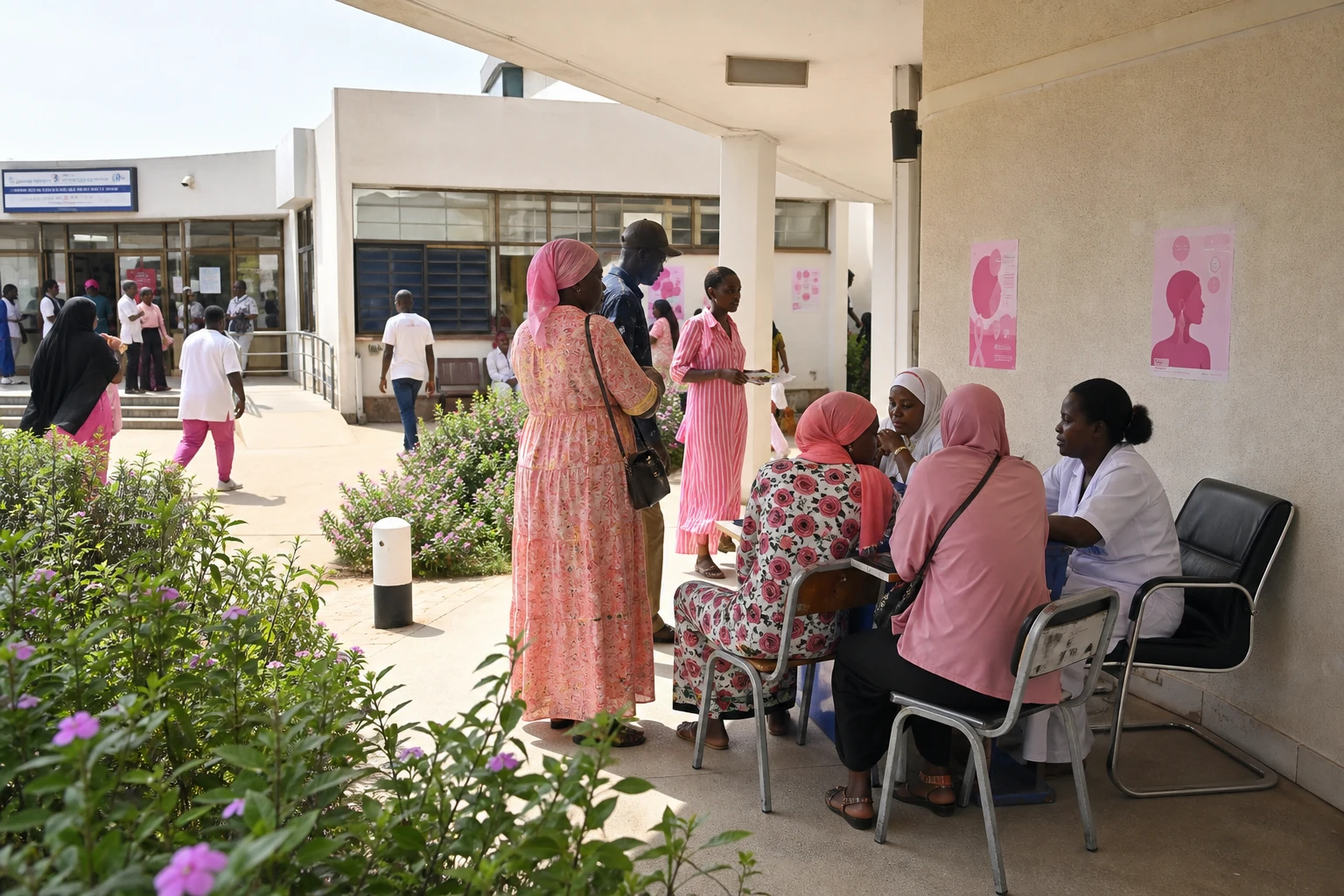
In Dakar, the Pink October campaign is about more than a colour. It brings a very practical question back to the fore: how can diagnostic delays be reduced when they still too often turn treatable breast cancer into a long and costly medical journey ?
On Sunday 27 September 2026, a walk organised in the Senegalese capital launched the 2026 edition of the campaign. Hundreds of Senegalese women and men took part, alongside the Senegalese League Against Cancer (LISCA) and health professionals involved in prevention.
A common cancer, but figures to treat with caution
LISCA president Fatma Guenoune announced around 2 220 new cases of breast cancer and more than 1 300 deaths each year in Senegal. These figures were released at the launch of the campaign and should be understood as estimates presented by the organisation.
International databases give a somewhat different picture. The International Agency for Research on Cancer’s GLOBOCAN 2022 estimates record 1 838 new cases and 976 deaths from breast cancer in Senegal. Senegal’s Ministry of Health uses these figures in its screening documents.
This difference does not necessarily mean that one figure is wrong. Reference years, data collection methods and the scope of the data may vary. Above all, it highlights the need to strengthen cancer registries in order to ensure more regular and precise national monitoring.
According to World Health Organization estimates for the African Region, Senegal has a breast cancer incidence rate of around 29.9 cases per 100 000 people. The issue is therefore part of a regional trend in which cancers affecting women account for a significant share of the burden on health systems.
Diagnostic delays remain the central challenge
In Senegal, as in several West African countries, access to care depends heavily on where people live, their income and the availability of specialists. A woman living in Dakar does not always face the same delays as a patient in a rural area or far from a hospital.
The care pathway may begin with a consultation, then require imaging, a biopsy and a pathological analysis. Each step requires qualified staff, equipment and financial resources. When diagnosis comes late, treatment is generally more complex.
Transport costs also weigh on families. Patients sometimes have to travel to the capital or a major city to obtain an examination or specialist opinion. For women working in the informal economy, a day spent in hospital can also mean lost income.
LISCA has announced consultations at its headquarters from 1 October 2026, Monday to Saturday. The organisation also plans awareness-raising and screening activities in several parts of the country. The aim is to bring information and services closer to communities, rather than concentrating the campaign solely in major urban centres.
Raising awareness without reducing prevention to self-examination
Messages shared during Pink October emphasise recognising unusual signs: a persistent lump, a change in the shape of the breast, changes to the skin or abnormal discharge. These signs alone cannot establish a diagnosis. They should prompt consultation with a health professional.
Self-examination can help some women become more familiar with their bodies. However, it does not replace a medical consultation or the examinations recommended according to age, medical history and symptoms. Prevention must therefore combine information, prompt referral and effective care.
This final step is essential. Earlier screening only makes sense if a patient can then access diagnostic confirmation and treatment. Without this continuity, an awareness campaign risks raising expectations that the health system cannot always meet.
Breast cancer also affects family and working life. Surgery, chemotherapy or radiotherapy can change daily life for several months. Psychological care, social support and information for relatives must therefore complement medical treatment.
A national effort that must reach beyond Dakar
The 27 September walk gave the campaign national visibility. However, the effectiveness of Pink October will be measured less by the number of participants in the capital than by the ability of services to reach the regions, refer patients quickly and ensure their follow-up.
Senegal’s Ministry of Health has previously supported screening operations carried out with LISCA. Government departments, businesses and associations have also organised information and examination sessions. This cooperation can help with detection, provided it remains linked to a clearly defined medical pathway.
For the authorities, the challenge also lies in making the fight against cancer a long-term effort. An annual campaign draws attention, but it cannot replace a structured public policy: staff training, accessible equipment, treatment funding, reliable data and support for patients.
An issue that extends beyond Senegal’s borders
Senegal is a member of the Economic Community of West African States (ECOWAS), a regional bloc where health systems continue to face significant disparities between capitals, secondary cities and rural areas. Senegalese experience in raising awareness can inform regional exchanges, particularly on screening and the referral of patients.
Across West Africa, breast cancer is the most commonly diagnosed cancer among women, according to regional estimates from the International Agency for Research on Cancer. Cervical cancer also remains a major concern. Health policies must therefore bring together prevention, vaccination, screening, diagnosis and treatment.
In Senegal, the next step will be to establish how many women can actually access the consultations announced from 1 October 2026. The campaign will also show whether activities reach the regions and whether referred patients receive complete follow-up. The real impact of Pink October will depend on this continuity, rather than on symbolic mobilisation alone.
The figures announced by LISCA in Senegal and the GLOBOCAN estimates for Senegal make it possible to compare the available orders of magnitude. The differences between sources argue for continued improvement in national epidemiological surveillance.



