Algeria
 Egypt
 Libya
 Morocco
 Sudan
 Tunisia
 Benin
 Burkina Faso
 Cabo Verde
 Côte d'Ivoire
 Ghana
 Guinea
 Guinea-Bissau
 Liberia
 Mali
 Mauritania
 Niger
 Nigeria
 Sierra Leone
 The Gambia
 Togo
 Cameroon
 Central African Republic
 Chad
 DR Congo
 Equatorial Guinea
 Gabon
 Republic of the Congo
 São Tomé and Príncipe
 Burundi
 Comoros
 Djibouti
 Eritrea
 Ethiopia
 Kenya
 Madagascar
 Malawi
 Mauritius
 Mozambique
 Rwanda
 Seychelles
 Somalia
 South Sudan
 Tanzania
 Uganda
 Angola
 Botswana
 Eswatini
 Lesotho
 Namibia
 South Africa
 Zambia
 Zimbabwe
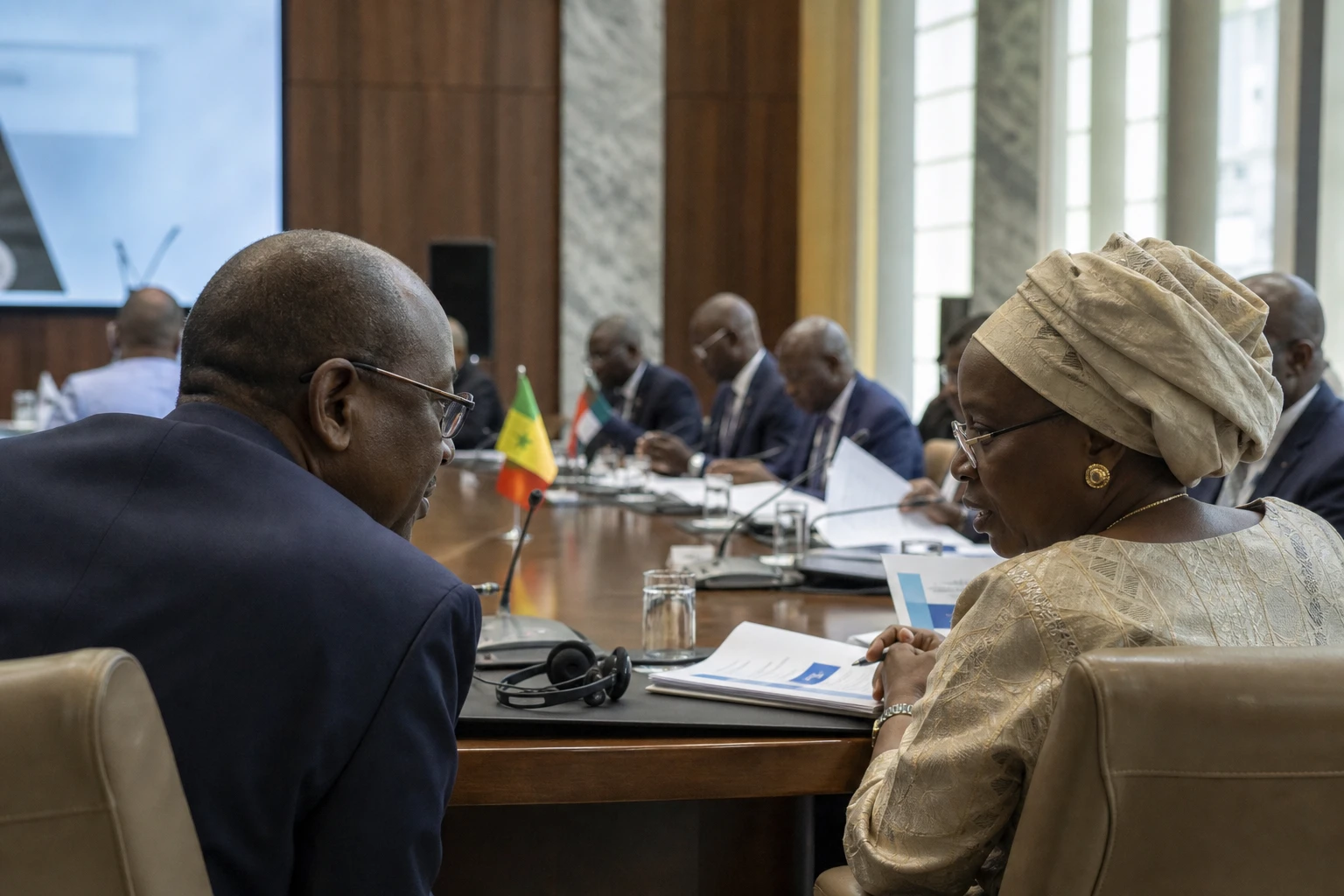
A tense Parliament, but no open rupture
In Dakar, this political sequence is no mere communications exercise. It reveals a government still seeking its point of balance, between a parliamentary majority won amid electoral turmoil and an executive forced to contend with debt, social expectations and internal rivalries. In Senegal, the debate is no longer only about the government’s words. It now concerns its methods, the majority’s discipline and the real place of dialogue in the institutions.
On 8 September 2026, Prime Minister Ahmadou Al Aminou Lô delivered his general policy statement before the National Assembly, as required by Senegal’s parliamentary procedure. The event took place in a delicate context: the Assembly does not share the government’s political complexion, and the majority Pastef camp chose not to turn the session into an immediate showdown. Ousmane Sonko, now president of the National Assembly, did distance himself from the head of government’s approach. But he also rejected the idea of permanent hostility at the top of the state, preferring to call for “loyal dialogue” with President Bassirou Diomaye Faye. This position reflects tactical caution as much as a still-fluid balance of power.
Public debt, the central fault line
The heart of the matter remains financial. The Senegalese government has reached an agreement in principle with the International Monetary Fund on a 36-month programme under the Extended Credit Facility, worth about $2.2 billion. The IMF says this framework is intended to support the authorities’ economic and financial reforms between 2026 and 2029, with a focus on budget governance and public debt management. In Dakar, this is not merely a technical issue. It determines the government’s room for manoeuvre to pay, invest and ease social tensions already fuelled by arrears and slowing economic activity.
Addressing MPs, Ahmadou Al Aminou Lô offered a clear-eyed assessment of the situation: restoring the public finances must come before launching major infrastructure projects. The Senegalese Press Agency reports that he cited debt estimated at 134% of gross domestic product and payment arrears of 1,956 billion CFA francs. He also spoke of “reprofiling” rather than restructuring, a sign that the executive wants to ease the burden of debt service without signalling a sharp break with international partners. In short, the state is seeking breathing space. But that breathing space will carry a political cost if the bill falls on households, local businesses or investment expected in the regions.
For the Pastef majority, the issue is not simply whether to pass a budget bill. It is about deciding how far to support an adjustment that may be seen by some of its base as a retreat from promises of a break with the past. The vote on the 2026 supplementary budget will therefore be the next test. The government must incorporate the commitments made with the IMF, while majority MPs will be judged on their ability to amend, constrain or toughen the package. This episode will show whether Senegal’s Parliament acts as a rubber stamp or as a genuine forum for arbitration.
Between party loyalty and institutional breathing space
The major political development is not just the prime minister’s statement. It is also the attitude of the majority camp. Two months earlier, Ousmane Sonko had warned that he could bring down the government “as many times as necessary” if the line he had pursued as prime minister changed. But after the 8 September general policy statement, the tone became more measured. Sonko called for “loyal dialogue” with the president and stressed the need for institutions to “stand upright”, without being aligned. This formula says much about Senegal’s current political scene: conflict exists, but all sides are weighing the risk of institutional escalation in a country already tested by the political upheavals of recent years.
Bassirou Diomaye Faye’s position adds another layer of complexity. On 25 July 2026, the head of state launched his own political party, Kiiraay/Les Patriotes républicains, formalising a split with his former ally Ousmane Sonko. The move confirmed an evolution that had already been visible since the change of prime minister. In the Assembly, the parliamentary speaker was elected amid controversy, after Ousmane Sonko’s return to the chamber and amid appeals filed by the opposition. The lines have thus shifted within the very camp that came to power under the Pastef banner. The challenge is no longer simply to govern. It is to govern without deepening the divisions.
This realignment affects each player differently. For the president, the challenge is to assert his autonomy. For the prime minister, it is to impose an approach to economic recovery without losing political legitimacy. For Pastef, it is to prevent a parliamentary majority from becoming a machine for internal conflict. And for Senegalese people, the equation remains very tangible: prices, jobs, payment delays and postponed projects. In a country where the formal and informal economies are closely intertwined, every budget decision quickly ripples through markets, transport, construction and services.
A signal to watch in West Africa
Senegal is following a trajectory that many West African capitals are watching closely. The debate over debt, the role of the IMF, fiscal discipline and cohesion between institutions is not confined to Dakar. It also resonates across a region where ECOWAS is undergoing a period of political realignment, and several states are seeking to reconcile declared sovereignty with severe financial constraints. Senegal’s case is being watched because it combines institutional pluralism, a recent change of government and intense economic pressure, without tipping into an authoritarian rupture.
The next milestone will therefore be as much about the budget as about politics. The supplementary budget will show whether the government opts for severe consolidation, a social shift in priorities or a more gradual compromise. It will also show whether the Pastef majority is willing to support an adjustment that is not ideological, but is very much a test of credibility. In the weeks ahead, it will be the state’s ability to deliver, rather than the rhetoric of a break with the past, that is judged. And in Dakar, as elsewhere in West Africa, such episodes always end up reaching beyond the walls of Parliament.