Algeria
 Egypt
 Libya
 Morocco
 Sudan
 Tunisia
 Benin
 Burkina Faso
 Cabo Verde
 Côte d'Ivoire
 Ghana
 Guinea
 Guinea-Bissau
 Liberia
 Mali
 Mauritania
 Niger
 Nigeria
 Sierra Leone
 The Gambia
 Togo
 Cameroon
 Central African Republic
 Chad
 DR Congo
 Equatorial Guinea
 Gabon
 Republic of the Congo
 São Tomé and Príncipe
 Burundi
 Comoros
 Djibouti
 Eritrea
 Ethiopia
 Kenya
 Madagascar
 Malawi
 Mauritius
 Mozambique
 Rwanda
 Seychelles
 Somalia
 South Sudan
 Tanzania
 Uganda
 Angola
 Botswana
 Eswatini
 Lesotho
 Namibia
 South Africa
 Zambia
 Zimbabwe
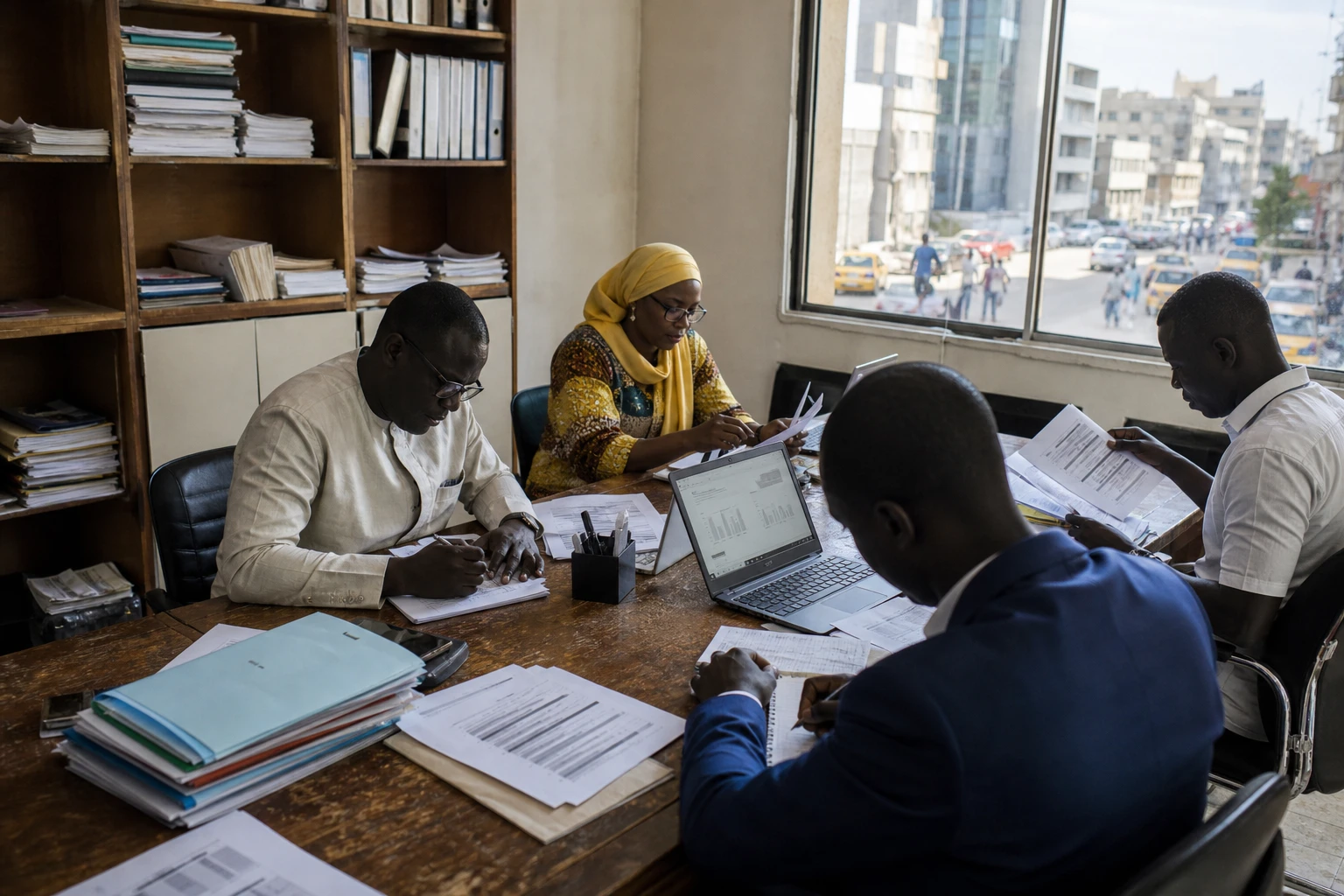
In Dakar, the question is no longer simply whether Senegal will secure new external financing. The challenge is now to understand the conditions under which this support can restore confidence, stabilise public finances and preserve the country’s room for manoeuvre.
President Bassirou Diomaye Faye is due to revisit this equation in an interview recorded in New York on the sidelines of the United Nations General Assembly. It is scheduled to be broadcast on Thursday 24 September 2026 at 8pm Paris time.
A financial agreement still subject to approval
On 1 September 2026, International Monetary Fund (IMF) staff and the Senegalese authorities reached a staff-level agreement on a 36-month programme. The proposed arrangement amounts to about $2.2 billion, or nearly 1,250 billion CFA francs, according to conversions used in the Senegalese press.
This is not yet an automatic disbursement. The staff-level agreement must be submitted to the IMF’s executive board. This step is expected to set out the schedule for payments and the commitments attached to the programme.
The arrangement is based on the Extended Credit Facility, an instrument designed to support countries facing prolonged financial difficulties. In practice, the financing is intended to support Senegal’s economic and budget programme over the 2026-2029 period.
The IMF says discussions with Dakar have focused in particular on public financial management, debt sustainability and the conditions for sustainable growth. The institution also notes that Senegal’s economy grew by 6.7% in 2025, driven by the first full year of oil production. Excluding hydrocarbons, however, growth was limited to 2.2%.
This distinction matters. Oil and gas revenues can improve the external accounts, but they do not automatically translate into higher household incomes. The sectors that employ the most Senegalese people, including agriculture, trade, services and the informal economy, remain directly exposed to the cost of living and the slowdown in activity.
Debt at the heart of the new relationship with the IMF
Senegal’s return to the IMF comes after significant discrepancies in public accounts were revealed. The authorities who came to power following the 2024 change of government said that the true levels of debt and the deficit had been understated under the previous administration.
This situation led the IMF to suspend its previous financing programme. Since Bassirou Diomaye Faye’s election, several missions have been carried out to review budget data and establish a new basis for co-operation.
For the government, the new agreement must therefore address an urgent financing need. It must also restore Senegal’s statistical and budgetary credibility with donors, investors and regional markets.
For Senegalese people, the question is more tangible. An IMF-backed programme can help avert a liquidity crisis and ensure that the state can be financed. But it may also entail difficult measures: spending limits, subsidy reform, improved tax collection or changes to certain economic benefits.
The challenge will be to share the burden. Large companies, government departments, local authorities, self-employed workers and households do not have the same capacity to absorb it. A uniform reform could weigh more heavily on lower incomes and on regions far from Dakar, where access to public services remains more costly.
A political phase defined by the break with Ousmane Sonko
The presidential interview also comes amid a profound political realignment. Bassirou Diomaye Faye and Ousmane Sonko came to power together in 2024, after promising a break with the governance practices of previous administrations.
The two men now hold distinct positions. Ousmane Sonko is president of the National Assembly, while the head of state has launched his own political party. This development has formalised a split that has been visible for several months.
Tensions concern the conduct of the executive, economic strategy and control of the political majority. They come as Senegal must negotiate with its creditors and implement a budget recovery programme.
Rumours point to a possible fresh dissolution of the National Assembly. For now, this possibility should be presented as speculation. It is nevertheless being closely watched, as any parliamentary reshuffle could alter the balance between the president, the government and the legislative majority.
The precedent is recent. In September 2024, Bassirou Diomaye Faye dissolved the National Assembly before calling early parliamentary elections on 17 November that year. The current context is different, but this experience shows how quickly the institutional calendar can become a major political lever.
Senegal between ECOWAS and the Alliance of Sahel States
Regional diplomacy is another issue expected to feature in the presidential interview. Dakar is seeking to maintain dialogue with Mali, Burkina Faso and Niger, which are grouped in the Alliance of Sahel States (AES).
These three countries have left the Economic Community of West African States (ECOWAS), an organisation tasked with promoting economic integration and political co-operation in the region. Their withdrawal, which took effect on 29 January 2025, has ushered in a period of considerable uncertainty over the movement of people, trade and security co-ordination.
Senegal retains close human, commercial and cultural ties with the AES countries. Exchanges do not stop at institutional borders. Traders, transport operators, families and students still depend on this West African mobility.
At the same time, the AES authorities defend their political autonomy and object to the pressure exerted by ECOWAS after military takeovers. Senegal cannot, therefore, claim to impose a solution. Its influence will depend more on its ability to listen to all sides and keep channels of dialogue open.
A test of economic and diplomatic sovereignty
The current phase brings together three interconnected issues: debt, political realignment and regional fragmentation. In each, the Senegalese government must show that it can secure external resources without losing control of its national priorities.
The IMF’s approval of the programme will be the next financial milestone. Its actual terms, the disbursement schedule and the budget measures will need to be examined closely. Politically, developments in the relationship between Bassirou Diomaye Faye and Ousmane Sonko will affect the executive’s ability to pass reforms.
Across West Africa, Dakar will also have to clarify the role it intends to play between ECOWAS and the AES. Its position will be watched by neighbouring countries as well as by the African Union, which is seeking to prevent a lasting rift between regional organisations and Sahelian states.
For Senegal, the stakes therefore go beyond the announced amount of financing. They concern the strength of its institutions, the protection of its social balance and the place it wants to occupy in a West Africa undergoing profound change.