
 Algeria
 Egypt
 Libya
 Morocco
 Sudan
 Tunisia
 Benin
 Burkina Faso
 Cabo Verde
 Côte d'Ivoire
 Ghana
 Guinea
 Guinea-Bissau
 Liberia
 Mali
 Mauritania
 Niger
 Nigeria
 Sierra Leone
 The Gambia
 Togo
 Cameroon
 Central African Republic
 Chad
 DR Congo
 Equatorial Guinea
 Gabon
 Republic of the Congo
 São Tomé and Príncipe
 Burundi
 Comoros
 Djibouti
 Eritrea
 Ethiopia
 Kenya
 Madagascar
 Malawi
 Mauritius
 Mozambique
 Rwanda
 Seychelles
 Somalia
 South Sudan
 Tanzania
 Uganda
 Angola
 Botswana
 Eswatini
 Lesotho
 Namibia
 South Africa
 Zambia
 Zimbabwe
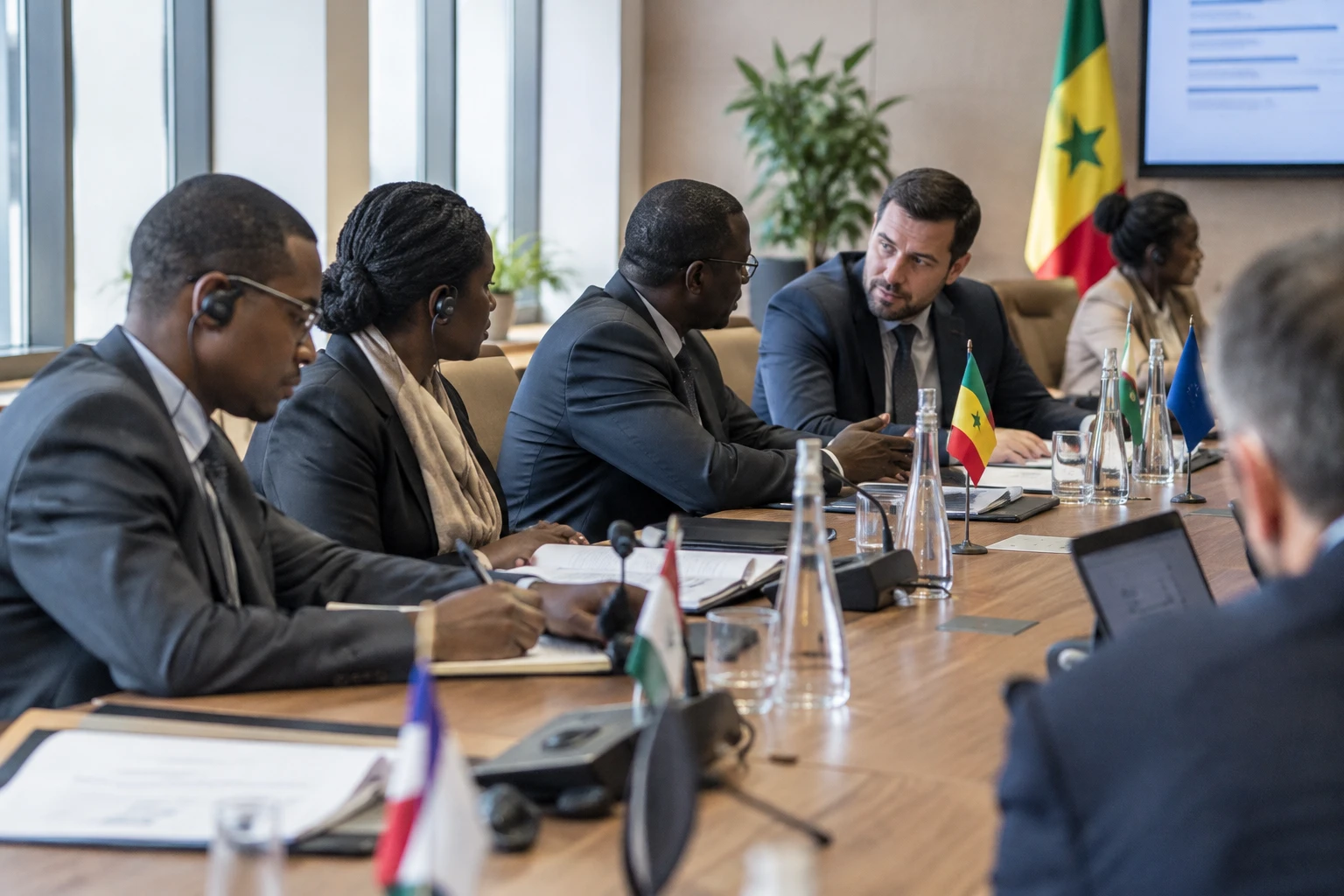
As a growing share of public revenue goes towards repaying loans, every budgetary choice becomes more constrained. In Senegal, the debate over debt is therefore as much about creditors as it is about services, investment and the households affected by the government’s trade-offs.
Debt is narrowing room for manoeuvre
The burden of Senegal’s debt is also explained by a review of public accounts following the discovery of previously undeclared liabilities. The International Monetary Fund (IMF) estimated public debt at about 132% of gross domestic product (GDP) at the end of 2024. This figure should not be confused with a definitive measure of debt for 2025: estimates vary according to the scope used and statistical revisions.
The situation is part of a turbulent recent trajectory. An audit of public finances published after the change of government in 2024 highlighted significant discrepancies between announced figures and recorded commitments. The authorities have since sought to restore confidence, fund public services and negotiate with financial partners without sharply cutting spending that benefits the population.
The problem extends beyond relations with international lenders. Senegal also borrows on the regional market of the West African Economic and Monetary Union (WAEMU), where states raise funds in CFA francs. These securities help finance budgets and the region’s financial institutions. An operation that undermined this market could therefore have effects beyond Dakar.
A fast-approaching timetable
On 15 October 2026, a US Treasury official called for Senegal’s debt treatment to be concluded in less than a year. Washington presented the case as a test for the G20 Common Framework, the mechanism that coordinates negotiations between debtor countries and different categories of creditors. This target is diplomatic pressure, not a deadline already accepted by all parties.
A concrete step followed on 23 October: the committee of creditor banks chose Houlihan Lokey as its financial adviser, according to information reported by Reuters, citing several sources. The firm is to support the banks in discussions. The choice does not mean that an agreement has been reached or that the terms of the debt have been set.
The Senegalese government, for its part, has launched a Senegal Debt Treatment Plan. It describes the plan as a way to restore a sustainable repayment profile and preserve priority investment. The authorities have also spoken of reprofiling: in other words, changing repayment dates or certain payment terms to make them more consistent with the country’s financial capacity. Creditors, meanwhile, will defend their interests in negotiations.
A staff-level agreement with the IMF on 1 September 2026 paves the way for a three-year, $2.2 billion financing programme. It remains subject to the approval steps required by the institution. The programme and debt treatment are linked, but they are not the same: the former provides a framework for financing and reforms, while the latter organises discussions with the holders of the claims concerned.
The budgetary cost is reflected in public choices
Senegalese budget documents provide for nearly CFAF 5,498 billion in debt service in 2026, compared with about CFAF 4,435 billion in 2025. Debt service includes repayment of principal and interest payments. The projected increase is about 24%. This is a budget forecast, not an amount already paid.
For the state, this burden means less flexibility when an urgent need arises or a project must be accelerated. For Senegalese people, the effects may vary: social spending, infrastructure, subsidies and public services are all competing for limited resources. Low-income households are particularly affected when reforms hit energy prices or broad-based support. Small businesses, meanwhile, depend both on domestic demand and on the government’s ability to pay its contracts on time.
The question, then, is not simply how to reduce a debt ratio. It is also how to avoid an adjustment that is too rapid, which could slow economic activity or shift the cost on to the least protected citizens. Conversely, postponing decisions could prolong uncertainty, make new borrowing more expensive and complicate the funding of public projects. Finding a balance requires credible budget assumptions and clear information about the state’s commitments.
A regional and continental issue
Senegal is a member of ECOWAS, the Economic Community of West African States, and WAEMU, which shares a common currency, the CFA franc, and a regional financial market with seven other countries. Investors across the union, including banks and institutions holding Senegalese government securities, are therefore following the negotiations. The way Dakar handles its debt claims could affect perceptions of sovereign risk in the region, although it would not by itself determine the situation of its neighbours.
Recourse to the G20 Common Framework also tests coordination among bilateral creditors, commercial banks and bondholders. Discussions will have to reconcile differing interests and respect the principle that creditor groups should contribute on a comparable basis. The US timetable provides political impetus, but the complexity of the groups involved makes the outcome uncertain.
The next milestones will be final approval of the IMF programme, a detailed presentation of the terms of Senegal’s plan and progress in discussions with creditors. For Senegalese people, the decisive measure will not simply be whether an agreement is reached: it will also be whether the agreement can create budgetary room without halting essential investment or quietly shifting the burden on to households.
Sources consulted: Senegalese Ministry of Finance and Budget, Senegal investor portal, IMF, African Development Bank, Reuters, 15 October 2026 report, Reuters, 23 October 2026 report, Senegalese Press Agency.



