
 Algeria
 Egypt
 Libya
 Morocco
 Sudan
 Tunisia
 Benin
 Burkina Faso
 Cabo Verde
 Côte d'Ivoire
 Ghana
 Guinea
 Guinea-Bissau
 Liberia
 Mali
 Mauritania
 Niger
 Nigeria
 Sierra Leone
 The Gambia
 Togo
 Cameroon
 Central African Republic
 Chad
 DR Congo
 Equatorial Guinea
 Gabon
 Republic of the Congo
 São Tomé and Príncipe
 Burundi
 Comoros
 Djibouti
 Eritrea
 Ethiopia
 Kenya
 Madagascar
 Malawi
 Mauritius
 Mozambique
 Rwanda
 Seychelles
 Somalia
 South Sudan
 Tanzania
 Uganda
 Angola
 Botswana
 Eswatini
 Lesotho
 Namibia
 South Africa
 Zambia
 Zimbabwe
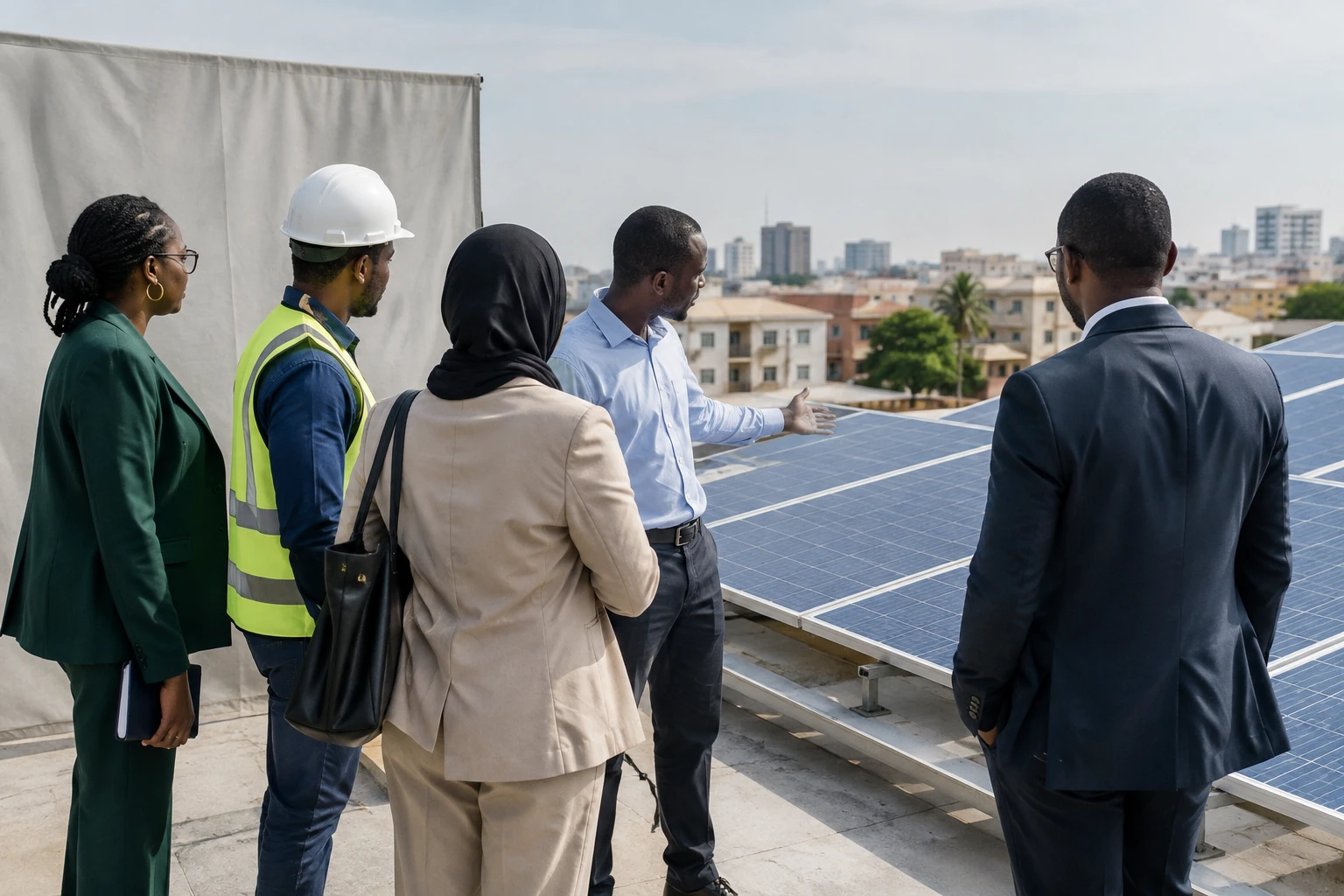
For a factory or a cold-storage warehouse, generating some of its electricity on site can reduce bills and strengthen the continuity of operations. In Senegal, new private financing is set to enable Afreenergy Solar to expand this offer for businesses while refinancing installations already in service.
Portfolio set to more than quintuple
The Renewable Energy Performance Platform 2 (REPP 2) fund, managed by Camco, is providing Afreenergy Solar with a €12 million senior loan. Senior debt is repaid before lower-ranking claims. The financing will be used to refinance operational solar plants and build new photovoltaic installations, with 5.7 megawatt-hours (MWh) of battery storage.
The company plans to increase its portfolio from 2.7 megawatt-peak (MWp) to 14.9 MWp. MWp measures the panels’ theoretical maximum output, while MWh measures an amount of energy, here the storage capacity. The 14.9 MWp figure is a target capacity, not a fleet already fully operational.
The financing brings together several sites covered by electricity supply contracts with clients in distribution, food processing, agribusiness and infrastructure. Afreenergy retains ownership and operation of the equipment. Clients buy electricity over the long term. The company estimates that this model can reduce their electricity costs by about 30%; this projected saving will, however, depend on the conditions at each site.
Decentralised solar complements grid investment
The deal builds on an existing trajectory. In July 2024, Afreenergy Solar acquired three rooftop solar plants in Senegal previously owned by GreenYellow. According to information published at the time, the portfolio amounted to 2.6 MWp. In March 2026, development finance group PIDG announced a €4.3 million commitment through InfraCo, its project development arm. This separate support is intended for a platform that could eventually deploy up to 30 MW of solar and 10 MWh of batteries in the country.
The two financings should therefore not be confused: PIDG’s commitment supports the development of the platform, while the REPP 2 loan finances the refinancing of assets and new construction. Together, they illustrate the mobilisation of several financial instruments around commercial and industrial solar, often referred to by the acronym C&I.
For businesses, the benefit is direct: on-site generation can limit exposure to grid electricity costs and support activities that depend on a regular power supply. Storage can shift some solar energy to periods when the panels produce less. But it does not, on its own, guarantee an uninterrupted supply. Performance will depend on battery sizing, each client’s consumption and the availability of the installations.
This private-sector model does not replace the investment needed in national generation, transmission and distribution. Nor does it address the needs of households, small informal businesses or communities far from major economic centres in the same way. Its immediate benefits are aimed at commercial and industrial clients able to enter into long-term contracts. The question will therefore also be how the gains are distributed and whether these solutions can be accessed beyond large companies.
A test for energy financing in West Africa
Senegal has incorporated renewable energy development into its energy policy and aims for renewables to account for 40% of its electricity mix by 2030. Decentralised projects for businesses can contribute to this goal, provided the announced capacity is actually built and its integration with the grid is managed. The country also remains connected to its neighbours through ECOWAS, the West African regional organisation where energy trade and cross-border infrastructure are important to security of supply.
Camco describes REPP 2 as a private debt fund financing small and medium-sized renewable energy projects, both grid-connected and off-grid. In Afreenergy’s case, the challenge therefore goes beyond installing panels: it is to establish whether long-term private contracts and the bundling of several sites can attract repayable financing at scale.
The next milestones will be tangible: construction starting at new sites, their entry into operation, the storage capacity actually installed and the savings recorded by clients. The company has also raised the possibility of a platform for larger industrial and mining projects in Africa. This ambition will depend on the results achieved in Senegal and the ability to replicate the model in other markets, with different regulatory frameworks and grids.
Sources: REPP 2 financing announcement ; PIDG statement on its March 2026 commitment ; corroborating report by Agence Ecofin ; information on the acquisition of the GreenYellow portfolio ; Camco’s overview of REPP 2.



