Algeria
 Egypt
 Libya
 Morocco
 Sudan
 Tunisia
 Benin
 Burkina Faso
 Cabo Verde
 Côte d'Ivoire
 Ghana
 Guinea
 Guinea-Bissau
 Liberia
 Mali
 Mauritania
 Niger
 Nigeria
 Senegal
 Sierra Leone
 The Gambia
 Togo
 Cameroon
 Central African Republic
 Chad
 DR Congo
 Equatorial Guinea
 Gabon
 Republic of the Congo
 Burundi
 Comoros
 Djibouti
 Eritrea
 Ethiopia
 Kenya
 Madagascar
 Malawi
 Mauritius
 Mozambique
 Rwanda
 Seychelles
 Somalia
 South Sudan
 Tanzania
 Uganda
 Angola
 Botswana
 Eswatini
 Lesotho
 Namibia
 South Africa
 Zambia
 Zimbabwe
In São Tomé, an old stage addresses a very current issue
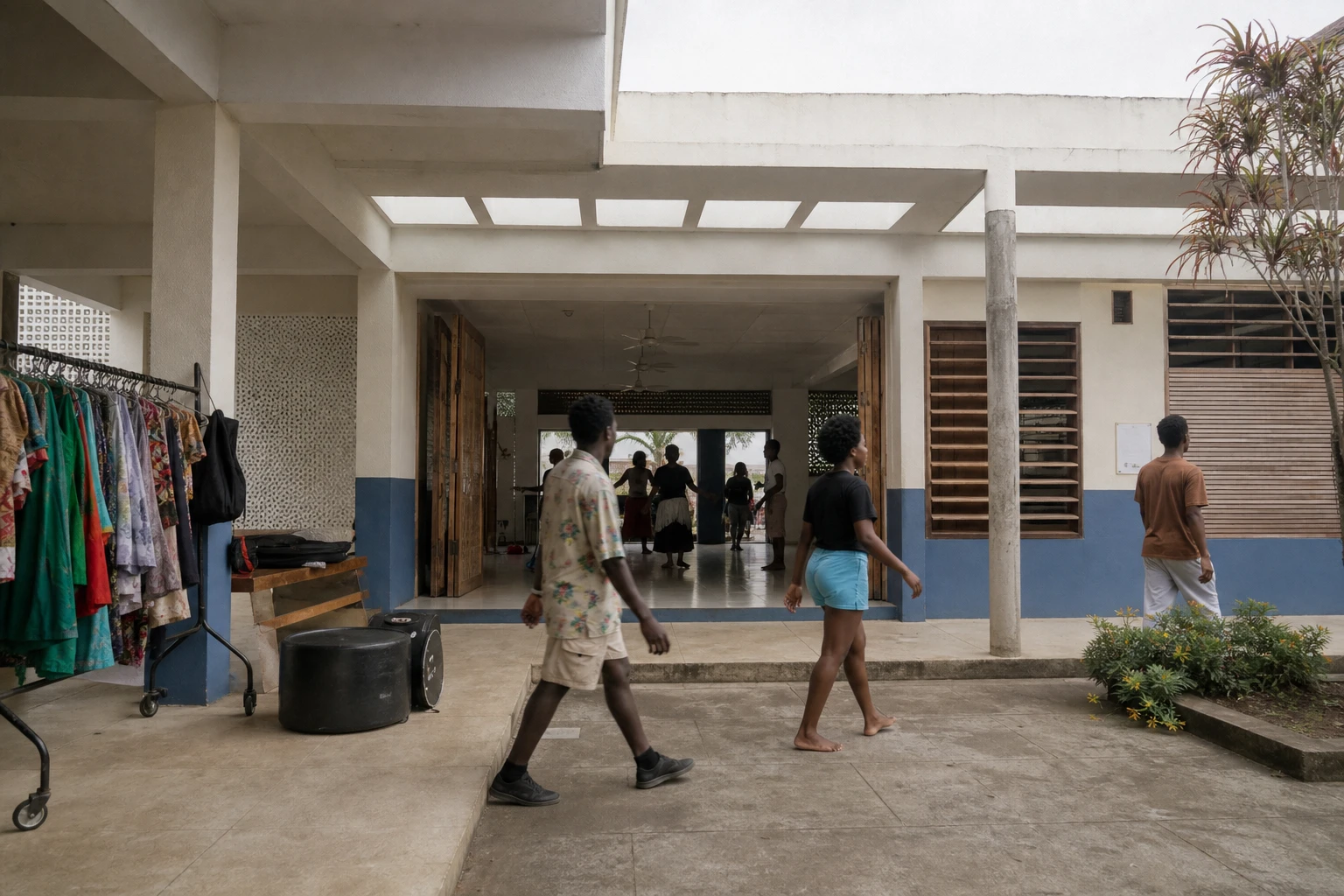
In São Tomé’s neighbourhood courtyards, theatre is not just for entertainment. It becomes a way of asking who judges, who betrays, who must answer to the community, and how a society tells its own story. This explains the power of Tchiloli, a living Santomean art in which colonial memory, the Portuguese language and African experience meet without dissolving into one another. UNESCO now lists it among the elements of intangible cultural heritage associated with São Tomé and Príncipe, confirming international recognition long championed first and foremost by its practitioners.
On an archipelago such as São Tomé and Príncipe, where national culture was shaped by the forced encounter between colonial history and local reclamation, Tchiloli is not a frozen relic. It forms part of a broader landscape in which music, historic plantations, creole languages and forms of popular sociability make up a distinctive Santomean identity. The country belongs to ECCAS, the Economic Community of Central African States, which also places its cultural policies in a regional setting where heritage preservation has become an issue of symbolic sovereignty as much as development.
A theatre born elsewhere, made deeply Santomean
Tchiloli draws on a plot from medieval Europe, performed in old Portuguese and passed down in the archipelago for more than five centuries. The story, centred on Charlemagne, his son Charles the Younger, the Marquis of Mantua and Ganelon, deals with a transgression, a trial and justice that must apply to everyone. But in São Tomé, the story has taken on a new status. It is no longer merely an echo of a repertoire brought by the Portuguese in the 16th century. It has become a local form of open-air theatre, with its musicians, costumes, gestures, codes and community allegiances.
This shift is decisive. In postcolonial societies, many legacies from elsewhere disappear or remain the preserve of an elite. Tchiloli has followed a different path. It has been absorbed, transformed and reinterpreted. Santomean actors do not simply perform an old European story; they adapt it to their own references and their own way of talking about law, responsibility and living together. This is also why the country’s cultural authorities present the tradition as an art that unites, while emphasising the primacy of law and dialogue. This official interpretation reflects a reality visible among audiences: the story retains an immediate moral force, including for younger people.
The right word here is not folklore, but transmission. Tchiloli lives because it rests on troupes, musicians, families and neighbourhoods willing to carry its memory. This chain is fragile. It depends on the time available, teenagers’ interest, access to rehearsal spaces and older generations’ ability to train newcomers. In a small country with limited cultural resources, each generation that learns the play prevents it from becoming a museum piece.
Justice, memory and cultural sovereignty
Tchiloli’s strength also lies in its central theme. Justice is staged as a public requirement, not an abstraction. In an African context marked by recurring debates over equality before the law, corruption, access to institutions and trust in the state, this choice resonates beyond São Tomé. The theatre offers no simple lesson. Instead, it reminds us that a community is also defined by how it deals with conflict. The formula is old, but the question remains contemporary: who is held to account for their actions, and before what kind of justice?
This significance matters to São Tomé and Príncipe itself. In a small country, culture often serves as a backbone for national image, tourism, education and social cohesion. The Santomean government also presents Tchiloli as one of the major expressions of national culture, alongside other traditions of the archipelago. UNESCO, for its part, works with local authorities to safeguard intangible heritage and compile an inventory of living practices, including as part of efforts to build resilience to climate risks. In other words, the issue is not simply to celebrate a legacy, but to create the practical conditions for its survival.
This approach also fits a broader African view of heritage. The African Union has made culture a driver of development, memory and continental renaissance. For a state such as São Tomé and Príncipe, often viewed through the lens of its size or geographical isolation, recognition of an art such as Tchiloli is a reminder of another reality: small African nations produce highly rich cultural forms capable of speaking to the entire continent. Heritage is not a backdrop here. It is a tool for historical continuity and collective projection.
What this tradition says about the archipelago and Central Africa
At the level of Central Africa, Tchiloli also tells us something very concrete: island societies are not on the margins of regional dynamics. They too carry memories of the slave trade, plantations, migration and cultural mixing. On the islands of São Tomé and Príncipe, cultural history has been shaped by Atlantic circulation, contact languages, African influences from several regions of the continent, and constant local reinterpretation. This historical depth explains why Tchiloli touches on justice, language, identity and the place of Santomeans in their own national story.
Its continental significance is clear. At a time when African states are seeking to better protect and document their intangible heritage, and to draw social benefits from it without distorting it, Tchiloli offers a clear example: an imported legacy can become a local language of dignity and memory. The question now is whether this cultural recognition will lead to more structured transmission, greater support for troupes and a firmer place in Santomean public policy. It is at this practical level that the future of São Tomé’s living theatre will be decided.