Algeria
 Egypt
 Libya
 Morocco
 Sudan
 Tunisia
 Benin
 Burkina Faso
 Cabo Verde
 Côte d'Ivoire
 Ghana
 Guinea
 Guinea-Bissau
 Liberia
 Mali
 Mauritania
 Niger
 Nigeria
 Senegal
 Sierra Leone
 The Gambia
 Togo
 Cameroon
 Central African Republic
 Chad
 DR Congo
 Equatorial Guinea
 Gabon
 Republic of the Congo
 São Tomé and Príncipe
 Burundi
 Comoros
 Djibouti
 Eritrea
 Ethiopia
 Kenya
 Madagascar
 Malawi
 Mauritius
 Mozambique
 Seychelles
 Somalia
 South Sudan
 Tanzania
 Uganda
 Angola
 Botswana
 Eswatini
 Lesotho
 Namibia
 South Africa
 Zambia
 Zimbabwe
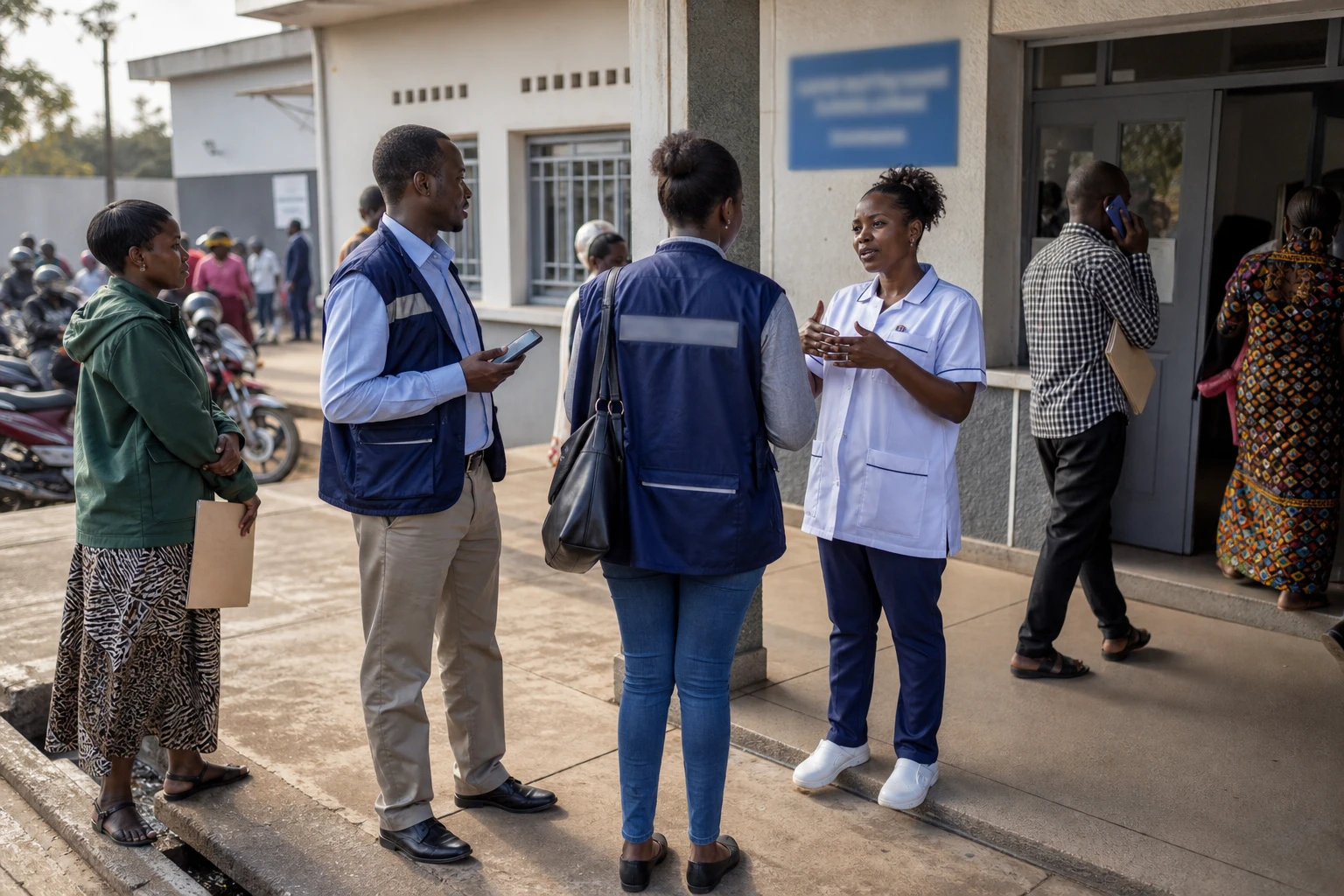
Digital technology as a response to a real shortage
In Kigali, healthcare is no longer confined to hospital walls. It also takes place in databases, connected health centres and tools that can help a health worker make decisions faster. Rwanda has been making progress on this front for several years, with a clear ambition: to make digital technology a lever for public services, not a prestige gadget.
The country is part of the East African Community, a regional bloc in which the movement of people and goods, as well as health standards, increasingly shape national policies. Within this framework, Kigali is seeking to show that a health system can become more efficient without waiting for a windfall from abroad or copying an imported model wholesale.
What Bill Gates came to see in Rwanda
On Monday 20 July 2026, Bill Gates visited Rwanda to see the country’s progress in health, artificial intelligence and digital public infrastructure. Accompanied by Health Minister Sabin Nsanzimana, he met community health workers in Mwulire, visited the local health centre and observed the TKMD syringe manufacturing unit.
This visit is part of a broader effort. In January 2026, OpenAI and the Gates Foundation announced Horizon 1000, a $50 million programme to support 1,000 primary care clinics in Africa, with Rwanda as its starting point. The stated aim is simple: to use AI to support frontline teams, particularly with triage, documentation and decision support, without replacing clinical judgement.
Rwanda was also chosen because of the infrastructure already in place. The Ministry of Health has launched a Health Intelligence Center that aggregates data from community health workers, health centres, hospitals and several digital systems, including eBuzima and cEMR. This foundation connects villages to the national level and turns data into a tool for management.
A health system under pressure, but better equipped than others
Rwanda did not choose digital technology as a passing trend. It is doing so amid structural pressures. The Ministry of Health acknowledges a density of around one health professional per 1,000 inhabitants, well below the WHO benchmark cited in public debate in Rwanda. The government has also launched the so-called 4×4 reform, introduced in July 2023, to quadruple the number of health workers in four years.
Across the continent, the picture is even broader. The WHO estimates that Africa had 5.72 million health workers in 2024, meeting 46% of its needs, with a projected shortfall of 5.85 million by 2030. The same report notes that a significant proportion of trained personnel remain unemployed or in precarious work, showing that the crisis is not only one of training, but also of deployment, funding and retention.
In this context, Rwanda has a rare advantage: a dense community care network. The NHIC portal says that 58,298 community health workers are active across the 30 districts. This gives the country a valuable human foundation for testing digital tools at local level, where access to specialists remains limited.
Medical AI: a useful accelerator, but no magic solution
The issue is not merely technical. It is also linguistic, organisational and political. The Associated Press noted in January 2026 that experts had raised concerns about using tools designed in English in a country where Kinyarwanda remains the everyday language of the majority. If AI cannot understand local phrasing, it could slow work down rather than ease the burden. This is central to the programme’s effectiveness in practice.
Rwanda is seeking to anticipate this risk. Its national artificial intelligence policy, published in 2023, emphasises skills, infrastructure, governance and collaboration. The ministry and RISA also present AI as a tool serving practical sectors, including health, education and public administration. In other words, Kigali is not talking about AI in the abstract, but about integrating it into existing services.
The country is also making progress on data protection and interoperability. In 2026, RISA launched a national digital public infrastructure strategy. The Ministry of Health is working in parallel to harmonise electronic medical records and connect community care to referral facilities. For patients, this could mean less information being lost. For health workers, less paperwork. For the state, a clearer picture of actual demand.
The signal Kigali is sending across Africa
The implications extend beyond Rwanda. If Horizon 1000 can operate in a Francophone, resource-constrained environment, the project could inform other African health systems facing the same combination of low staffing levels, pressure on primary care and a need to make better use of data. Countries already mentioned as potential candidates for expansion, such as Kenya, South Africa and Nigeria, are closely following this kind of experiment.
Rwanda is therefore being watched as a proving ground, but also as a policy laboratory. Its interest in medical AI, digital health and digital public infrastructure is part of a broader trajectory towards modernising the state. At the level of the East African Community, this trajectory raises a simple question: how can health innovation circulate between countries without creating a new divide between those able to adopt it and those left behind?
The answer will emerge in the coming months, as the programme is rolled out on the ground. Success will depend not only on algorithms, but on Rwanda’s ability to train, equip and connect its health workers. That is where the difference will be made between a technological showcase and a genuine transformation in care.