Algeria
 Egypt
 Libya
 Morocco
 Sudan
 Tunisia
 Benin
 Burkina Faso
 Cabo Verde
 Côte d'Ivoire
 Ghana
 Guinea
 Guinea-Bissau
 Liberia
 Mali
 Mauritania
 Niger
 Nigeria
 Senegal
 Sierra Leone
 The Gambia
 Togo
 Cameroon
 Central African Republic
 Chad
 DR Congo
 Equatorial Guinea
 Gabon
 Republic of the Congo
 São Tomé and Príncipe
 Burundi
 Comoros
 Djibouti
 Eritrea
 Ethiopia
 Madagascar
 Malawi
 Mauritius
 Mozambique
 Rwanda
 Seychelles
 Somalia
 South Sudan
 Tanzania
 Uganda
 Angola
 Botswana
 Eswatini
 Lesotho
 Namibia
 South Africa
 Zambia
 Zimbabwe
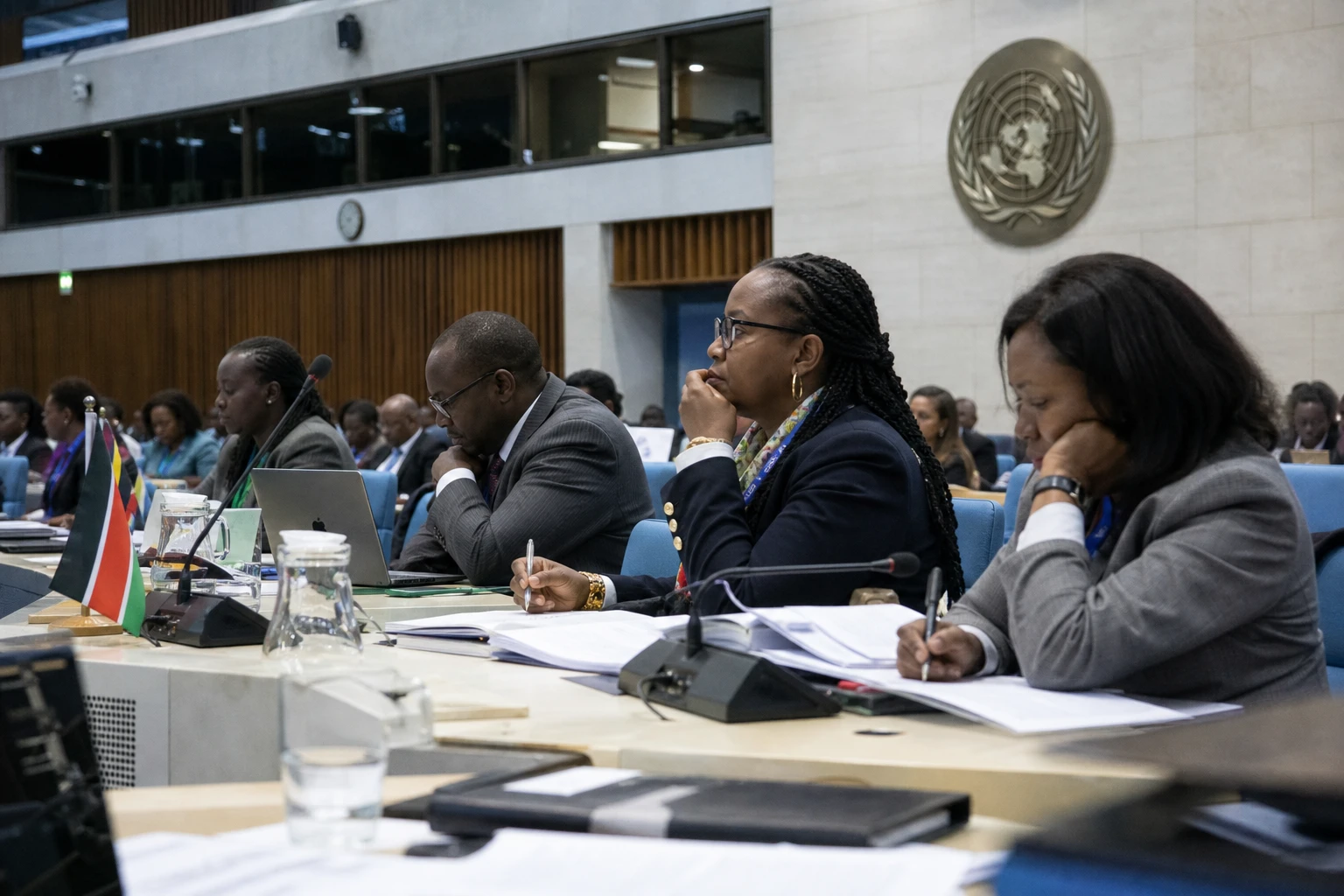
In Nairobi, as in many African capitals, the question is no longer simply who sits on the United Nations Security Council. It is now about the continent’s ability to have a direct say in decisions affecting its wars, peacekeeping operations and political balance.
Kenyan President William Ruto reignited the debate on Wednesday 23 September 2026, during his address to the UN General Assembly. He called for reform of the body responsible for international peace and security, denouncing the complete absence of African representation among its permanent members.
A global institution frozen in 1945
The Security Council has 15 members. Five have permanent seats and veto powers: the United States, Russia, China, France and the United Kingdom. The other 10 are elected for two years and cannot block a resolution on their own.
This structure dates back to the creation of the UN in the aftermath of the Second World War. At the time, most African countries were still under colonial rule. They therefore had no part in designing the current international system.
William Ruto summed up this disconnect with a phrase he has already used in his diplomatic advocacy: “The world has since transformed. The Security Council has not.” For the Kenyan head of state, an institution that claims to organise collective security cannot remain structured according to the balance of power of another century.
Africa has 54 UN member states, more than a quarter of the General Assembly. Yet no African country has a permanent seat on the Security Council. The continent can be invited to take part in debates, but it has no lasting place in the circle that holds veto power.
Kenya advances a continental demand
William Ruto’s speech does not present Kenya as the natural candidate for a permanent seat. Instead, it echoes the common position put forward by the African Union since 2005. The AU is calling for at least two permanent seats for Africa, with the same powers as current members, as well as five additional non-permanent seats.
This position, known as the Ezulwini Consensus, seeks to address what the African Union describes as a historical injustice. The organisation also emphasises a politically sensitive point: an outside power should not be the sole arbiter of who represents Africa.
The selection of future representatives should be left to African states through the African Union’s mechanisms. This requirement is intended to avoid direct competition between major national powers, notably South Africa, Egypt, Nigeria, Algeria and other countries regularly mentioned in diplomatic debates.
In a recent statement, the African Union Commission reaffirmed its call for two permanent seats with veto power, for as long as that power continues to exist on the Council.
Kenya has particular standing to make this case. Nairobi hosts a major United Nations hub and plays an active role in regional security issues. The country also participates in the mechanisms of the East African Community, an organisation of eight states that coordinates economic, political and security initiatives in the region.
The East African Community considers peace and security essential conditions for regional integration. For people in the region, decisions taken in New York have tangible effects on peacekeeping missions, sanctions, humanitarian aid and the movement of people.
A permanent voice on African crises
The paradox highlighted by William Ruto is clear from the Council’s agenda itself. African crises regularly feature in its meetings: Sudan, Somalia, the Democratic Republic of the Congo, the Sahel, Libya and the Central African Republic.
African states are often directly affected by the resolutions adopted. They also provide soldiers, police officers and mediators for international operations. Yet they have no permanent presence to defend their priorities when members with veto power negotiate the wording of a text.
This absence affects several groups. For governments, it limits their ability to influence diplomatic decisions. For populations, it can delay or weaken international responses during conflicts. For regional organisations, it makes it harder to coordinate African initiatives with UN decisions.
The debate, however, is not simply about prestige. A permanent seat would give Africa an additional means of advancing its analysis of conflicts, calling for mandates suited to local realities and challenging measures that could harm economies or civilians.
It would not automatically resolve the continent’s crises. Institutional representation is no substitute for conflict prevention, mediation or the accountability of African governments. But it would alter the balance of power when international responses are being defined.
A case led by Africa, but negotiated beyond the continent
Reforming the Security Council requires an amendment to the United Nations Charter. It must therefore secure a large majority in the General Assembly, followed by the agreement of the current permanent members. This hurdle explains the slow pace of negotiations, which have been under way for several decades.
The Pact for the Future, adopted by the UN in 2024, recognised the need to make the Council more representative and address Africa’s historical under-representation. This political recognition has not yet produced a precise timetable or an institutional proposal accepted by all.
A further issue is African unity. Governments agree on the principle of two permanent seats, but the question of who will fill them could revive rivalries between regions and diplomatic powers. The credibility of the demand will therefore depend as much on the pressure brought to bear on permanent members as on the African Union’s ability to maintain a common position.
From Nairobi, William Ruto is seeking to position Kenyan diplomacy within a broader continental cause. The next step will be to turn statements of principle into formal negotiations, with proposals on the Council’s composition, veto power and the procedure for selecting African representatives.
For East Africa, the issue also resonates with debates about the region’s place in global governance. For the African Union, the goal is to secure a seat at the table where responses to conflicts are decided. And for the UN, the question is becoming increasingly difficult to avoid: can an organisation that seeks to remain universal continue to operate without an African permanent member ?