Algeria
 Egypt
 Libya
 Morocco
 Sudan
 Tunisia
 Benin
 Burkina Faso
 Cabo Verde
 Côte d'Ivoire
 Ghana
 Guinea
 Guinea-Bissau
 Liberia
 Mali
 Mauritania
 Niger
 Nigeria
 Senegal
 Sierra Leone
 The Gambia
 Togo
 Cameroon
 Central African Republic
 Chad
 DR Congo
 Equatorial Guinea
 Gabon
 Republic of the Congo
 São Tomé and Príncipe
 Burundi
 Comoros
 Djibouti
 Eritrea
 Ethiopia
 Madagascar
 Malawi
 Mauritius
 Mozambique
 Rwanda
 Seychelles
 Somalia
 South Sudan
 Tanzania
 Uganda
 Angola
 Botswana
 Eswatini
 Lesotho
 Namibia
 South Africa
 Zambia
 Zimbabwe
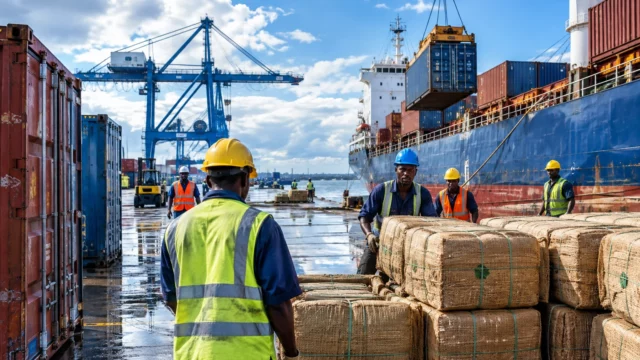
The price of an imported good is not determined at sea alone. In Kenya, every wait at the port, repeated inspection or stop on the road can add to the bill before the product even reaches the shops. And when freight crosses the country to Uganda, these costs extend beyond Kenya’s borders.
A vital corridor for Kenya and its neighbours
The port of Mombasa links the Indian Ocean to the Northern Corridor, a road and rail route serving Kenya and several landlocked countries in East Africa. For Uganda, Rwanda, Burundi and some regions of the Democratic Republic of the Congo, the smooth flow of traffic along this route directly affects access to international markets.
This strategic position forms part of the East African Community (EAC) common market, which aims to facilitate trade among its member states. But transporters can also choose the Central Corridor, from Tanzania’s port of Dar es Salaam. The region’s ports and routes are therefore competing for commercial activity that depends as much on infrastructure as on transit time and cost.
Mombasa port remains a major hub. The Kenya Ports Authority said cargo traffic there reached 40.99 million tonnes in 2024, up from 35.98 million in 2023. This increase underscores the port’s importance, but also raises the stakes over its capacity to handle cargo quickly.
Costs mount from quay to road
In its 34th edition of the Kenya Economic Update, published in November 2026, the World Bank lists multiple inspections, system failures and governance weaknesses among the factors driving up logistics service costs. The Shippers Council of Eastern Africa, an organisation representing the region’s shippers, estimates that these costs account for between 35% and 42% of the total landed cost of goods. This estimate concerns goods transported within the region and does not mean that every import bears exactly the same proportion.
At the port, several government agencies are involved in checks, including Kenyan customs and bodies responsible for standards and combating counterfeiting. These checks serve legitimate objectives. However, when they overlap or computer systems go down, operators face delays and additional costs. The World Bank report more broadly links numerous inspections and integrity shortcomings to higher costs for businesses.
Road transport inland adds another charge. According to data presented in the report, moving a 20-foot container from Mombasa to Nairobi, about 480 kilometres away, costs between $850 and $1,250. By comparison, shipping from China to Mombasa is estimated at about $2,000. The final leg by land can therefore weigh heavily on the cost of supply.
The effects are not limited to large importing companies. Manufacturers reliant on imported raw materials or parts face higher costs. Agricultural producers, meanwhile, may lose some of the value of their exports when transport delays and a lack of cold-chain equipment hold up perishable goods. At the end of the chain, businesses decide whether to pass some of the costs on to customers or reduce their margins. The scale of the effect on prices varies by product and market.
Frequent stops and uncertain journey times
On the road to Malaba, at the Ugandan border, checkpoints are another source of friction. An assessment cited by Kenyan authorities counted between 22 and 27 police roadblocks along the corridor. Trucks were then taking between 76 and 80 hours to reach the border, according to figures reported when new measures were announced. Delays make it harder for transporters to plan and can leave both goods and vehicles idle.
On 21 April 2026, Caroline Karugu, the principal secretary for East African Community Affairs, presented a plan to reduce the number of officially authorised stopping points to fewer than five. The stated aim is to bring transit time down to 36–48 hours. This is a government target: the sources consulted do not establish that the reduction has already been achieved across the entire corridor.
Reducing stops does not mean scrapping checks needed for road safety, compliance with load limits or the fight against fraud. The challenge is to co-ordinate inspections better and make the rules predictable. Without transparent monitoring, reducing official roadblocks alone does not guarantee that delays or informal payments will disappear.
Regional competition is also about reliability
For Kenyan businesses, high costs can make locally manufactured products less competitive and deter investment that relies on imported inputs. For neighbouring countries, delays on the Northern Corridor complicate both supply and exports. Small traders and informal-sector operators often have less room to absorb higher transport costs than large businesses.
Tanzania offers another regional gateway through Dar es Salaam and the Central Corridor. This competition is not simply a ranking of ports: shippers also assess roads, customs formalities, total costs and the reliability of transit times. In its 2026 report, the East African Legislative Assembly also highlighted the burden of regional logistics costs and called for a review of procedures that complicate trade.
The next step will be to measure the concrete results of the announced reforms: the actual number of stops, average journey time, fees paid and changes in transit flows. For Nairobi, preserving Mombasa’s role as a regional platform will depend less on announcements than on their implementation across the entire chain, from the quay to Malaba.