Algeria
 Egypt
 Libya
 Morocco
 Sudan
 Tunisia
 Benin
 Burkina Faso
 Cabo Verde
 Côte d'Ivoire
 Ghana
 Guinea
 Guinea-Bissau
 Liberia
 Mauritania
 Niger
 Nigeria
 Senegal
 Sierra Leone
 The Gambia
 Togo
 Cameroon
 Central African Republic
 Chad
 DR Congo
 Equatorial Guinea
 Gabon
 Republic of the Congo
 São Tomé and Príncipe
 Burundi
 Comoros
 Djibouti
 Eritrea
 Ethiopia
 Kenya
 Madagascar
 Malawi
 Mauritius
 Mozambique
 Rwanda
 Seychelles
 Somalia
 South Sudan
 Tanzania
 Uganda
 Angola
 Botswana
 Eswatini
 Lesotho
 Namibia
 South Africa
 Zambia
 Zimbabwe
In Bamako, a legal case becomes a political test
In Bamako, a trial tells more than the story of an individual case. It also says something about the relationship between public speech, justice and power in a Mali still grappling with political transition and security tensions. In this context, the case of Mohamed Youssouf Bathily, known as Ras Bath, goes beyond the commentator himself: it touches on the place of criticism in Mali’s public sphere.
The proceedings come as Mali remains engaged in an extended transition, following the institutional rupture of 2020 and the reshuffles that followed. The World Bank notes that the country experienced the institutional collapse of 18 August 2020, followed by the establishment of a transitional government and a National Transitional Council, while ECOWAS has since taken repeated positions on the timetable and conditions for a return to constitutional order.
What is known about the trial
The case was listed before the Bamako Court of Appeal for 10 August 2026, according to several Malian media outlets, after a series of legal proceedings that kept Ras Bath in pre-trial detention for lengthy periods. APA had already reported in December 2025 that the Indictments Chamber of the Bamako Court of Appeal had upheld his detention in the case involving him and Rokia Doumbia, known as Rose Vie chère.
The charges cited in the case include “criminal conspiracy” and offences relating to undermining the standing of the state, its institutions and its leaders through digital means. The Malian press also reports that prosecutors sought a 10-year prison sentence and a fine of 240,000 CFA francs for Ras Bath, as well as a 10-year prison sentence, five years suspended, and the same fine for his co-defendant. These demands do not amount to a ruling: they mark the final stage before closing arguments and the court’s decision.
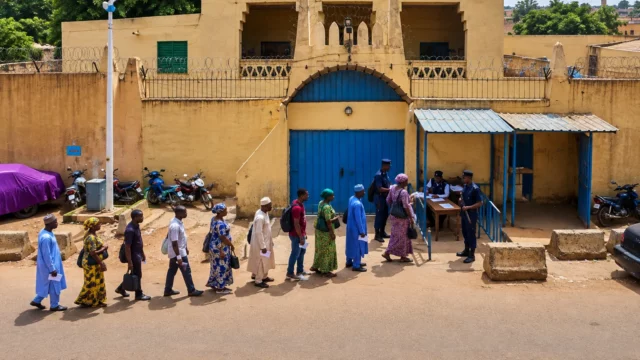
Local sources have described a heightened security presence around the court. Maliweb reported tightly controlled access, parking restrictions and the presence of supporters near the courthouse. This kind of security arrangement reflects the sensitivity of the case: in Bamako, the hearing is taking place in a climate where the streets, social media and the memory of recent crises remain closely intertwined.
A trial viewed through the fractures of the transition
Ras Bath is no stranger to Mali’s public debate. His name has circulated for years in cases linked to his positions against first civilian and then military authorities. The current proceedings are part of a longer history: in 2021, an earlier case had already brought him before the courts, followed by a new series of prosecutions in the context of the transition. This continuity fuels the view among his supporters that the case is political; others see it as a common-law matter being examined by the Malian judiciary.
The case also illustrates a familiar tension in periods of transition: the more the executive claims to be restoring order, the more sensitive the question of critical space becomes. The transitional government emphasises sovereignty, institutional discipline and the fight against instability. Journalists, lawyers and civil society figures, for their part, point out that a transition’s credibility is also measured by its ability to tolerate dissent, protect the right to a defence and prevent public debate from being conflated with criminal prosecution of dissenting speech.
In practical terms, the impact is very real for families, activists and listeners who followed Ras Bath as a critical voice on political life. For the authorities, the challenge is the opposite: to show that the rules apply, including to highly visible figures. Between these two readings, justice becomes a stage for making a point. And that is precisely what makes this case broader than an ordinary criminal hearing.
Beyond Bamako, a case watched across the Sahel
The case’s significance extends beyond Mali. Since the rift between Bamako and ECOWAS, and the rise of the Alliance of Sahel States alongside Burkina Faso and Niger, Mali’s political scene has been viewed as a testing ground for political, security and institutional sovereignty in West Africa. Every sensitive case then becomes a signal: about the treatment of opposition, the independence of the judiciary and how a transition wants to present itself to its own people and the rest of the continent.
The trial also comes in a country where security remains an overwhelming priority. The World Bank says the situation has remained unstable, with persistent risks along supply routes and pressure on state capacity. In other words, attention to a legal case cannot be separated from the daily lives of Malians: it overlaps with the high cost of living, logistical difficulties, security concerns and institutional fatigue built up since 2020.
What happens next will depend less on comment than on the decisions expected from the Bamako Court of Appeal. If the closing arguments uphold the severity of the prosecutors’ demands, the political signal will be strong. If the court departs from them, the message will be just as significant. Either way, Mali will offer a fresh indication of the place it gives to criticism, the law and stability in a transition that has become prolonged.