Algeria
 Egypt
 Libya
 Morocco
 Sudan
 Tunisia
 Benin
 Burkina Faso
 Cabo Verde
 Côte d'Ivoire
 Ghana
 Guinea
 Guinea-Bissau
 Liberia
 Mali
 Mauritania
 Niger
 Nigeria
 Senegal
 Sierra Leone
 The Gambia
 Togo
 Cameroon
 Central African Republic
 Chad
 DR Congo
 Equatorial Guinea
 Gabon
 Republic of the Congo
 São Tomé and Príncipe
 Burundi
 Comoros
 Djibouti
 Eritrea
 Ethiopia
 Kenya
 Madagascar
 Malawi
 Mauritius
 Mozambique
 Rwanda
 Seychelles
 Somalia
 South Sudan
 Tanzania
 Uganda
 Angola
 Botswana
 Eswatini
 Lesotho
 Namibia
 Zambia
 Zimbabwe
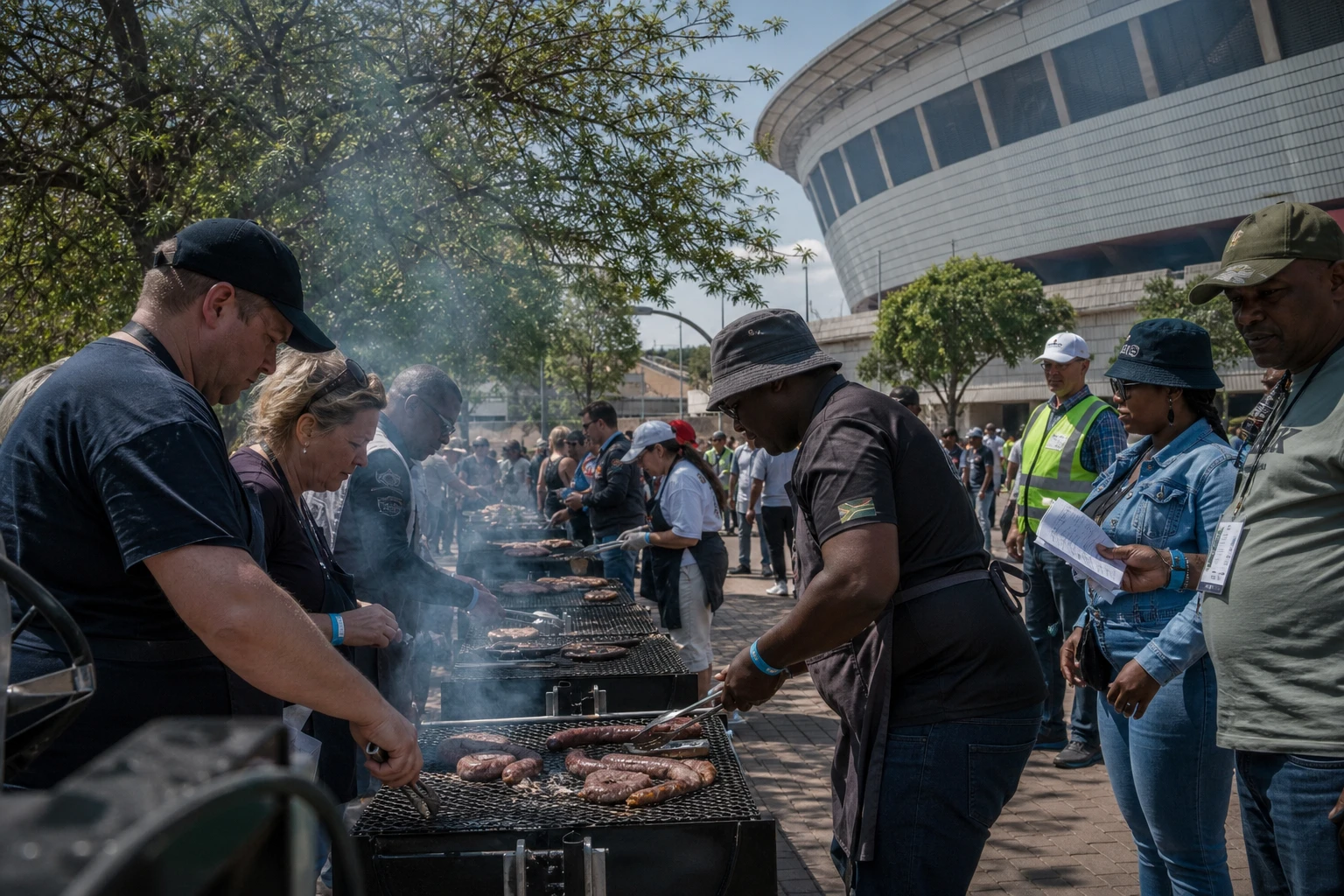
In Pretoria, the challenge was not simply to light a fire. Participants also had to stay by their own barbecue, without joining a neighbour, taking a photo or leaving the area. On 24 September 2026, thousands of South Africans attempted to turn a sociable tradition into an officially recognised world record.
An event that became a test of rigour
The attempt took place at Loftus Versfeld Stadium in South Africa’s capital, on Heritage Day. This national holiday celebrates the country’s cultural diversity. It is also widely associated with the braai, the South African barbecue, often shared with family, friends or neighbours.
The organisers were aiming for 3,000 participants gathered around 500 cooking stations. The principle was simple: grill meat or an alternative provided by the organisers simultaneously for at least five consecutive minutes. The challenge lay in adhering precisely to the counting rules.
Participants had to remain at their stations throughout the official sequence. This requirement had already undermined the previous South African attempt, held at the same venue on 24 September 2025. The organisers had announced that 2,412 people were in the cooking area, compared with the 2,220 needed to beat the record held by Japan since November 2023.
But the raw number was not enough. Several participants had moved away from their stations to chat, greet friends or enjoy the atmosphere. Guinness World Records therefore did not certify the achievement. The event’s official 2026 page describes this as the main lesson from the previous edition.
For the new attempt, the arrangements were strengthened. Monitoring staff were assigned to different sectors. Wristbands, access and the location of each participant were more closely controlled. Fires had to be prepared before the public arrived to limit movement at the crucial moment.
The braai, a popular practice that goes beyond cooking
In South Africa, braai refers to more than a method of cooking. The Afrikaans word also describes a social occasion. People come to eat, but also to talk, listen to music and welcome people from different backgrounds.
Boerewors, a traditional South African sausage, had a central place at the event. Vegetarian and halal options were also available. The choice was intended to broaden participation in a country where dietary practices vary according to communities, beliefs and family habits.
The 24 September celebration is officially known as Heritage Day. In everyday usage, it is also called Braai Day. The name remains popular, although it does not, on its own, capture the country’s historical and cultural richness.
The date also brings to mind a sensitive question: how can a shared national story be built after decades of institutionalised separation under apartheid? The braai can provide a space for people to meet. It does not, however, erase inequalities of access, income disparities or the competing memories that run through South African society.
A cultural event, but also a commercial venture
The Pretoria gathering follows a now familiar format: a popular celebration linked to a commercial operation, concerts and a fundraiser for social initiatives. After the attempt, the programme was due to continue with performances, food stalls and family areas.
According to information published on the event platform, proceeds were to contribute to the goal of distributing one million meals in South Africa. The announced funding also covers youth, health and community programmes. These commitments will need to be assessed on the basis of documented results, separately from the event’s festive publicity.
For the organisers, the benefits are therefore not measured solely by the number of participants. A gathering of this scale involves suppliers, security staff, technicians, artists and vendors. It generates temporary activity around the stadium and draws attention to Pretoria, the country’s political and administrative centre.
The impact nevertheless varies between groups. Businesses and service providers can benefit from the crowds. Visitors have access to an event in an urban setting. By contrast, households on tight budgets may be left out of a ticketed event, even when the celebration is presented as a national one.
Japan’s record remains the benchmark
The 2,220 participants recorded in Japan in 2023 provide a concrete measure of South Africa’s challenge. In 2025, Pretoria brought more people into the cooking area, but the lack of certification meant the Japanese record remained in the available records.
The situation illustrates the difference between a popular achievement and a recognised record. The former can be visible, widely reported and successfully completed on the ground. The latter depends on a precise protocol, witnesses, video evidence and compliance with every condition announced in advance.
Guinness World Records generally says its decisions may require a review after an event. Organisers must submit the necessary evidence: participant counts, videos, stewards’ reports and checks on how the event was conducted. As of the publication date, final certification of the 24 September 2026 attempt does not yet appear in the sources consulted.
A significance beyond Pretoria’s fires
Across Southern Africa, the event demonstrates South Africa’s ability to turn an everyday practice into a large-scale cultural gathering. The country has a developed events market, major sports infrastructure and a music industry capable of supporting mass gatherings.
The attempt also raises a broader question about how African societies showcase their popular practices. An international record can increase the visibility of a tradition. It should not, however, replace sustained work on cultural representation, access to leisure and the redistribution of income generated by such events.
The next milestone will be the adjudicators’ official decision. If the attempt is approved, Pretoria will take from Japan a title that has become a symbol of organised conviviality. If it is not, the gathering will nonetheless have confirmed a distinctly South African reality: around a fire, sociability is often harder to discipline than the recipe itself.
Consult the Guinness World Records rules, information about the Pretoria event and background on South Africa’s new attempt.