Algeria
 Egypt
 Libya
 Morocco
 Sudan
 Tunisia
 Benin
 Burkina Faso
 Cabo Verde
 Côte d'Ivoire
 Ghana
 Guinea
 Guinea-Bissau
 Liberia
 Mali
 Mauritania
 Niger
 Nigeria
 Senegal
 Sierra Leone
 The Gambia
 Togo
 Cameroon
 Central African Republic
 Chad
 DR Congo
 Equatorial Guinea
 Gabon
 Republic of the Congo
 São Tomé and Príncipe
 Burundi
 Comoros
 Djibouti
 Eritrea
 Ethiopia
 Kenya
 Madagascar
 Malawi
 Mauritius
 Mozambique
 Rwanda
 Seychelles
 Somalia
 South Sudan
 Tanzania
 Uganda
 Angola
 Botswana
 Eswatini
 Lesotho
 Namibia
 Zambia
 Zimbabwe
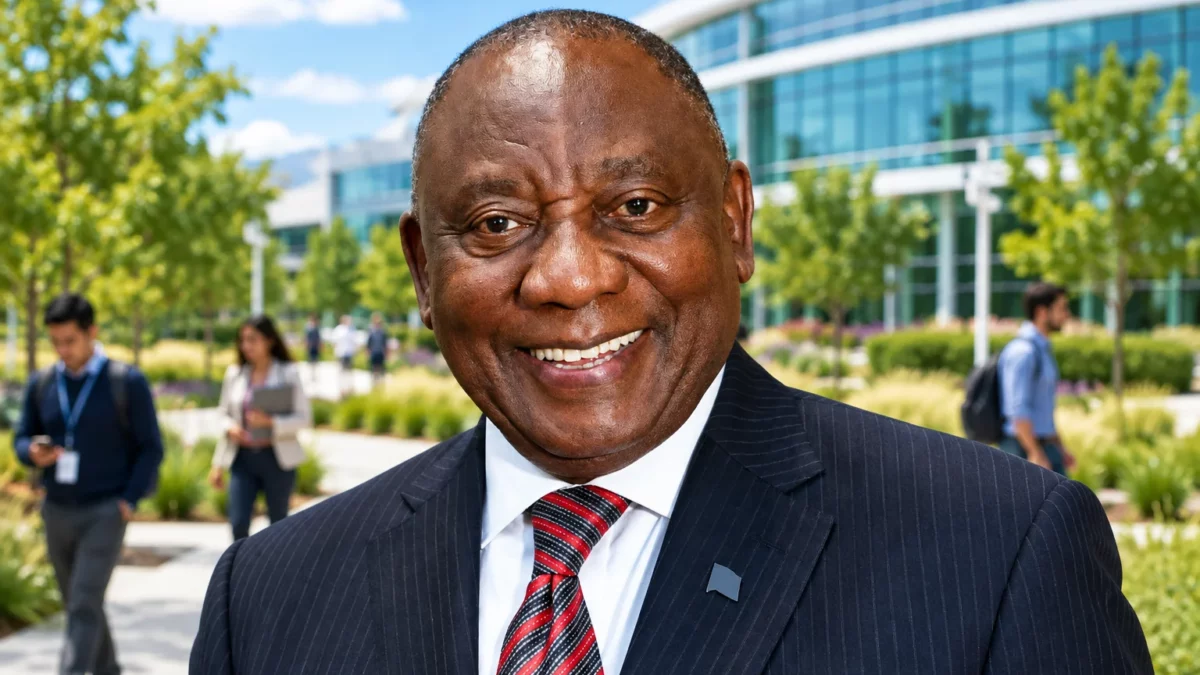
For South Africa, the stakes around artificial intelligence go beyond attracting investors. The question is also who will design the tools, control the data and reap the jobs created by this economy. Cyril Ramaphosa put this issue at the centre of a working visit to California, as Pretoria seeks to strengthen its technological capabilities and its trade relations with Washington enter another period of tension.
A national ambition in a continental context
From 15 to 21 November 2026, the South African president is leading a delegation of public officials, academics, researchers, entrepreneurs and students to Silicon Valley. The mission is intended to provide a better understanding of the global AI ecosystem, explore partnerships and inform the country’s choices on developing and adopting these technologies. Pretoria has also highlighted cybersecurity, training and investment opportunities.
This initiative comes as the issue reaches beyond South Africa’s borders. In July 2024, the African Union Executive Council approved a continental AI strategy. It calls on states to develop local capabilities and regulate the technology responsibly. One aim is to reduce dependence on tools, infrastructure and systems designed elsewhere. The African Union’s strategy on artificial intelligence thus provides a common framework without erasing the priorities of individual countries.
South Africa has already done some groundwork. Its national AI framework, published in 2024, and government planning work have identified potential uses in public services, research and the economy. The Minister of Science, Technology and Innovation, Blade Nzimande, presents digital technology as a pillar of the national decade plan for science and innovation, covering the period 2022-2032. The California visit is therefore part of a policy under development, rather than a project starting from scratch.
From discovery to measurable projects
In San José, Ramaphosa called for practical initiatives to be identified within three months of the delegation’s return. He wants the mission to lead to partnerships, investment and projects capable of improving public services and creating jobs. The president also called for closer ties between government, business and researchers, and warned that bureaucracy would have to speed up if the country wanted to turn discussions into results.
The 90-day timetable provides a political benchmark. It is not yet a detailed programme, however: publicly available information does not specify which services would be involved, what budgets would be allocated or what criteria would be used to assess results. Moving from intention to implementation will therefore depend on decisions made in Pretoria, the resources allocated and institutions’ ability to coordinate projects.
Potential applications are tangible: processing some administrative requests more quickly, identifying network failures more effectively or helping officials analyse large volumes of data. But effectiveness will not be measured solely by how fast a tool works. South Africans will need to understand how an automated decision affects them, challenge an error and protect their personal data. Online services must also remain accessible to people with limited internet access or who prefer human support.
The promise of job creation calls for similar caution. Ramaphosa acknowledged that some jobs could change or disappear and stressed the need for training and support for workers. The benefits risk being unevenly distributed: technology companies and skilled workers may seize new opportunities, while workers whose tasks are automated could face the fastest transitions. Small businesses, universities and public administrations outside major centres will also need access to the skills and tools required.
Relations with Washington under strain
The visit comes amid trade tensions. On 2 November, the United States announced its intention to withdraw AGOA benefits from South Africa from 1 January 2027. The agreement grants certain products from African countries preferential access to the US market, subject to conditions. Pretoria said the decision could affect exporters, businesses and communities linked to the supply chains concerned. The announced withdrawal does not prohibit exports, but may make them more expensive. The notice period leaves room for further discussions. The South African government has set out its response to the US announcement.
Ramaphosa is not planning a stop in Washington during this trip. The California mission nevertheless offers a channel for dialogue with US companies and specialists. It does not resolve the trade dispute or replace negotiations between governments. Rather, it illustrates a multi-level approach: maintaining technological exchanges while defending South African interests in a broader bilateral relationship.
The test: building capacity, not just buying tools
For South Africa, the challenge is to benefit from foreign investment without becoming merely a market for imported technologies. That means developing local businesses, skills, data suited to the country’s realities and a sustainable research capacity. It also means negotiating the terms of partnerships: intellectual property, data hosting, infrastructure costs and skills transfer. Discussions in California may open doors, but the results will depend on these national choices.
At SADC level, the Southern African regional economic community, stronger South African capacity could support regional cooperation in training, research and digital services. At continental level, the African Union strategy provides a forum for coordinating priorities and avoiding a situation in which each country negotiates alone with major providers. It remains to be seen whether the projects announced within 90 days will be published with responsibilities, deadlines and verifiable criteria. That is the point at which the stated ambition can be judged.