Algeria
 Egypt
 Libya
 Morocco
 Sudan
 Tunisia
 Benin
 Burkina Faso
 Cabo Verde
 Côte d'Ivoire
 Ghana
 Guinea
 Liberia
 Mali
 Mauritania
 Niger
 Nigeria
 Senegal
 Sierra Leone
 The Gambia
 Togo
 Cameroon
 Central African Republic
 Chad
 DR Congo
 Equatorial Guinea
 Gabon
 Republic of the Congo
 São Tomé and Príncipe
 Burundi
 Comoros
 Djibouti
 Eritrea
 Ethiopia
 Kenya
 Madagascar
 Malawi
 Mauritius
 Mozambique
 Rwanda
 Seychelles
 Somalia
 South Sudan
 Tanzania
 Uganda
 Angola
 Botswana
 Eswatini
 Lesotho
 Namibia
 South Africa
 Zambia
 Zimbabwe
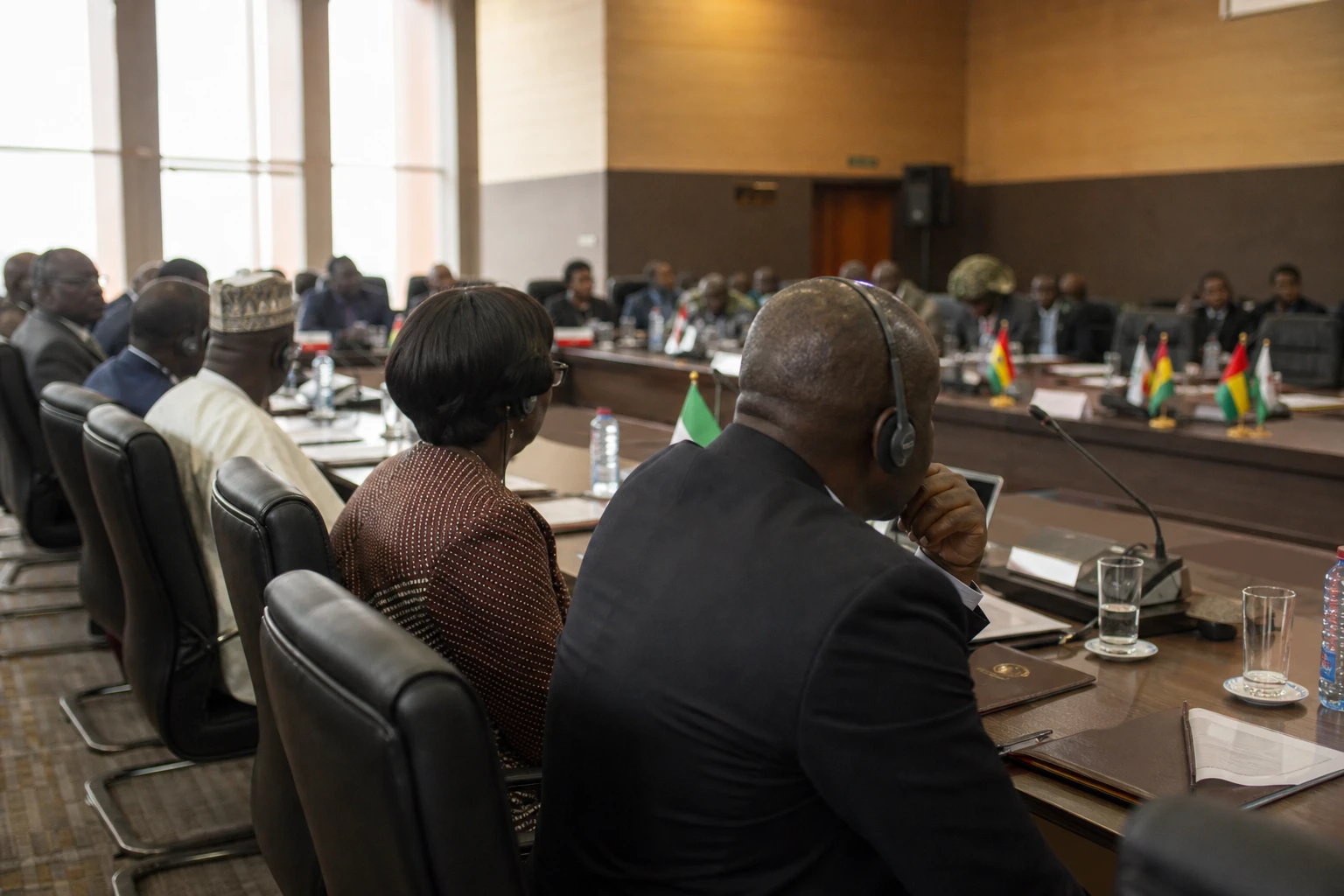
In Bissau, a building associated with the birth of independent Guinea-Bissau has become the focus of a new confrontation between the military authorities and the opposition. The national headquarters of the African Party for the Independence of Guinea and Cape Verde (PAIGC) has been marked as « State heritage », after a deadline imposed on political parties based near sensitive sites expired.
A historic site at the heart of the capital
The PAIGC headquarters is located on National Heroes’ Square, a few metres from Bissau’s presidential palace. The building also houses archives relating to the anti-colonial struggle against Portugal. It therefore holds a special place in Guinea-Bissau’s political memory.
The PAIGC led the struggle for independence before becoming the country’s main political force after 1974. For several decades, it shaped the state, the administration and public life. Although weakened by internal crises and recent changes of power, the party remains a central actor in the country’s history.
The presidency’s official website describes the neighbouring palace as the official residence of the head of state. An institutional guide to Bissau also identifies the party’s former headquarters as a major landmark on National Heroes’ Square. This proximity gives the current dispute significance beyond the property question alone.
Military deadline expires
On 15 September 2026, the High Military Command tasked with the « restoration of security and public order » ordered parties whose headquarters are within 500 metres of a sovereign institution, hospital, diplomatic mission or military facility to move.
The decision is based on the framework law on political parties adopted on 24 February 2026. The parties concerned had seven working days to vacate their premises. The measure directly affects the PAIGC and the Movement for Democratic Alternation, known by the acronym MADEM-G15, whose national headquarters are located near the presidential palace.
On Wednesday 23 September, at the end of the deadline, a plaque reading « Republic of Guinea-Bissau, State heritage » was affixed to the façade of the PAIGC headquarters. The Bissau-Guinean media outlet O Democrata reports the date and specifies that the plaque was installed as the ultimatum expired.
Armed men in military uniform are said to have subsequently entered the building, which was unoccupied at the time. Several sources report damage to an entrance door and windows. However, no detailed official assessment of the damage has been made. These reports should therefore be treated with caution.
The PAIGC had already denounced the decision as illegal. The party argues that the eviction or forced relocation of a political headquarters is a matter for the courts, not a military authority. Its president, Domingos Simões Pereira, has also disputed the classification of the building as state property, arguing that the party has rights to the premises.
A security measure weighs on political competition
The military authorities present the 500-metre rule as a general measure intended to safeguard security around public institutions. The text does not name the PAIGC. In practice, its implementation mainly affects parties whose offices are located around the presidential palace.
This gap between the general wording and the measure’s concrete effects is fuelling opposition. A party forced to leave its headquarters must find new premises, move its teams and reorganise its meetings. In Bissau, where political and administrative resources are concentrated in the capital, this process could further unbalance access to the election campaign.
The PAIGC’s archives are also at stake. Their preservation concerns the memory of the anti-colonial struggle and the passing on of national history. Taking control of the building without a public inventory or clear judicial process could heighten concerns about the protection of these documents.
The headquarters had already been closed since the change of power on 26 November 2025. On that date, military officers announced the suspension of political institutions and the electoral process, following violence around the presidential palace. The country has since embarked on a transition dominated by the High Military Command.
This trajectory is weighing on relations between the transitional authorities and the parties. Relocating headquarters does not affect all actors in the same way. Parties with financial support or networks abroad can more easily rent new offices. Local organisations, meanwhile, risk losing some of their visibility and organisational capacity.
ECOWAS faces a new regional test
Guinea-Bissau belongs to the Economic Community of West African States (ECOWAS), which brings together countries in the region and intervenes in matters including political stability and a return to constitutional order. The organisation is already facing several military transitions in West Africa.
The Guinea-Bissau case nevertheless has its own characteristics. The country has experienced numerous coups, repeated institutional crises and a strong influence of the military establishment on political life. The standoff over the PAIGC headquarters now adds a heritage and electoral dimension to the transition.
Presidential and legislative elections have been announced for 6 December 2026. The central question will be the practical conditions for political competition: freedom of assembly, access to party headquarters, the safety of officials, the functioning of the electoral administration and the protection of party property.
For the people of Guinea-Bissau, the case is therefore about more than a plaque put up on a façade. It puts the boundary between public security, political ownership and national memory at issue. The military authorities’ next decisions, the parties’ response and ECOWAS’s position will show whether this episode leads to a simple administrative reshuffle or a lasting hardening of the transition.