Algeria
 Egypt
 Libya
 Morocco
 Sudan
 Tunisia
 Benin
 Burkina Faso
 Cabo Verde
 Ghana
 Guinea
 Guinea-Bissau
 Liberia
 Mali
 Mauritania
 Niger
 Nigeria
 Senegal
 Sierra Leone
 The Gambia
 Togo
 Cameroon
 Central African Republic
 Chad
 DR Congo
 Equatorial Guinea
 Gabon
 Republic of the Congo
 São Tomé and Príncipe
 Burundi
 Comoros
 Djibouti
 Eritrea
 Ethiopia
 Kenya
 Madagascar
 Malawi
 Mauritius
 Mozambique
 Rwanda
 Seychelles
 Somalia
 South Sudan
 Tanzania
 Uganda
 Angola
 Botswana
 Eswatini
 Lesotho
 Namibia
 South Africa
 Zambia
 Zimbabwe
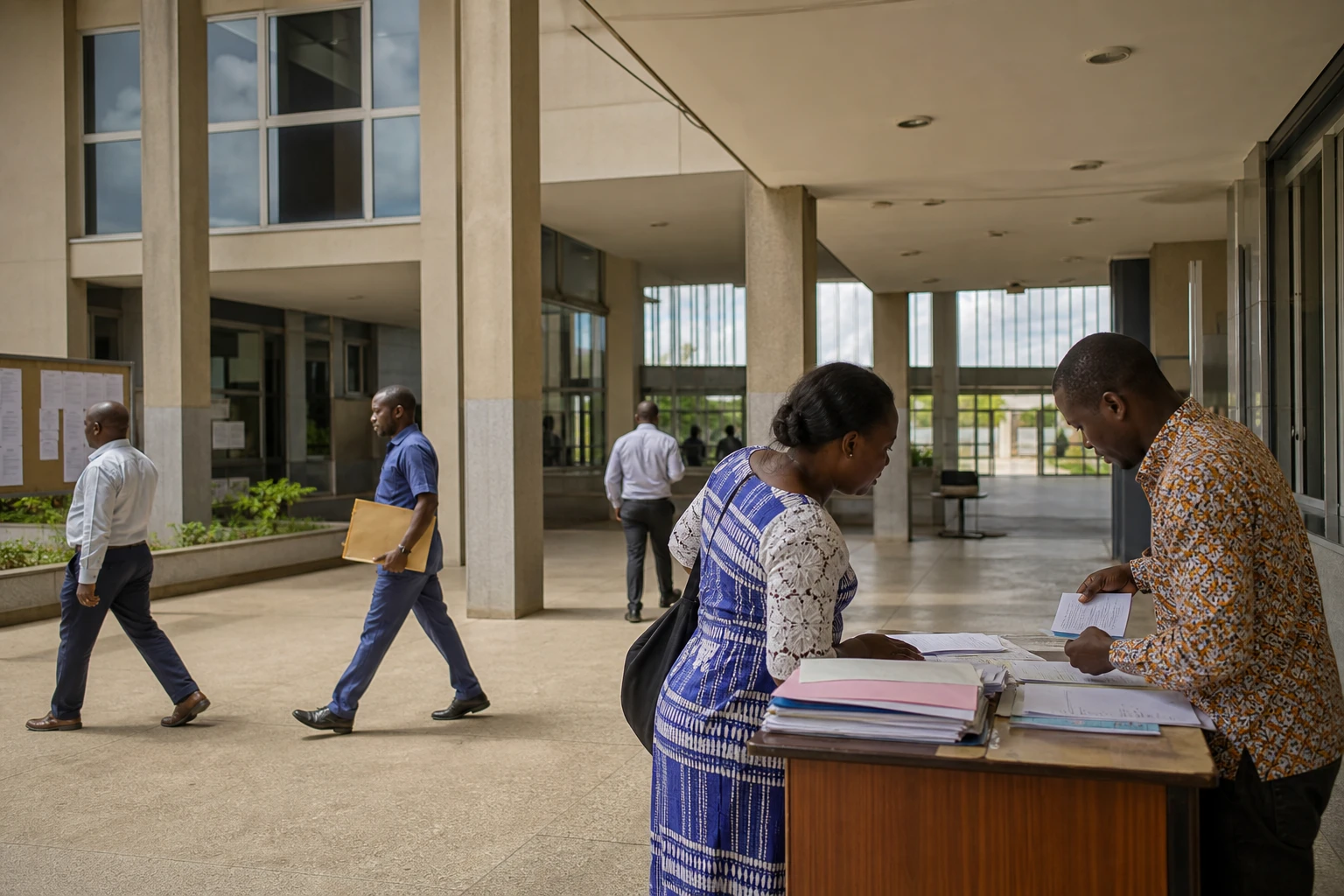
When the start of term becomes a cash-flow issue
With the return to classes just weeks away, the issue is no longer limited to exercise books and uniforms. In Côte d’Ivoire, the start of the school year often weighs as another expense on households already facing multiple education-related costs, from transport to enrolment fees. In this context, back-to-school credit has become a very practical banking product, designed to turn an immediate expense into repayments spread over time.
NSIA Banque Côte d’Ivoire has entered this market with an offer called Prêt Études, which it says will be available from 28 July to 28 October 2026. The bank says the offer is aimed at its individual customers, with financing capped at CFAF 5 million, a maximum repayment period of 12 months and a promotional rate of 0% excluding tax.
A private-sector tool in a firmly engaged public framework
The initiative comes in an environment where education remains a strong political marker in Côte d’Ivoire, whose capital is Yamoussoukro. The Ministry of National Education and Literacy says the state devotes about 22.4% of its national budget to the sector, with the effort also presented as amounting to 4% of gross domestic product. This figure had already featured in official communications on education funding, in connection with reforms stemming from the General Education and Literacy Conference, known as EGENA.
The issue is not confined to Côte d’Ivoire. In 2024, the African Union made education its annual theme, with a roadmap drawn up alongside member states and regional economic communities, including ECOWAS in West Africa. Côte d’Ivoire then highlighted its own reform strategy, centred on foundational learning, the teaching profession and digital technology.
In this landscape, commercial banks are taking their place alongside the state. They are not there to replace public spending, but to smooth the financial shock of the start of term for families with a stable income and sufficient repayment capacity.
What NSIA Banque is offering, and to whom
In practical terms, NSIA Banque’s offer is targeted. The loan is reserved for the bank’s customers. The amount ranges from CFAF 200,000 to CFAF 5,000,000, depending on the applicant’s attachable income quota, that is, the share of their income they can legally allocate to repayments. The bank says the loan can be set up within 48 working hours. It also specifies insurance conditions and requires standard documents: a payslip, a handwritten application, proof of identity and, for some applicants, a certificate for a bank loan or salary domiciliation.
The commercial message is clear: finance tuition fees, enrolment, supplies, uniforms and transport. The mechanism is therefore aimed above all at salaried households in urban or peri-urban areas that can access formal banking. For families in the informal sector, which accounts for a large share of Côte d’Ivoire’s economy, access remains more difficult because eligibility is based on strict banking criteria. This is where the social divide in school credit lies.
The offer also follows a broader institutional development. On 4 August 2026, the Ministry of National Education, Literacy and Technical Education signed a renewable three-year strategic partnership with the NSIA Group. The framework covers school infrastructure, girls’ education, literacy, adult training and the economic empowerment of women and young people. The loan campaign therefore gives a banking expression to an already established relationship between the group and the education sector.
A signal for Côte d’Ivoire’s school market and the region
Beyond the one-off promotion, this type of product says a great deal about the back-to-school market in Côte d’Ivoire. First, it shows that education expenses are predictable enough to be bank-financed. It also shows that private-sector players are seeking a place in a public policy landscape where the state remains central, but families are often on the front line when it is time to pay.
For households, the benefit is immediate: more time, avoiding a sudden cash outlay and securing a smooth start to term. For the bank, the bet is commercial, but also reputational. It is positioning itself in a sensitive, socially useful segment with a product that is easy to understand and sell. For the state, the issue is different: the more private education finance grows, the more the question of genuine access to schooling returns to centre stage, especially in a country with strong ambitions for quality and inclusion.
Across West Africa, the Ivorian example reflects a broader trend. ECOWAS countries are seeking to improve access, quality and continuity in schooling, while households continue to bear the cost of supplies, transport and various contributions. Short-term credit arrangements such as this study loan do not resolve the underlying issue. But they reveal a reality across the continent: education is now viewed as a public service, a family investment and a financial market all at once. This is the three-part dynamic to watch as the 2026/2027 school year approaches.